

 17 hours ago
1
PROTECT YOURSELF with Orgo-Life® QUANTUM TECHNOLOGY
Orgo-Life the new way to the future Advertising by AdpathwayYour customer data is split across email, your site, your app, your store, and your sales records. You want one tool to pull it together. But you have never bought one, and every vendor says it can do it all.
You can open Table of Contents show
The fix is to test nine Customer Data Platform features and make each vendor pass or fail. In rank order, they are fast data intake, one profile per customer, segments, reach across channels, AI, privacy and consent, customer journeys, fit with your tools, and scale at your busiest hour. The first two rank highest because every other feature needs fresh data tied to the right person.
Each section below explains one feature and gives you one pass/fail test for a demo or contract talk. That matters because buying a CDP is not the same as using one. Only 22% of marketers say their team makes heavy use of its CDP.
You will also learn how to run a peak-load test and a match-rate test. Then you will build a shortlist from the 2026 vendor market without overbuying.
What Is a Customer Data Platform (CDP)?
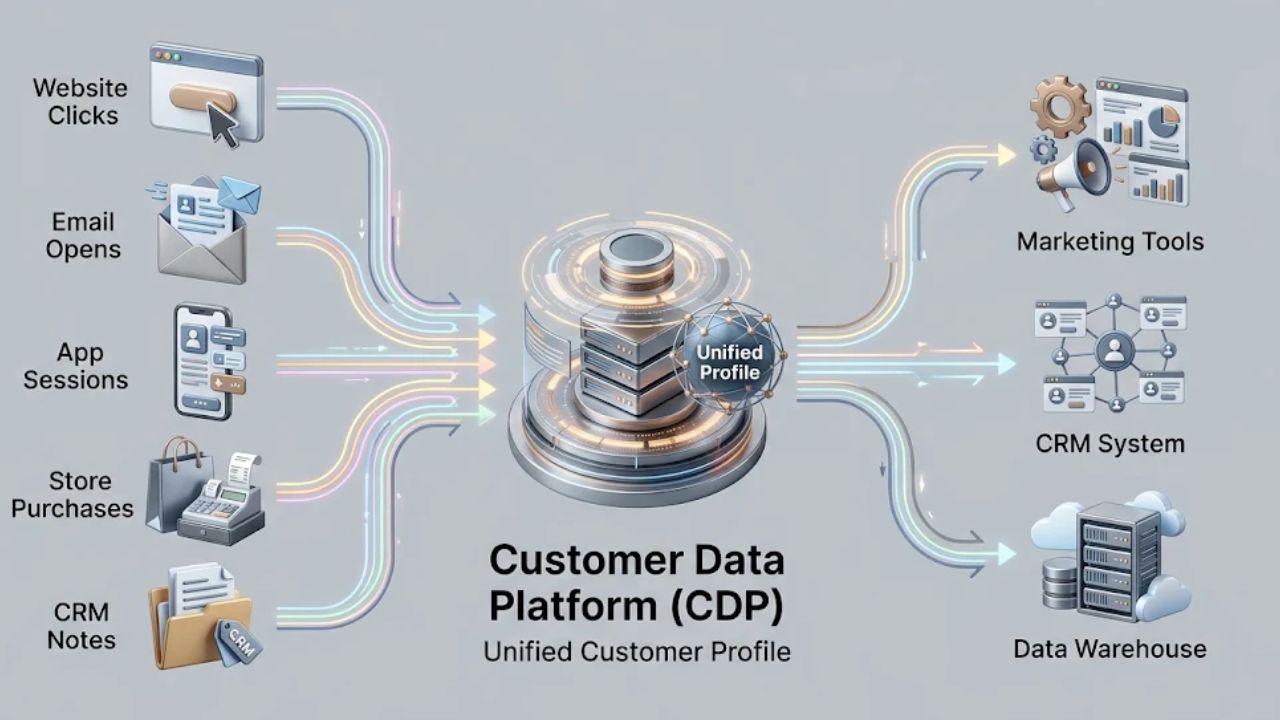
The CDP Institute still uses the definition David Raab wrote in 2013: “A Customer Data Platform is packaged software that creates a persistent, unified customer database that is accessible to other systems.” Put simply, it is software that keeps one lasting record for each customer, and your other tools can read that record.
A CDP pulls customer data from many sources into one place. Because the data sits together, the CDP can build one full view of each customer. That view covers website clicks, email opens, app sessions, store purchases, and CRM notes.
Why not just use the data warehouse you already have? The CDP Institute’s answer is that a unified customer experience needs unified customer data, and warehouses and data lakes have not solved that problem well. A CDP is built for that one job.
Here is the basic flow. The CDP takes in behavior data from many touchpoints and works out which records belong to the same person. It builds one profile per person, and those profiles feed your marketing tools, your customer relationship management system, and your data warehouse.
Platforms such as Adobe Real-Time CDP, Treasure Data, Salesforce, and mParticle serve different business sizes and needs. So a well-known name tells you little about fit. That is why this guide uses tests, not brand names. A capability list only helps once each item becomes something a vendor can pass or fail.
1. Real-Time Data Ingestion and Activation
Data ingestion is how the CDP takes in customer events. Those events come from your website, your mobile app, your store systems, and server-side data streams. Activation is the next step, where the CDP turns that data into action, such as a triggered email or a new ad audience.
Real time matters because customers act fast. Say a shopper browses a product in your app and then opens your email an hour later. If the CDP has not logged the app visit yet, the email shows the wrong thing.
Look for schemaless ingestion and real-time personalization. These are two of the ten capabilities CDP.com lists for an enterprise CDP. Schemaless means you can send new kinds of events without rebuilding your data model first.
Speed has to hold up when traffic spikes, too. Averages absorb exactly the spikes that break campaigns. A platform that runs well on a slow Tuesday can still fall behind during a holiday sale.
Keep one more line in mind. A measurement tool tells you what happened last week. A CDP with real-time activation acts on what a customer is doing right now.
The Test: Time a Live Event
Before the demo, write down your time limit for an event to reach a profile and a segment. In the demo, ask the vendor to send one test event from your site or app. Then time both steps yourself.
Pass: the event lands on the profile and in the segment within your limit. Fail: the vendor shows a recorded video or only offers average speed numbers. You will repeat this check under heavy load in feature 9.
2. Identity Resolution That Builds One Profile per Customer
Identity resolution is how the CDP decides that “[email protected],” an app user, and a store loyalty card all belong to one person. It matches identifiers such as email addresses, device IDs, phone numbers, and loyalty numbers. CDP.com puts customer data unification at the top of its list of needs.
There are two main ways to match. Deterministic matching links records that share an exact identifier, such as the same email address. Probabilistic matching uses clues, such as device and location patterns, to make a likely match.
Neither method is always better. Exact identifiers can be shared, old, or wrong. How well each method works depends on your identifiers, the vendor’s rules, and the cutoffs it uses, so ask each vendor which method it uses, and when.
Some brands also use outside identity partners, such as LiveRamp, to connect records. Data enrichment layers can add context. You can also blend first-party data with second-party and third-party data to fill gaps.
Keep consent rules in mind when you do. Outside data still has to follow the choices your customers made.
Why it matters: the payoff is a Customer 360, one full view of each customer, which Simon Data lists as a must-have. It lets your team see one customer instead of five scattered ones. Without it, the same person gets duplicate emails and offers that do not fit.
Watch out for one trap. A vendor can push its match rate up by merging people who are not the same. A high rate with many wrong merges is worse than a lower rate that is right.
The Test: Ask for a Match-Rate Report
Build a test sample before the demo. Pull records from two or three sources, such as email, app, and store. Mark which records you know are the same person and which you know are different people.
Agree with the vendor on how the match rate is counted. For example, it might be correct matches divided by all the pairs you marked as the same person. Then set two limits: the share of true matches the CDP must find, and the most wrong merges you will accept.
Ask for a report broken out by source pair, such as email to app or app to store. It should list matched records, unmatched records with reasons, wrong merges, and missed matches. Then ask the vendor to show you how to undo a wrong merge.
Pass: the CDP meets both limits on your marked sample and can undo a bad merge. Fail: you get one single percentage with no detail, or no way to split a merged profile.
3. Advanced Audience Segmentation That Updates Itself
Segmentation means splitting customers into groups based on who they are, what they do, and what they like. You might group people by location, purchase history, site clicks, or email opens. Simon Data lists no-code segmentation as a must-have, so marketers can build groups without writing code.
The key idea is segments that update themselves. CDP.com lists profiles that change as new data arrives as a core capability. A self-updating segment rebuilds as events come in, so people move in and out without anyone touching it.
For example, a rule might move a customer into a VIP segment once they pass a spending level within a month. Another rule might remove people who have not opened an email for a set number of days. Your team should be able to edit these rules, add new ones, and test them.
Why it matters: a growing brand rarely has a data analyst for every campaign. If your marketers cannot build segments on their own, the CDP sits idle while requests wait in a queue.
The Test: Let Your Marketer Drive
Bring a short segment brief to the demo. Ask one of your own marketers, not the vendor’s sales engineer, to build it in the no-code tool. Time how long the segment takes to build.
Then send a test event that should move a customer into the segment. Send a second event that should move them out.
Pass: your marketer builds it without help, the customer enters and leaves on their own, and the build time meets your limit. Fail: the build needs SQL, a support ticket, or a nightly batch run.
4. Omnichannel Activation Across Every Channel You Use
Omnichannel activation means sending customer data and audiences to every place you talk to customers. That includes email, SMS, push notifications, paid social, your website, and your store. Simon Data lists email marketing and multichannel orchestration among its must-haves.
Data moves out of the CDP through connectors, webhooks, SDKs, and APIs. When customer behavior changes, the new audience should reach your channels fast. That is how a customer gets the same offer by email, text, and app message instead of three mixed ones.
Personalization is the main payoff. Content personalization is the top reason most organizations use AI today. It only works if the personalized content reaches each channel on time.
Why it matters: if even one channel is left out, it works from old data. Then your brand feels split to the customer.
The Test: Watch an Audience Change Arrive
List every channel you use today and the ones you plan to add within a year. Set a time limit for an audience change to reach each one.
In the demo, add a test customer to an audience, then remove them. Check that both changes show up in each channel, with the right fields, inside your limit.
Pass: every current channel gets the add and the removal on time, and the vendor says in writing who fixes a broken connector. Fail: a connector “is on the roadmap” or needs a custom build you have to pay for.
5. AI and Predictive Analytics You Can Explain
Predictive analytics uses machine learning to guess what a customer will do next. Common examples are churn risk, likely next purchase, and best time to send. Most advanced platforms use machine learning algorithms for deeper customer insights and predictions.
Users like what they get. In a 2025 industry survey, “81% of CDP users reported high satisfaction with their platform’s ability to support AI/ML projects,” and “84% of CDP users say their CDP makes AI tasks and projects easier.”
The bar is rising in 2026. Gartner now expects CDPs to offer “packaged AI agents for specific business functions, with the ability to autonomously make decisions and take action.” That means software that does not just suggest a step but takes it.
That is Gartner’s bar for listing a vendor, not your bar for buying one. A growing brand may not need agents on day one. If you do use them, you need firm limits on what they can do.
Generative AI is newer ground. CDPs are still early in exploring how it can improve their products. So treat bold GenAI claims with care and ask to see them working.
The Test: Name the Decision, the Fields, and the Refresh
For each AI feature, ask the vendor to write down three things. First, the decision the model makes. Second, the profile fields it uses, and third, how often the scores refresh.
Next, agree on how you will judge the scores before you see them. For example, run churn scores on last year’s customers and check whether the high scores flagged the people who actually left. Then have the vendor score a sample of your records.
For any AI agent, ask what it may do alone and what needs a human to approve. Then ask the vendor to show the approval step and the off switch live.
Pass: clear written answers, scores that meet your agreed measure, and working agent controls. Fail: “the model is proprietary” with no field list, or no way to stop an agent.
6. Privacy Compliance and Consent Management
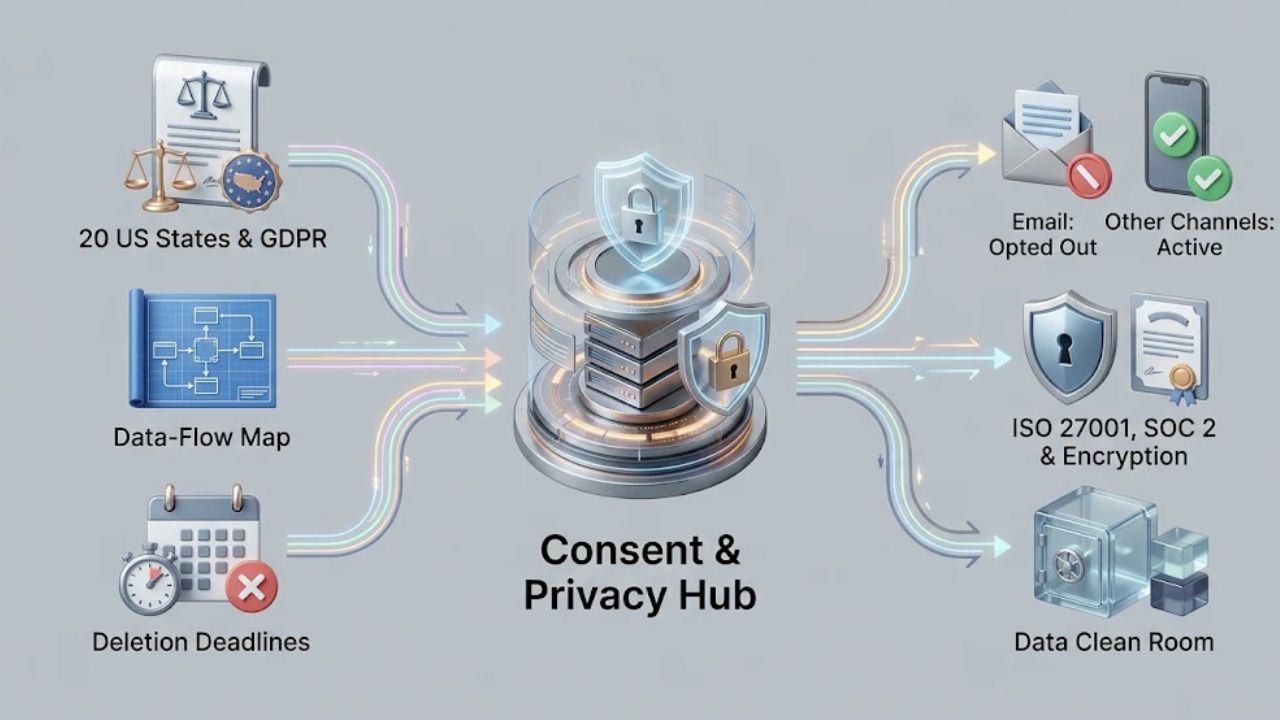
Privacy compliance means the CDP helps you follow the law on how you collect, store, and use customer data. Consent management means it records what each customer agreed to and respects that choice in every channel. Privacy controls are one of CDP.com’s ten core capabilities.
This is no longer just about GDPR in Europe or one state. As of 2026, 20 US states had broad consumer privacy laws in force. A growing brand that sells across state lines needs consent rules that work state by state.
Use this list to test vendors:
- Write down your rules first. List which laws apply to you, where your data must live, and how fast you must delete records when asked.
- Ask for a data-flow map. It should show where your data travels and how long it stays at each stop.
- Get deletion deadlines in writing. Pass if the vendor commits to dates that match your policy. Fail if the answer is “we follow best practice.”
- Test consent one channel at a time. Opt a test customer out of email only. Pass if email sends stop in every connected tool while channels they still agreed to keep working.
- Test a state-law opt-out. Send an opt-out request under a state law that applies to you. Pass if the vendor shows, in writing, how fast that choice reaches every connected tool.
- Request ISO/IEC 27001 and SOC 2 Type 2 reports. These show how the vendor runs its own controls. They do not prove that your use of the data is legal. That part is still your job.
- Ask about encryption and login security. Look for encryption and industry-standard sign-in methods.
- Ask about data clean rooms if you share data with partners. Clean rooms let two companies match audiences without handing over raw customer records.
If you go with a composable setup, check how easy it is to audit. You should be able to trace each data movement and show it to a regulator.
7. Customer Journey Orchestration
Journey orchestration means planning and automating the steps a customer goes through, across channels, based on what they do. A cart reminder, a follow-up text, and a review request can all run as one journey. Simon Data lists multichannel orchestration as a must-have.
Journeys need to bend. CDP.com lists journey flexibility among its ten capabilities. If a customer buys halfway through a reminder journey, the next reminder should stop.
Why it matters: a growing brand often runs journeys by hand across separate tools. That works for one campaign but breaks at ten. Orchestration lets a small team run many journeys without losing track.
The Test: Build One Journey, Then Break Its Path
Pick one real journey, such as abandoned cart or first-purchase welcome. Name the key destinations and the fields that matter at each stage.
Ask the vendor to build it in the demo with a test customer inside. Then send a purchase event for that customer and watch whether the next reminder stops. Last, change one step while the journey is running.
Pass: the purchase stops the reminders, the edit takes effect without a rebuild, and the vendor says in writing who fixes broken connectors and how fast. Fail: reminders keep going, or changes need a new release or a services contract.
8. Integration With Your Existing Tech Stack
Integration means the CDP works with the tools you already pay for. That includes your CRM, email platform, ecommerce site, store system, and data warehouse. A good fit saves your IT team months of work, and a poor fit can stall the whole project.
Many CDPs sit on top of a cloud data warehouse such as Snowflake, which handles centralizing, organizing, and cleaning the data. This is often called a composable or warehouse-native setup. The CDP works from your warehouse or lakehouse, such as Snowflake or Databricks, though how much data each vendor copies or stores varies.
Composable setups can help you avoid vendor lock-in and costly data moves. But recall why CDPs exist: warehouses and data lakes alone have not solved customer data integration well. A warehouse-native CDP fits best when you already have a clean warehouse and someone to look after it.
Time to value is the real risk. Only 22% of marketers report high use of their CDP. CDP.com lists fast time to value as a core capability for that reason.
Follow these steps to test integration:
- List your systems and key fields. Write down every source and destination, plus the fields each one must send or receive.
- Check connectors field by field. A long integration catalog does not prove fit. Sync a test record through your top systems and check that each field arrives correct and in the right place.
- Decide packaged or warehouse-native. If you have a well-run warehouse and a data team, test a composable option. If not, a packaged CDP may get you live sooner.
- Ask for a data-flow map. It should show how each connected system uses your customer data.
- Set dated go-live milestones. Tie each date to your first production use case going live, not to the day you get a login.
- Link payment to milestones where you can. Pass if the vendor agrees to dated milestones in the contract. Fail if it will only promise “onboarding support.”
9. Scalability and Performance at Peak Load
Scale means the CDP keeps working as your customer count, event volume, and team size grow. CDP.com’s list says scale must be proven at peak load, not claimed. Enterprise CDPs handle millions to tens of millions of profiles while serving several business units and enforcing data residency rules.
Do not accept average speed numbers. Averages absorb exactly the spikes that break campaigns. Even your busiest hour can hide a five-minute burst, so measure the short peaks too.
Set your own limits before you talk to vendors:
- Peak events per second. Use the highest short burst you have measured, such as the first minutes of a sale.
- Total profile count. Include your growth plan, not just today’s list.
- Source identifiers. Count how many IDs each profile may carry, such as email, phone, device, and loyalty number.
- Maximum segment build time. State how long your largest segment may take to build at peak.
- Maximum profile lookup time. This matters for live website and app personalization.
- Data retention and archive terms. Long-term retention with disclosed archive terms is a core capability. Ask how many years of data are included and what extra years cost.
How to Run the Peak-Load Test
- Agree on the setup. Load your projected profile count with the identifiers you listed.
- Replay real traffic. Use a copy of your event mix, including your measured short bursts, not a smooth flat line.
- Run everything at once. Take in events, run profile lookups, and build your largest segment at the same time.
- Record the results. Track speed, errors, dropped events, backlog, and how long the system takes to catch up after the burst.
Say you set a 10-minute limit for your largest segment. That is only an example, so use your own number.
Pass: the CDP meets every limit you set for the whole test, not just most of it. Fail: the vendor only offers a controlled demo, a quote based on averages, or results with no dropped-event count.
Retention terms are a hidden cost. Settle them in the contract before you sign, not when your first archive bill arrives.
How to Test Vendors on All 9 Features
A capability list only does work once each item becomes something a vendor can pass or fail. Use this table as your written requirements. Fill in your own numbers before the first demo.
| Feature | Pass/fail question | Proof to ask for | Fail sign |
| 1. Real-time ingestion | Does a live test event reach the profile and segment within our time limit? | Live event timed in the demo | Recorded demo or averages only |
| 2. Identity resolution | Does it meet our match limit and wrong-merge limit on our marked sample? | Report by source pair with unmatched reasons, wrong merges, missed matches, and a live merge undo | One single percentage, no detail |
| 3. Segmentation | Can our marketer build a self-updating segment that people enter and leave on time? | Our marketer builds it live; entry, exit, and build time checked | Needs SQL, a ticket, or a nightly batch |
| 4. Omnichannel activation | Do audience adds and removals reach every channel within our time limit? | Live add and removal checked in each channel, fixes owner in writing | “On the roadmap” |
| 5. AI and predictive | Do scores meet our agreed measure, and can we approve or stop agent actions? | Written decision, fields, and refresh; scores on our records; live approval step and off switch | “Proprietary,” no field list, no off switch |
| 6. Privacy and consent | Does an email-only opt-out stop email everywhere, and do state-law opt-outs spread on time? | Data-flow map, written deletion and spread deadlines, ISO/IEC 27001 and SOC 2 Type 2 reports | No written deadlines |
| 7. Journey orchestration | Does a purchase stop reminders, and can we edit a live journey? | Purchase event and live edit in the demo | Reminders keep going, or edits need a services contract |
| 8. Tech stack integration | Do our key fields sync correctly, and will our first use case go live by a set date? | Field-level test sync; dated go-live milestones in the contract | Only “onboarding support” |
| 9. Scale at peak load | Does it meet every limit for the whole test at our measured peak bursts? | Load test results with errors, dropped events, and catch-up time; retention and archive costs in writing | Average-based quotes only |
Shortlist Using the 2026 Market Picture
The 2026 Gartner Magic Quadrant for CDPs moved several big names. Four vendors now hold Leader status: Salesforce, Hightouch, Oracle, and Uniphore, which bought ActionIQ.
Tealium dropped from Leader to Challenger. Adobe remains the “only Visionary in the 2026 Magic Quadrant.”
ActionIQ, Redpoint Global, mParticle, and Zeta Global fell off the chart for failing “updated inclusion criteria for CDP software customers and contract value.” BlueConic, Amperity, and Twilio are Niche Players.
Falling off the chart does not mean a product is bad. It means it did not meet Gartner’s size rules this year. The chart shows market position, not fit for your brand.
Use these steps to build a shortlist without overbuying:
- Name your first use case and its owner. For example, an abandoned-cart journey run by your email lead.
- Pick packaged or warehouse-native. Base it on how clean your warehouse is and who will run it.
- Mark each of the nine features. Label it “must have now” or “can wait.” Only the “now” items should block a vendor.
- Pick a small set of vendors. We’d suggest three or four, drawn from the chart and from vendors outside it. Run the same tests on each.
Ask every vendor about AI agents, since Gartner now expects “packaged AI agents for specific business functions, with the ability to autonomously make decisions and take action.” But only make agents a must-have if your first use case needs them.
Final Thoughts
The Customer Data Platform features that matter most are real-time ingestion, identity resolution, segmentation, omnichannel activation, AI and predictive modeling, privacy and consent, journey orchestration, tech stack integration, and scale. None of them counts until a vendor passes a test for it.
Set your own numbers before the first call. Write down your match and wrong-merge limits, your peak events per second, your profile count, your largest segment build time, and your retention needs. Then make each vendor prove those numbers with your data at your busiest moments.
Last, plan for use, not just purchase. Only 22% of marketers report high use of their CDP. Pick one first use case, tie it to a dated go-live milestone in the contract, and judge the vendor on whether it actually goes live.
Start by copying the table above into a shared doc. Add your numbers, send it to your shortlist, and let the test results make the choice.
Frequently Asked Questions About Customer Data Platform Features
1. What is a customer data platform?
A customer data platform, or CDP, is software that unifies customer data from every source (your website, CRM, email tools, ads) into a single profile for each person. According to Gartner, the CDP market grew to $4.8 billion in 2024 because fragmented data was costing brands real revenue. You see the whole story, not just pieces.
2. Which CDP features matter most for growing brands?
Look for real-time data sync, identity resolution, easy integrations, and smart audience segments. Strong privacy controls matter too, since CCPA violations can cost up to $7,500 per record in the US.
3. How do I know if a CDP will grow with my brand?
Check how it handles more data, more users, and new tools over time. Ask the vendor for proof, like case studies from brands your size, and confirm the platform can manage at least 100,000 customer profiles without slowing down.
4. Do small teams need a CDP?
Yes, if your customer data sits in many tools and slows your work. A 2024 Forrester study found that teams using a CDP save an average of 12 hours per week on manual data tasks.




















 English (US) ·
 French (CA) ·
 French (FR) ·