

PROTECT YOURSELF with Orgo-Life® QUANTUM TECHNOLOGY
Orgo-Life the new way to the future Advertising by Adpathway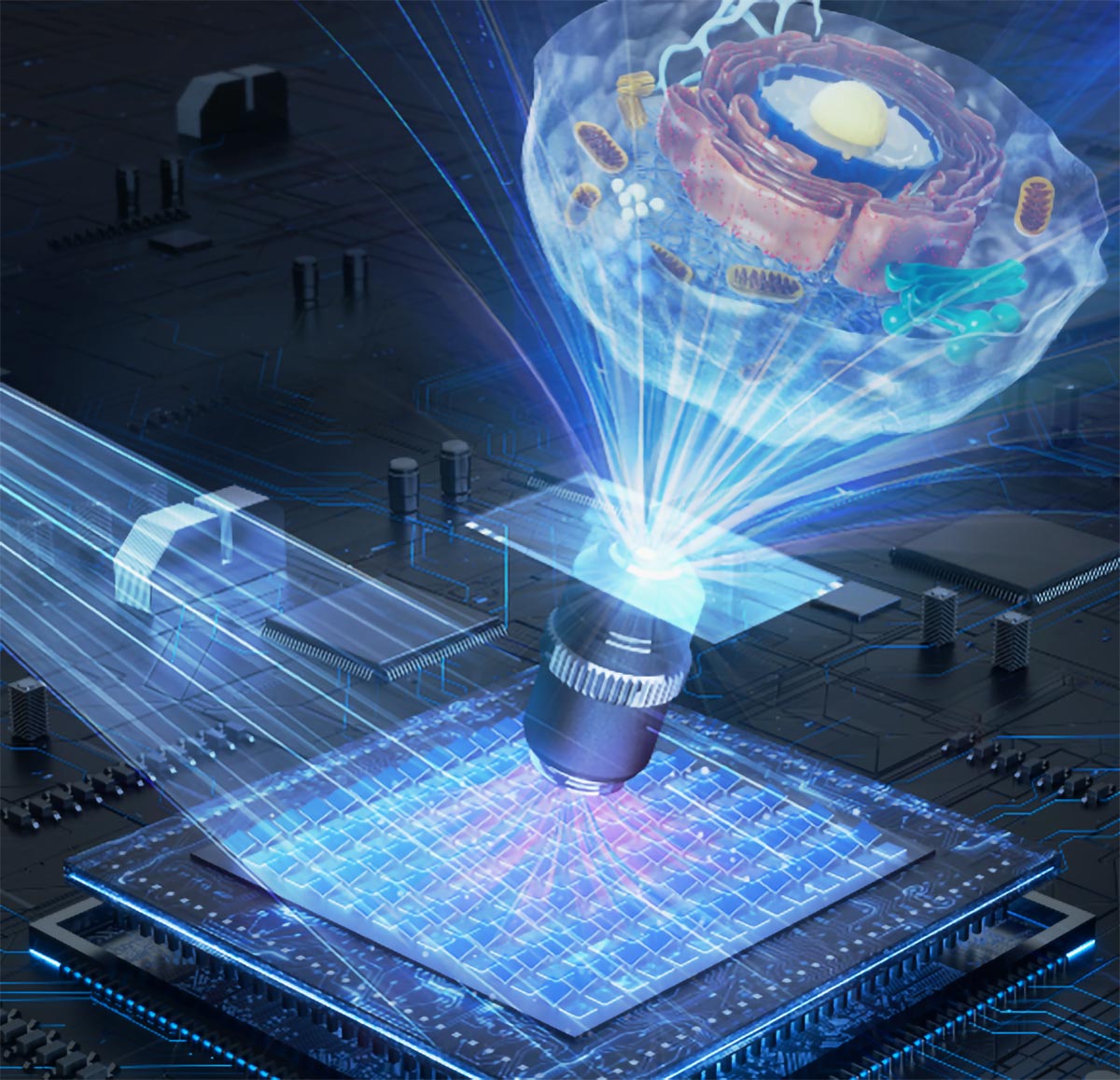 Schematic of the imaging process. Incoherent light, modulated by the DMD, is directed into the microscope and focused onto the sample plane by the objective lens, creating structured illumination for super-resolution imaging of subcellular microstructures. Credit: Jiaming Qian et al. from Nanjing University of Science and Technology, Nanjing, China
A new imaging framework is pushing the boundaries of how scientists observe life at the microscopic scale.
Understanding life at the cellular and subcellular scale depends on seeing extremely small biological structures in fine detail. Super-resolution fluorescence microscopy has become essential in modern research because it allows scientists to image beyond the limits of traditional optical systems.
Among these methods, structured illumination microscopy (SIM) stands out for combining strong resolution, fast imaging, and low phototoxicity, making it well-suited for long-term studies of living cells.
Even with these advantages, many super-resolution systems remain difficult to use in practice. High-performance versions, particularly interference-based SIM, often rely on complex optical setups, precise alignment, and bulky equipment. These factors increase costs and limit accessibility, slowing the wider adoption of advanced imaging tools in everyday research and in labs with fewer resources.
A New Approach: PCA-iSIM
A team from the Smart Computational Imaging Laboratory (SCILab) at Nanjing University of Science and Technology, led by Professor Chao Zuo, has introduced a new imaging method called PCA-iSIM. This system delivers high-resolution, real-time imaging using a more compact and cost-effective design, addressing several limitations of conventional SIM techniques.
SIM works by using patterned light to shift fine details of a sample into a range that the microscope can detect. Digital micromirror device (DMD)-based incoherent SIM systems have gained attention because they are smaller and simpler than other designs. However, they face a major challenge.
When high-frequency patterns are used, the contrast of the projected fringes drops significantly due to the optical transfer function. This makes the patterns hard to detect, which complicates the process of estimating illumination parameters and producing accurate super-resolution images.
Overcoming Fundamental Limitations
To solve this issue, the researchers developed a computational strategy that combines high-modulation coefficient mapping with principal component analysis (PCA). Instead of relying on weak high-frequency signals, the method links easily detectable low-frequency patterns with their high-frequency counterparts. This approach allows the system to estimate illumination wave vectors even when contrast is very low.
PCA is then applied to pull out the strongest signals from noisy data. Explaining the method, Prof. Zuo says, “By leveraging PCA’s capability for dimensionality reduction and noise suppression, we are able to isolate the illumination-related information embedded in the data and accurately recover sub-pixel illumination parameters.”
This process improves both the reliability and accuracy of parameter estimation, which is essential for producing clear super-resolution images.
Experimental Validation and Performance
The team tested PCA-iSIM using a custom-built DMD-based incoherent SIM system. Their results show a resolution improvement of more than 1.9 times, reaching an effective resolution of about 100 nm (0.0001 mm), while maintaining real-time imaging speeds of up to 30 frames per second.
These gains come with a much simpler optical design. Compared to traditional laser-based SIM systems, the new setup reduces overall complexity by nearly 70%, making it easier to build and use.
In addition to improving resolution, the method performs reliably in low signal-to-noise conditions and in changing experimental settings. The researchers also demonstrated real-time imaging of mitochondrial activity in living cells, capturing structural details that standard wide-field microscopes cannot resolve.
“This work fundamentally extends the performance ceiling of incoherent structured illumination microscopy,” the authors note. “By combining compact hardware with advanced computational reconstruction, PCA-iSIM opens new opportunities for accessible, high-performance super-resolution imaging.”
Reference: “Breaking the Resolution Barrier in Incoherent Structured Illumination Microscopy via High-Modulation Coefficient Mapping and Principal Component Analysis (PCA-iSIM) (Laser Photonics Rev. 20(3)/2026)” by Maoxian Zhang, Xinyu Han, Jiaming Qian, Hongjun Wu, Tianchi Kang, Dongqin Lu, Jing Feng, Weihao Cheng, Yuzhen Zhang, Qian Chen and Chao Zuo, 5 February 2026, Laser & Photonics Reviews.
DOI: 10.1002/lpor.70881
Never miss a breakthrough: Join the SciTechDaily newsletter.
Follow us on Google and Google News.























 English (US) ·
  French (CA) ·
  French (FR) ·