

PROTECT YOURSELF with Orgo-Life® QUANTUM TECHNOLOGY
Orgo-Life the new way to the future Advertising by AdpathwayThe history of art in general, and literature in particular, is full of alcoholics, opium addicts, cocaine users, and junkies of all sorts. And the process is always the same: the chemical muse kills first the work, and then the artist. “Then I was drunk for many years, and then I died,” F. Scott Fitzgerald wrote in a diary.
Article continues after advertisement
Interestingly, one drug that had its moment among creators was coffee: Voltaire drank fifty coffees a day, Balzac forty, and Flaubert paired his dozens of daily cups with glasses of ice water. Nietzsche was addicted to chloral hydrate, a sedative made from chloroform; Freud and Robert Louis Stevenson, to cocaine; Ramón del Valle-Inclán smoked hashish heavily—just as Baudelaire had done in 1840, as a member of the Club des Hashischins, together with writers such as Honoré de Balzac, Théophile Gautier, Gérard de Nerval, and the painter Eugène Delacroix. Opium in particular has always had a strong following. “Of all drugs, opium is the drug,” said Jean Cocteau. “It gives form to the formless.” And isn’t that what all artists are seeking?
Opium was used by Shelley, Wordsworth, Byron, Keats, Flaubert, Rimbaud. Thomas De Quincey enthused that opium drew back the veil “between our present consciousness and the secret inscriptions on the mind.” Incidentally, the badly addicted De Quincey ended up suffering terribly, experiencing severe dissociation and horrific nightmares. Not to mention perhaps the most famous opium addict in the history of literature, Samuel Taylor Coleridge, whose renowned poem “Kubla Khan” came to him in a drug-induced dream (he woke up and hurriedly jotted down the lines, but could only remember part of it). Even someone like Octavio Paz, a formidable writer who gave the impression of being a very formal and serious gentleman, once said: “Drugs […] give life to analogy, put objects in motion, make of the world a vast poem of rhythms and rhymes.”
I understand what led them to alcohol. It’s as we said at the beginning: to heighten the emotions, enhance disinhibition, quell the controlling self.
As for cocaine, once it was first extracted from coca plants in 1860 it was immediately hailed as a miracle substance: the market was flooded with coca pills, syrups, and elixirs. Jules Verne thought it “a wonderful tonic.” The young and enterprising Mark Twain contemplated setting up a business that consisted of going to the Amazon to harvest coca in order to “open up a trade in coca with all the world.” For months he pondered the project, even setting off for Peru with a 50 dollar bill in his pocket that he’d found on the street, but he only made it as far as New Orleans. This incredible story is recounted by Sadie Plant in her fascinating book Writing on Drugs. She also reveals that, according to some authors, the visions of St. Teresa of Jesus and other mystics may have been facilitated by psychoactive substances, such as ergot. Ergot is a fungus that attacks cereal crops; consuming the infected flour of these crops can lead to a disease called St. Anthony’s Fire, which was quite common in the Middle Ages and causes terrible symptoms: seizures, dementia, and fatal gangrenous infections. However, if taken in small quantities, it can induce hallucinations. Ergot contains an alkaloid, ergoline, from which LSD was synthesized in 1938.
Before that, ergotamine had also been extracted from it, a medication for migraines that I have taken in large doses throughout my life (this has nothing to do with the story: I was just stunned to discover it). I’d previously read about the probable influence of ergot on painters such as Bosch (those kaleidoscopic deliriums), but I was unaware of the mystics. And Sadie Plant goes on to recount something even more shocking: scientist John Mann apparently discovered a connection between certain historical events and periods when the climate was favorable to the growth of ergot, which may have provoked a kind of collective hallucination. He points to the Salem witch trials in Massachusetts in the 1690s and the “Reign of Terror” during the French Revolution.
There are many drugs we haven’t even touched on yet: Truman Capote’s barbiturates, Philip K. Dick’s amphetamines…Although amphetamines have typically been more the politician’s drug of choice than the artist’s: Kennedy, Churchill, British Prime Minister Anthony Eden…and Hitler, who injected methamphetamine eight times a day. Other writers experimented with mescaline, like Jean-Paul Sartre, who spent years seeing crustaceans chase after him; or with peyote and, above all, LSD, the drug of Timothy Leary and his crackpots. It also fascinated Aldous Huxley, who argued that he needed to get high to “access [his] subconscious life” (just like we were saying). There is something he did at the end of his life that I’ve always found chilling. As he lay dying of oral cancer, he asked his wife—in writing because he could no longer speak—to inject him with LSD in his final moments. And she did. So Huxley died in the middle of an acid trip; he refused morphine because he said he wanted to die with as much mental clarity as possible. Although, as a child of the LSD age, I don’t know if that can truly be called mental clarity.
But the queen of drugs for artists, and especially the literati, is alcohol. “Drink heightens feelings. When I drink, it heightens my emotions and I put it in a story… My stories written when sober are stupid… all reasoned out, not felt,” Fitzgerald said to a friend early into his descent into hell. Incidentally, I think the oxymoron in Fitzgerald’s last sentence is beautiful: the more reason is used in art, the less sense it all makes. It’s what we were saying before, about needing to anesthetize the self.
Alcohol is the great plague of writers, especially during the 20th century. Of the nine U.S.-born Nobel laureates in literature, five were hopeless alcoholics: Sinclair Lewis, Eugene O’Neill, William Faulkner, Ernest Hemingway, and John Steinbeck. To which we could add dozens more authors, such as Jack London, Dashiell Hammett, Dorothy Parker, Djuna Barnes, Tennessee Williams, Carson McCullers, John Cheever, Raymond Carver, Robert Lowell, Edgar Allan Poe, Charles Bukowski, Jack Kerouac, Patricia Highsmith, Stephen King, Malcolm Lowry… Americans have been incredibly good at drinking themselves to death, but of course they are not the only ones; there’s also Dylan Thomas, Jean Rhys, Marguerite Duras, Oscar Wilde, Ian Fleming, Françoise Sagan… And we’re not talking about occasionally having a few too many, but about real personal catastrophes, delirium tremens, a total destruction of life.
The Norwegian Knut Hamsun, who won the Nobel Prize in 1920, attended the award ceremony so atrociously drunk that he rapped on the corset of Swedish author Selma Lagerlöf (also a Nobel Prize winner) and, after letting out a burp, shouted: “I knew it, I knew it would sound just like a bell!” The wonderful British poet Dylan Thomas, who died of drink at the age of thirty-nine, told his lover near the end: “I’ve had eighteen straight whiskies, I think that’s a record.” At the age of thirty-seven, Faulkner would breakfast on two aspirin and half a glass of gin to stop his hands shaking long enough for him to shower and shave. He would go on week-long binges, during which he would wander naked through hotel corridors or disappear completely. During one of these alcoholic absences, he passed out in his underwear on a radiator, remaining there until the concierge knocked down the door. By then he had a third-degree burn on his back. Faulkner’s alcoholism led to several hospitalizations and repeated electroshock treatments. Hemingway, who once drank sixteen daiquiris in a single sitting, also received around a dozen electroshock treatments in his lifetime.
But booze is a malicious, treacherous muse—an assassin who, before killing you, brutalizes you, humiliates you, and robs you of your words.
Some authors manage to quit before they kill themselves, like Nobel laureate Eugene O’Neill, who retired from drinking at the age of thirty-eight, or Stephen King, after having already tried everything in the 1980s: “I was drinking twenty-four or twenty-five cans of beer a day, plus everything you can imagine: cocaine, Valium, Xanax, Listerine, cough syrup…” And Bukowski recounts with horror in his autobiographical book On Writing how, after spending seven or eight years “just drinking,” he was admitted to the charity ward of the general hospital, vomiting blood with a perforated stomach. He was on death’s door, but what horrified him the most was having ended up on the charity ward; he evidently considered it the most degrading moment of his life. After that he only drank beer, a typical recourse of the alcoholic, with which he would still get hammered, but less seriously. In her book of autobiographical stories A Manual for Cleaning Women, American writer Lucia Berlin depicts what it is like to be an alcoholic in an incredible and harrowing way, the likes of which I have never seen anywhere.
Curiously, in the English-speaking world, drinking problems have always been more openly acknowledged. Perhaps it was because they have been mythologized for so long, as if drunkenness made you a better writer. There was also a bit of that in Spain too, in the generation before me—those writers who were forty-five or fifty when I was in my twenties. I’ve witnessed them drink with barbaric enthusiasm and boast about the brotherhood of alcohol and creative talent. But in our culture such things are swept under the rug, as if they should not be named. There is an essay entitled Alcohol and Literature, published in 2017, in which the author Javier Barreiro dares to name various Spanish and Latin American writers.
Some of these are known to those of us in the literary world: Juan Benet, Caballero Bonald, Dámaso Alonso, Alfonso Grosso, Fernando Quiñones, Gil de Biedma, Carlos Barral, and the great Ana María Matute, who suffered a few terrible years but later recovered. Those on the other side of the Atlantic include Juan Carlos Onetti, Alfredo Bryce Echenique, Juan Rulfo, José Donoso, Pablo Neruda, and Guillermo Cabrera Infante. I recall an interview I did with Spanish poet Leopoldo María Panero while he was in a psychiatric hospital, I believe in the small town of Ciempozuelos just outside of Madrid. He was permitted to leave the hospital for a few hours, which we spent chatting in a local bar in the village. He drank non-alcoholic beers continuously throughout our conversation, agonizingly sipping these 0.5% strength beers that were all you could get then, guzzling them down with shocking greed, one after another.
In The Thirsty Muse: Alcohol and the American Writer by Tom Dardis, the author says: “Over the years, many of our best artists have accepted the connection [between art and alcohol]. In fact, several have claimed they had little choice but to drink, and heavily at that, if they were to perform at their creative peak.” This is the most astonishing part: even if they were well aware of the carnage that drink was wreaking on their lives, many of them did not realize that, as their addiction progressed, their work actually became worse and worse, sometimes even to the point of rendering them completely silent. I understand what led them to alcohol. It’s as we said at the beginning: to heighten the emotions, enhance disinhibition, quell the controlling self. Neither Hemingway nor Fitzgerald could write without being drunk, for example. But booze is a malicious, treacherous muse—an assassin who, before killing you, brutalizes you, humiliates you, and robs you of your words. As Charles Bukowski said, with chastened experience, “To get through this game drinking helps a great deal, although I don’t recommend it to many.”
__________________________________
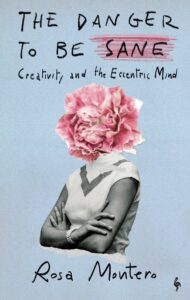
From The Danger to Be Sane: Creativity and the Eccentric Mind by Rosa Montero, translated by Lindsey Ford. Copyright © 2026. Available from Europa Editions.
















 English (US) ·
  French (CA) ·
  French (FR) ·