

PROTECT YOURSELF with Orgo-Life® QUANTUM TECHNOLOGY
Orgo-Life the new way to the future Advertising by Adpathway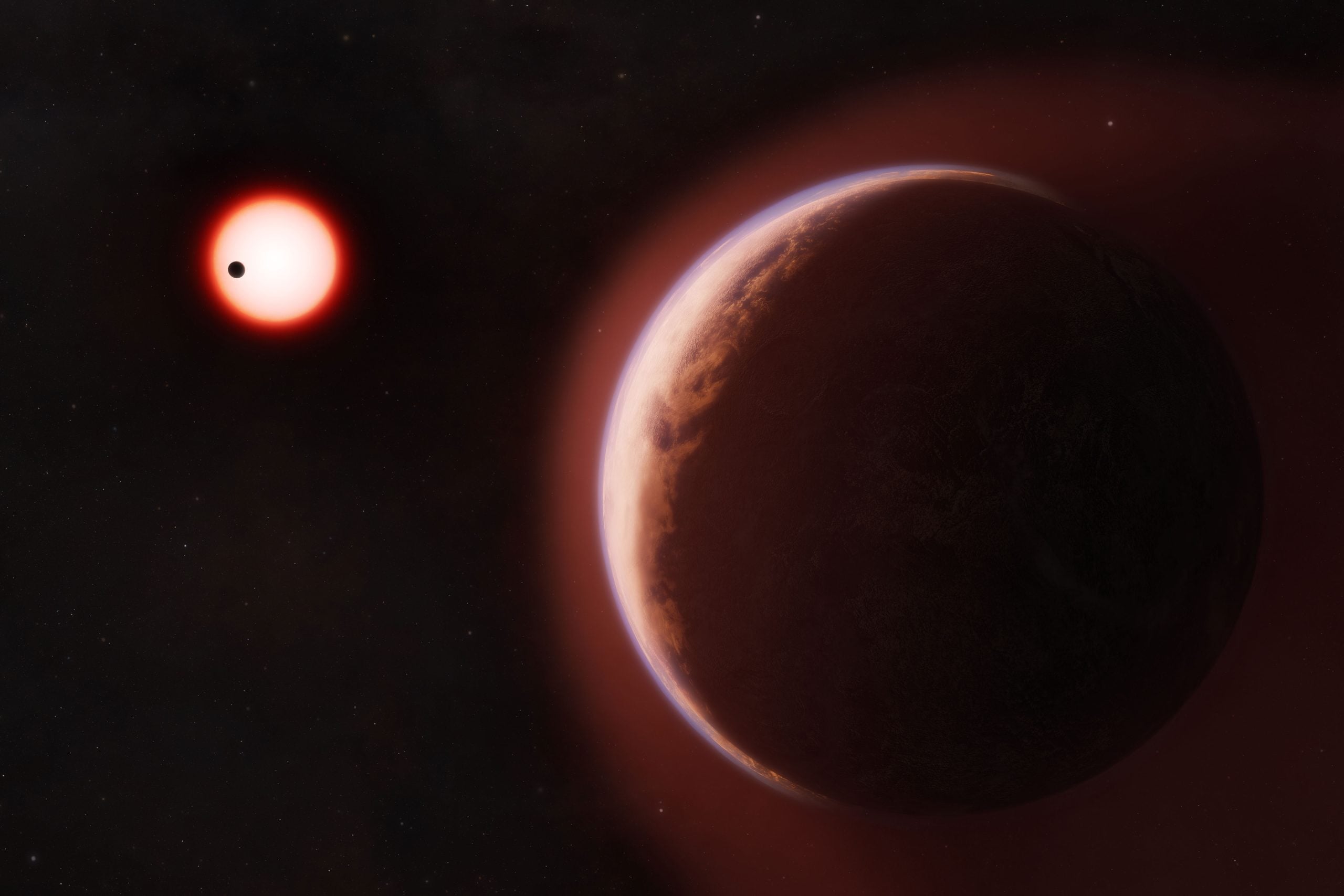 In this artist’s concept, the exoplanet LHS 1140 b is shown in the foreground, surrounded by a helium-rich atmosphere. Another nearby rocky planet orbits the same cool red dwarf star in the distance. A new study provides the strongest evidence yet that LHS 1140 b has retained an atmosphere, representing a milestone step toward the discovery of Earth-like rocky planets beyond our solar system. Credit: Melissa Weiss/CfA
This discovery marks a major milestone in the search for life on worlds beyond our solar system.
A faint stream of helium escaping from a distant rocky world has revealed something astronomers had never clearly detected before: an atmosphere around an Earth-like planet in another star’s habitable zone.
The result is the strongest evidence so far that planets resembling Earth in composition and temperature, and potentially capable of supporting life, exist beyond our solar system.
“An atmosphere is essential for a planet to support life as we know it,” said lead author Collin Cherubim, who recently earned his Ph.D. in Earth and Planetary Sciences from Harvard University.
“This is the first time anyone has found an atmosphere on a rocky planet in the habitable zone of another star.”
Escaping helium reveals an atmosphere
The study, published in Science, describes observations of helium leaking from LHS 1140 b, a rocky exoplanet located about 48 light-years from Earth. Guided by theoretical predictions, the researchers found evidence that the planet has retained an atmosphere.
LHS 1140 b circles a red dwarf within the star’s habitable zone, where temperatures and other environmental conditions could allow liquid water to remain on the surface.
 The lead study researchers, from left to right: Robin Wordsworth, Gordon McKay Professor of Environmental Science and Engineering and Professor of Earth and Planetary Sciences; Collin Cherubim, who recently earned his Ph.D. in Earth and Planetary Sciences from Harvard University and is affiliated with the Center for Astro; and David Charbonneau, head of the Harvard Department of Astronomy and astronomer in the Center for Astrophysics | Harvard & Smithsonian. Charbonneau and Wordsworth are Cherubim’s dissertation advisors. Cherubim will be joining the University of Chicago as a post-doctoral researcher in the fall. Credit: Carlos Sanchez, Harvard FAS
Thousands of exoplanets are now known, including several rocky planets in habitable zones. Establishing whether any of these worlds possess atmospheres, however, has proved far more difficult.
“Twenty years ago we wondered whether other terrestrial-type planets even existed,” said Robin Wordsworth, Gordon McKay Professor of Environmental Science and Engineering and Professor of Earth and Planetary Sciences at Harvard and one of Cherubim’s dissertation advisors. “Then we learned they’re common, and found some in the habitable zone. The next question was whether any of them had managed to keep an atmosphere. Now we know at least one has.”
A model predicts the hidden signal
Previous research had identified rocky planets within their stars’ habitable zones, but none had clearly established that such a world retained an atmosphere for billions of years.
A theoretical model developed by Cherubim and his colleagues predicted that the upper atmosphere of LHS 1140 b would contain abundant helium slowly leaking into space.
The researchers tested that prediction with the Warm Infrared Echelle (WINERED) Spectrograph mounted on the Magellan Clay telescope at Las Campanas Observatory in Chile. Their opportunity came during an unusual alignment in which LHS 1140 b and another planet crossed in front of their star during the same night.
No atmospheric signal appeared around one planet. Around LHS 1140 b, however, the instrument detected escaping helium, providing evidence that the rocky world still holds an atmosphere.
David Charbonneau, Cherubim’s joint advisor, head of the Harvard Department of Astronomy and an astronomer at the Center for Astrophysics | Harvard & Smithsonian, initially doubted the plan. The proposed signal came from a mathematical prediction and had never been observed around a rocky planet.
The data changed his view.
“Collin analyzed the planets we knew about and predicted that this one would have a helium atmosphere,” Charbonneau said. “Then he organized telescope time, got the data, and the detection was statistically rock solid.”
Ground telescopes gain a new tool
The results indicate that searches for gases escaping into space could give ground-based observatories a useful way to investigate the atmospheres of rocky exoplanets.
Astronomers estimate that the atmosphere surrounding LHS 1140 b has endured for more than three billion years, making the planet an important candidate for further study.
Cherubim hopes to determine the atmosphere’s complete chemical makeup and eventually examine whether LHS 1140 b has surface oceans or other features associated with habitability. He and his colleagues also plan to apply the model to searches for comparable planets.
“This has been a model validation, and hopefully it’s just the first of many more observations to come,” he said.
Reference: “Helium escaping from the atmosphere of a nearby rocky exoplanet orbiting in a habitable zone” by Collin Cherubim, Shreyas Vissapragada, Tim Cunningham, Annabella G. Meech, David Charbonneau, Robin Wordsworth, Aaron Householder, Johanna Teske, Leonardo A. Dos Santos, Nicole L. Wallack, William Misener, Zifan Lin, Andrew McWilliam, Michael Zhang, Jason A. Dittmann and Mercedes López-Morales, 16 July 2026, Science.
DOI: 10.1126/science.aea9708
Never miss a breakthrough: Join the SciTechDaily newsletter.
Follow us on Google and Google News.



















 English (US) ·
  French (CA) ·
  French (FR) ·