

 2 months ago
15
2 months ago
15
PROTECT YOURSELF with Orgo-Life® QUANTUM TECHNOLOGY
Orgo-Life the new way to the future Advertising by AdpathwayIn 1938, the Welsh naturalist Ronald Lockley described Ynys Enlli (Bardsey Island) as a mountain “crudely cemented to a lowland valley, and the whole thing thrown into the middle of a violent tide-race”. Much has changed since then, but that vivid picture holds true, as I wander it today.
Certainly there’s a lovely simplicity to Enlli being a sort of linear settlement arranged along the length of a single road. Having only two directions of travel – north or south – makes the lane a movable town square, where those travelling in opposite directions or at different speeds are bound to meet, greet, make dinner invitations or trade sightings and finds.
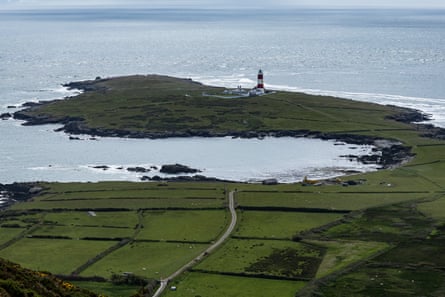
An oft-cited claim about Enlli is that 20,000 saints lie buried here, owing to its importance as a medieval pilgrimage site (three trips here was worth one to Rome, it was believed). If that seems improbable, it helps the imagination that the same economy of space necessary for such a density of graves was also applied to the crowded lattice of fields that crisscross the lowlands. All 183 carry a name, or in some cases, more than one.
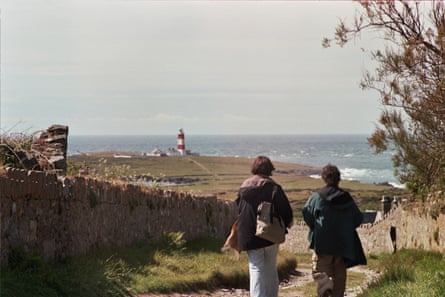
As I stroll along Enlli’s only, unlonely road, those old Welsh field names tell of islanders long departed – Bet, Cristin, Sionyn, Siôn, Siani. Then there are pedol, had, weirglodd, sofl, which speak of ponies shod in iron, of seeds and crops cultivated against the sea breeze, and of hay meadows and stubbled ground after the harvest. Cae Calch reminds us of the lime they spread to improve the earth. Another, cae gwrachod, ominously refers not to a single witch, but many.
There isn’t a harvest these days, only a few hundred sheep, also found in the old field names as cae’r ŵyn (lamb field). They are survivors of a changed landscape and rural economy, today grazing the daisies that obscure a rusting plough and old pigsties full of nettles.
A name can be a fleeting thing, vanishing along with old farmers and agricultural methods. But their worth is clear to me – more than just a memory or a witness to loss, they help us contextualise a changing world and are a seed of what could yet be again one day.










 English (US) ·
  French (CA) ·
  French (FR) ·