

 1 month ago
19
1 month ago
19
PROTECT YOURSELF with Orgo-Life® QUANTUM TECHNOLOGY
Orgo-Life the new way to the future Advertising by AdpathwayIn a crucial win for workplace equality, the Delhi High Court has directed the State Bank of India (SBI) to review alternative promotion pathways for its visually impaired staff.
Reaffirming that employees with disabilities cannot face discrimination in career advancement, Chief Justice Devendra Kumar Upadhyaya and Justice Tejas Karia said that the Visually Impaired Bank Employees Welfare Association, representing blind bank officers, is best equipped to propose practical solutions.
“The Petitioner, being an organisation representing blind and low vision bank officers serving in public and private sector banks across the country, is well placed to suggest solutions to the issues identified in the present Petition. The Petitioner has also submitted that Public Sector Banks other than Respondent No 1 (SBI) have adopted inclusive policies to accommodate blind and low-vision officers,” the May 29 order noted.
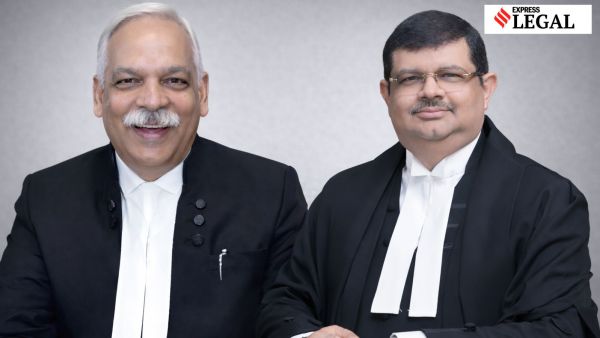 Chief Justice Devendra Kumar Upadhyaya and Justice Tejas Karia directed SBI to consider the recommendations suggested by the Visually Impaired Bank Employees Welfare Association
The bench, therefore, directed the SBI to place the petitioner association’s suggestions before its board of directors, which would then consider and take an appropriate decision on their implementation within 12 weeks.
’37 visually impaired officers against SBI promotion policy’
- The petitioner, Visually Impaired Bank Employees Welfare Association, comprising more than 600 visually impaired bank employees across India, filed a petition challenging a State Bank of India (SBI) promotion policy.
- The policy requires officers seeking promotion to Senior Management Grade Scale (“SMGS”) IV and V to have prior experience as a Branch Manager or in assignments related to credit/trade finance and foreign exchange.
- The aforementioned roles were inherently inaccessible to visually impaired officers due to the absence of assistive technology and the visual nature of the tasks.
- The Petitioner contends that the policy amounted to discrimination against visually impaired employees under the Rights of Persons with Disabilities Act, 2016 (“RPwD Act”) and the Constitution.
- The association emphasised that despite a clear order by the Chief Commissioner for Persons with Disabilities (CCPD) in December 2022, which recommended that SBI provide reasonable accommodations and modify policy, it did not comply with those recommendations.
- Petitioner’s case highlighted that because visually impaired officers cannot practically serve in the required roles, making such experience a mandatory condition for promotion would unfairly exclude them from promotions to higher management positions.
‘Visually impaired employees, systematically excluded’
Appearing for the association, advocates Rahul Bajaj and Sarah argued that 37 visually impaired officers employed with SBI are systematically excluded from promotion as the policy demands prior experience in roles such as bank manager and credit officer, which cannot practically be undertaken due to the visual nature of work and lack of assistive technology.
Bajaj contended that there was no adequate assistive technology for the visually impaired employees that would allow them to function independently and perform tasks such as physical inspection, verifying documents and signatures, monitoring CCTV footage, handling finances and certifying regulatory compliance.
Story continues below this ad
Other Public Sector Banks had extended reasonable exemptions and accommodations to facilitate the career progression of blind officers, including Punjab National Bank, which had adopted inclusive practices in conformity with the rights of persons with disabilities (PwDs), Bajaj added.
Bajaj and Sarah additionally contended that other public banks had adopted inclusivity by reasonably accommodating visually impaired officers, by allowing them to progress to managerial positions.
The counsel argued that the CCPD had already directed SBI with recommendations to have an alternative promotion criteria for including the visually impaired officer, but SBI did not comply with the same.
Calling the policy violative of the right to equality guaranteed under Article 14 of the Constitution, Bajaj submitted that there was no objective justification for the discrimination, and that it fails to provide equal opportunities to visually impaired employees.
Story continues below this ad
The counsel further argued that the policy effectively makes the career advancement conditional for visually impaired employees by taking up inaccessible assignments or by facing humiliation at the hands of being passed over for promotion.
‘Service matter, not PIL’: SBI
- Senior Advocate Santosh Rout, with advocates Divyam Nandrajog and Dhruv Kaushik, for SBI submitted that the association’s case was not maintainable as a Public Interest Litigation (PIL), as their concerns were of a service matter and could not be entertained as a PIL under Delhi High Court rules.
- It was argued that the petitioner had failed to disclose the names and addresses of its employees, who were stated to be aggrieved by the policy.
- The counsel on behalf of SBI contended that they did not receive any grievance from visually impaired officers claiming they could not perform the “mandatory assignments” required for their promotions.
- It was argued that SBI had its own inclusive mechanism for promotion of visually impaired employees and it did not violate the RPwD Act or the Constitution.
- The counsel further submitted that many visually impaired officers seeking promotion were discharging managerial duties and were being considered for promotion, and that such mandatory assignments were essential as management officers must oversee these critical functions.
- Rout submitted that SBI had already exempted them from serving certain requirements, such as rural and semi-urban postings, and also provided them with various assistive devices to enable them to discharge their duties effectively.
‘No promotional discrimination against persons with disabilities’
The Delhi High Court observed that persons with disabilities cannot be discriminated against in promotion matters and are entitled to work with dignity and equality under the RPwD Act that expressly prohibits denial of promotion based on a disability ground.
The court noted that although the requirements of the promotion policy did not bar people with disability from the course, it created an impediment for the promotion of visually impaired employees.
The significant question before the Delhi High Court was whether the case was technically maintainable as a PIL, noting that though the association’s members were directly affected by the challenged policy, it involved broader issues concerning people with disabilities and decided to entertain the current petition as a PIL.
Story continues below this ad
The court said that the association, representing the blind and low vision bank officers serving in public and private sector banks across the country, was well placed to suggest solutions to the issues identified in the present petition and gave requisite direction.
Court’s direction to Association
- The court directed the association to submit a detailed representation to SBI with information of the visually impaired employees aggrieved by the promotion policy.
- The association should represent an alternative pathway or mechanism by which the mandatory requirements under the policy can be met without stagnation and secure equal opportunities for visually impaired employees.
- The representation should also have documents in support of their case, including CCPD’s recommendations to suitably modify the promotion policy.
- The representation shall be submitted to SBI within four weeks of this judgment being passed, and after receiving it, the SBI’s board of directors must examine it and consider the suggestions after hearing the petitioner’s counsel, and implement the same within 12 weeks thereafter.

















 English (US) ·
  French (CA) ·
  French (FR) ·