

PROTECT YOURSELF with Orgo-Life® QUANTUM TECHNOLOGY
Orgo-Life the new way to the future Advertising by Adpathway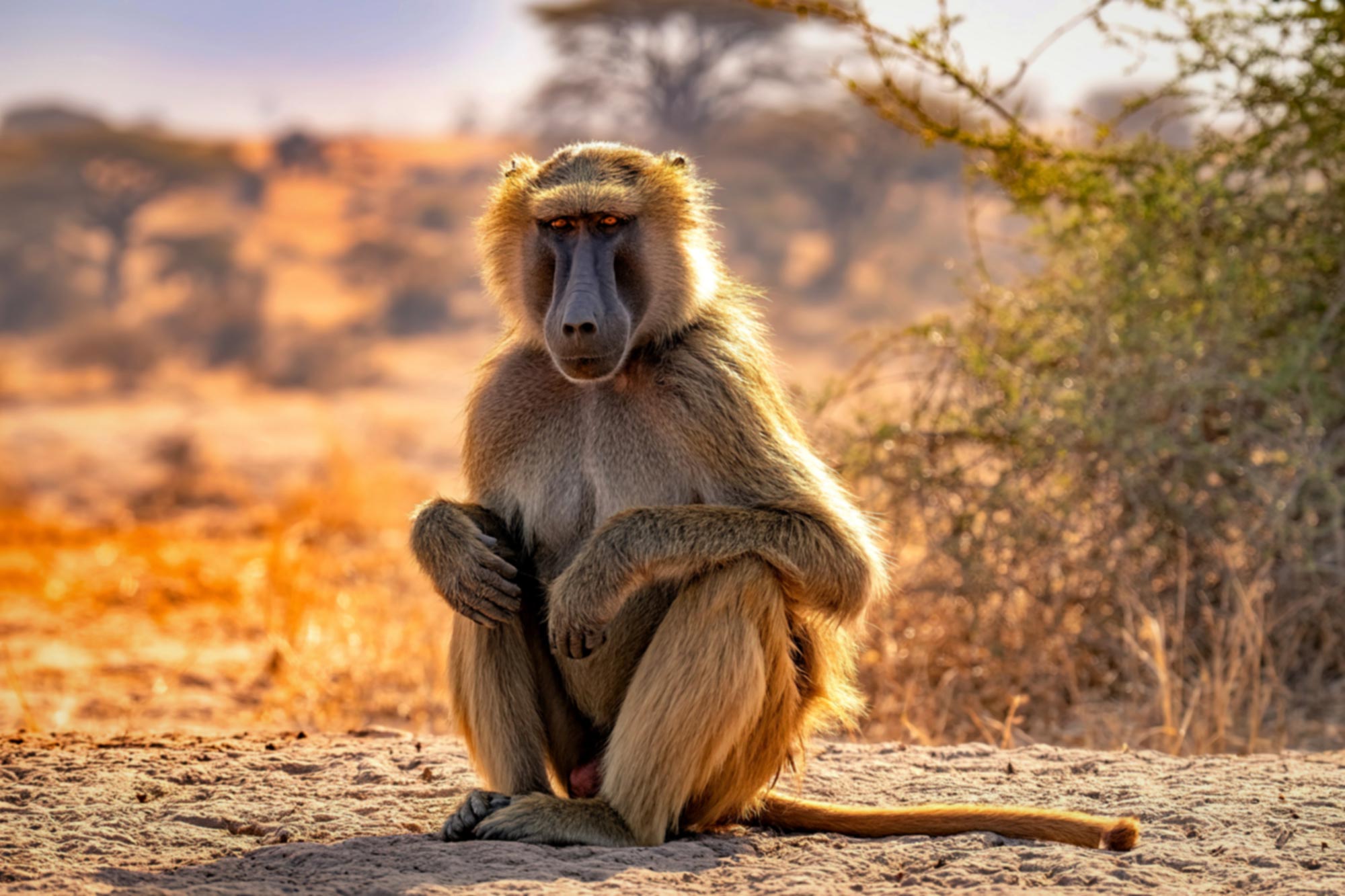 Baboons are highly adaptable primates known for their complex social structures, intelligence, and cooperative defenses against predators. Although adult males have long been considered too large for eagles to hunt, new evidence from the Sahara Desert is challenging this assumption. Credit: Shutterstock
Evidence of eagles hunting adult baboons suggests that aerial predators may have helped shape how early humans learned to communicate and protect one another.
In the middle of the Sahara, researchers have found evidence that eagles are killing primates as large as some of our early ancestors. One of the apparent victims, an adult male baboon, was estimated to have weighed more than 26 kilograms (57 pounds), challenging a long-held assumption about the dangers early humans faced.
Eagles have hunted primates for millions of years, yet no primate weighing more than 13 kilograms (29 pounds) had previously been confirmed to have been killed by a bird of prey. Scientists believed that humans and their ancestors had escaped this threat for roughly the past 2.5 million years because they were too heavy for even the giant eagles of the past to lift.
Talon marks reveal an unexpected predator
The discovery comes from the Ennedi Plateau in northern Chad, where an isolated population of baboons lives in the Sahara Desert. Researchers from the University of St Andrews traveled to the region with colleagues from Dartmouth College, the University of Konstanz, the Max Planck Institute of Animal Behavior, and African Parks.
Lead author Professor Catherine Hobaiter, from the School of Psychology and Neuroscience at the University of St Andrews, said, “This was such an extraordinary expedition, any primatologists dream! Some of the baboons there are so remote they rarely, if ever, see people, and so after a couple of days they ended up following us around—we were probably the most interesting thing they’d seen for a while!”
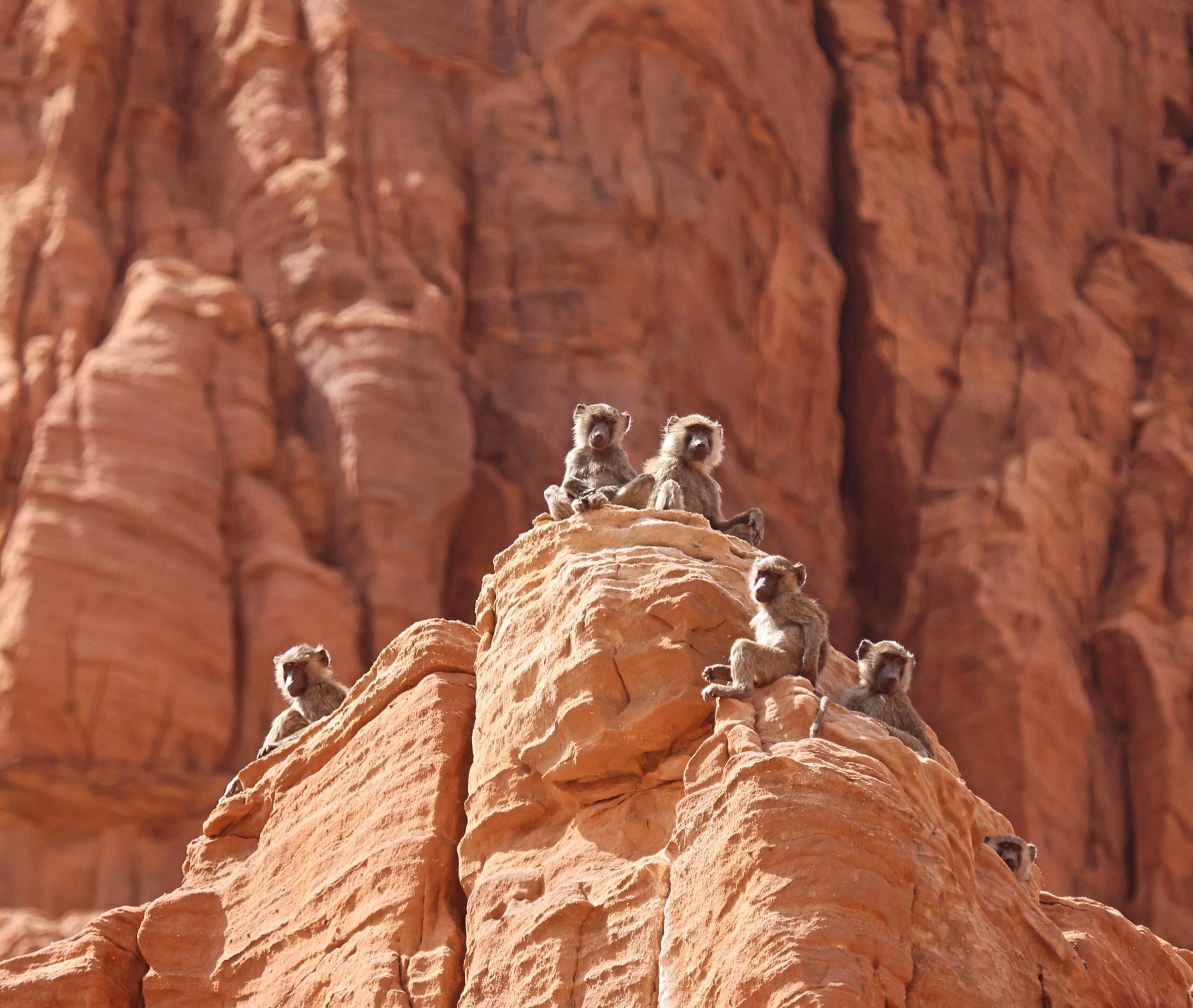 Young baboons in the cliffs of Ennedi. Credit: Catherine Hobaiter
She added: “We saw the eagles while we were searching for the baboons, but we never imagined that they might be a threat to them. Then we found the first skull with a puncture mark, and then another, and another.”
In a new study published in the American Journal of Biological Anthropology, the researchers describe finding the remains of adult male baboons with telltale signs of eagle predation, including talon punctures in their skulls and distinctive scrapes and rake marks on their shoulder bones.
Senior author Professor Nathaniel Dominy from Dartmouth College said, “At first, the idea of eagles hunting adult male baboons seemed to exist on the thin edge of possibility, until it didn’t. Our skepticism slowly gave way to acceptance. The evidence was convincing.”
The behavior of the living baboons offered another clue.
Professor Hobaiter explained, “One of the most exciting observations was seeing the baboons respond when a pair of Verreaux’s eagles swept overhead—primates are very specific about only responding to eagles that are a genuine threat. We’d seen them very relaxed around other big birds of prey, but as soon as the Verreaux came into view they alarm called and dropped down to safety.”
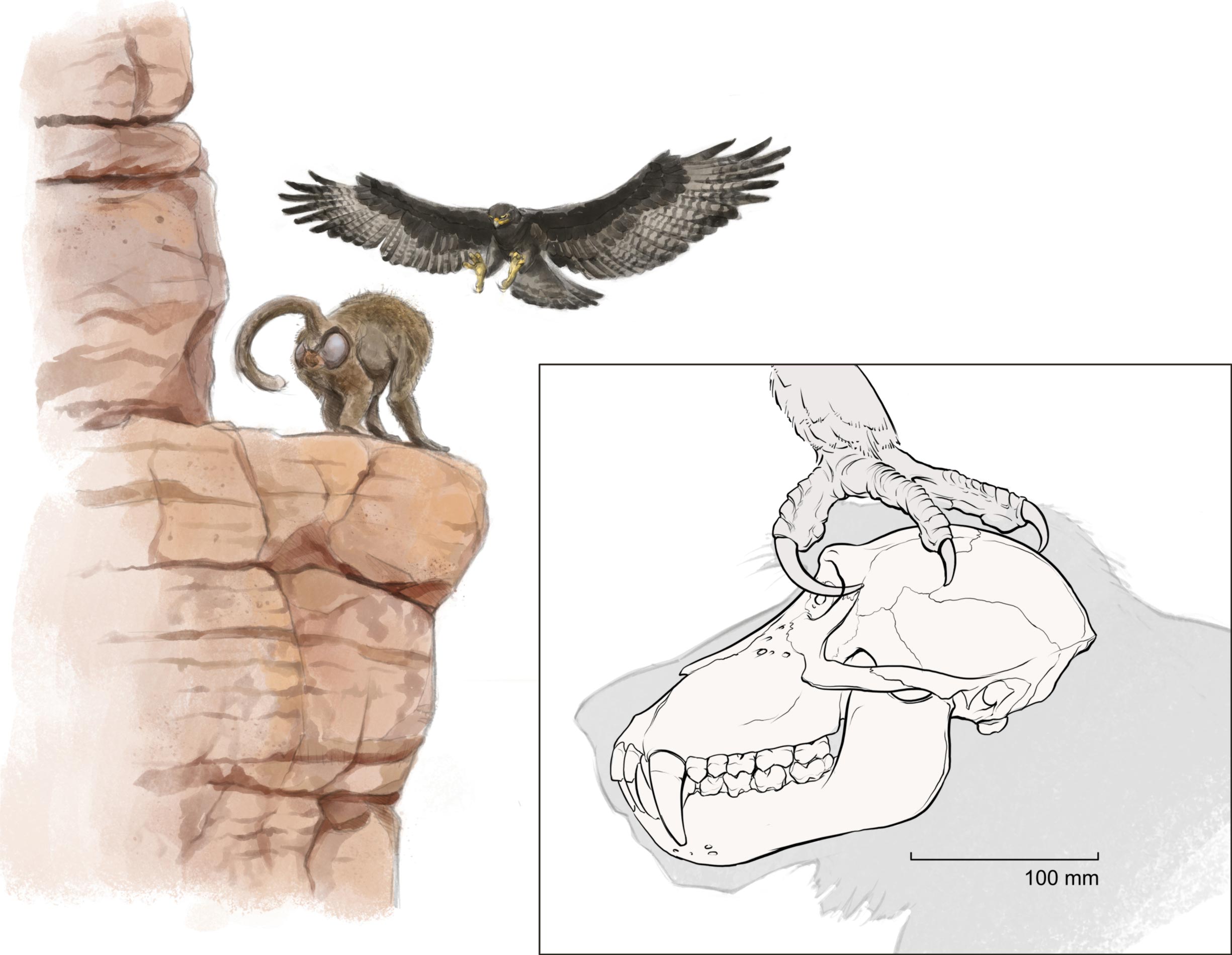 Hunting scene illustration of speculative face- off between an adult male baboon and Verreaux’s eagle, drawn to scale. Credit: Javier Lázaro (reproduction permitted: CC-BY-ND)
Could eagles have shaped human evolution?
For scientists studying human evolution, the possibility of attacks from above is particularly interesting. Primates defend themselves differently against eagles than they do against predators such as big cats and crocodiles. One strategy, known as mobbing, involves primates, particularly larger adult males, charging an attacker to drive it away. If our ancestors faced similar threats, eagles may have helped shape the evolution of communication and group cooperation.
Many primates living in areas where eagles hunt also travel in large groups alongside other primate species. For much of our evolutionary history, our ancestors shared their surroundings with other early human species and primates. Although these relationships are often viewed in terms of competition, protection from predators may have given them a reason to stay together.
Desert baboons defy scientific expectations
Dr. Gisela Kopp, from the University of Konstanz and the Max Planck Institute of Animal Behavior, said, “Primatology often focuses on regions with a high diversity of primates, but shifting our attention to a place where no primatological data has ever been collected before, proved to be extremely rewarding.”
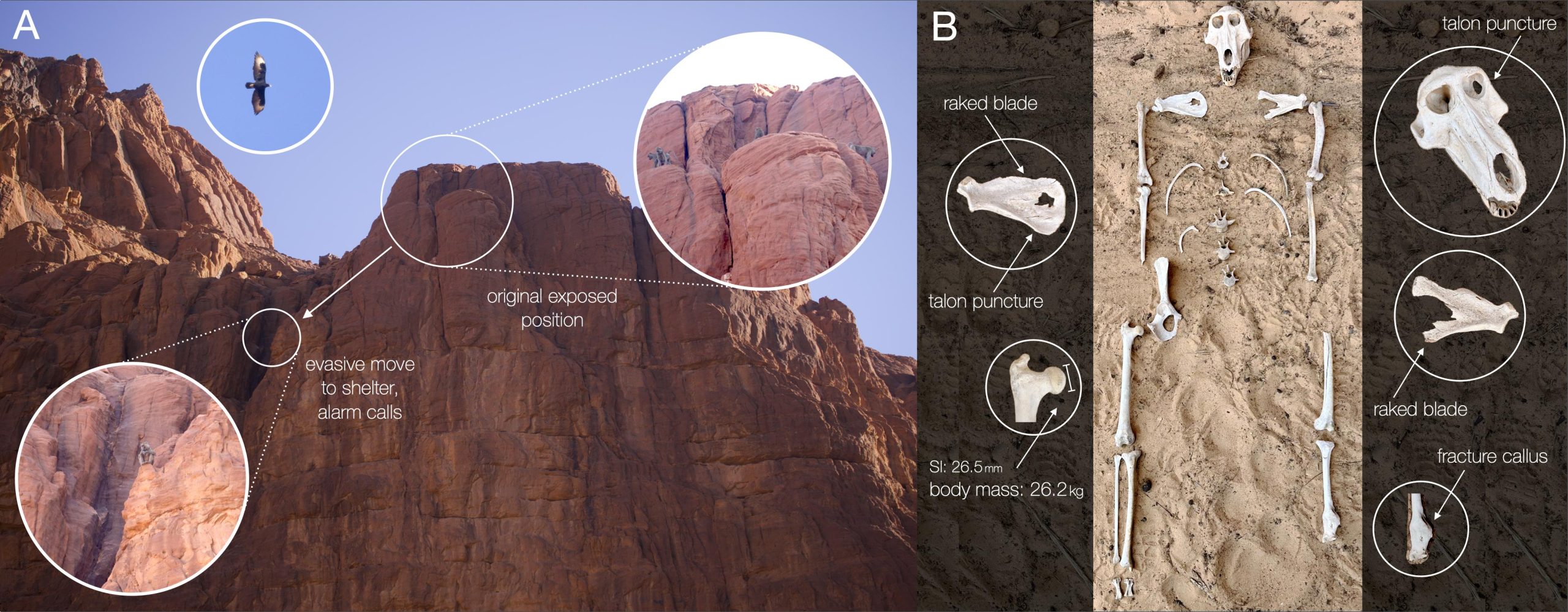 Figure from the paper describes an eagle baboon encounter and shows the bone markings associated with eagle predation. Credit: Catherine Hobaiter
Dr. Jean Didier Akpona, from African Parks, said, “Having worked in this region for about three years, I had the opportunity to visit these gueltas (pockets of water that form within rock formations) and often observed Verreaux’s eagles. I had never imagined that these predators would target primates of this size until the research team stumbled upon evidence. This discovery leads us to explore further the mystery that surrounds the gueltas of the Sahara Desert.”
The researchers are eager to continue studying the isolated baboon population, whose unusual lifestyle is already challenging several assumptions about the species.
Professor Hobaiter added, “Baboons are some of the best studied monkeys in Africa, but our very first observations from Ennedi upended all sorts of notions about what these baboons should be doing—from their diet to their social lives, I can’t wait to see what new ‘rules’ they’ll break next!”
Reference: “Signs of Eagle Predation on a 22-kg Adult Primate” by Catherine Hobaiter, Tewogbade J. D. Akpona, Gisela H. Kopp and Nathaniel J. Dominy, 18 November 2026, American Journal of Biological Anthropology.
DOI: 10.1002/ajpa.70377
This work was supported by the University of St Andrews (Global Partnerships Travel Grant), the Scottish Funding Council (International Science Partnership Fund), the Dartmouth College (Harris Distinguished Visiting Professorship program), the Marion and Jasper Whiting Foundation (Fellowship for Higher Education), the Rust Family Foundation; the Hector Stiftung II (Hector Pioneer Fellowship), and the Zukunftskolleg, University of Konstanz (ZENiT Fellowship, through the Federal Ministry of Education and Research (BMBF), and the Baden-Württemberg Ministry of Science as part of the Excellence Strategy of the German Federal and State Governments).
Never miss a breakthrough: Join the SciTechDaily newsletter.
Follow us on Google and Google News.




















 English (US) ·
 French (CA) ·
 French (FR) ·