

 3 months ago
305
3 months ago
305
PROTECT YOURSELF with Orgo-Life® QUANTUM TECHNOLOGY
Orgo-Life the new way to the future Advertising by AdpathwayEntering Albany by highway from the south, as a fleet of buses did in late February, requires weaving through a nest of interchanges between the city and its waterfront, then shuttling west along a series of dingy arteries, before emerging onto a plaza the New York Times once said looked more like “the planet Krypton than the capital of the state of New York.” The Empire State Plaza, as it’s called, does indeed seem like something from another world, or perhaps from several others. The Capitol building, a hulking castle of rough, dark stone capped with ruddy terra-cotta, sits at the north end of the square; the other three sides are lined with eleven anonymous, modern structures, a mix of squat blocks and slim vertical slabs, all sheathed in shining white marble, over forty thousand tons in total. This odd assemblage of vaguely sinister buildings looks down on three reflecting pools and one enormous oblong entity—a bizarre, six-story Brutalist construction known simply as the Egg, which officially serves as a performing arts center but resembles nothing so much as a newly landed UFO.
This Brasília on the Hudson, first opened to regular use fifty years ago this summer, was commissioned in the early sixties by the then governor Nelson Rockefeller, the philandering scion of the robber baron family, who funneled some two billion tax dollars into what he hoped would “symbolize the vitality of the state and its government.” In a way, it does—though primarily as a monument to Albany’s imperial power and baffling, byzantine inner workings. I’d arrived by bus that February morning for what was dubbed the Albany Takeover, the kickoff public event in a prolonged battle between New York’s various stakeholders over government revenue and where it would come from. New York City’s new mayor, Zohran Mamdani, had just cruised into office on a bold platform to expand public services, which he planned to fund primarily by raising taxes on large corporations and the ultra-rich. But the new mayor’s inauguration also marked the start of the state budget season—an arcane, monthslong process involving countless preliminary proposals, innumerable delays, and an annual begging ritual, evocatively known as Tin Cup Day, on which mayors from across the state schlep to Empire State Plaza to ask for funds.
Though New Yorkers ostensibly elect hundreds of legislators to make these sorts of decisions, the negotiations themselves are notoriously secretive—New York ranked dead last among all states for accountability and transparency in its budget process, according to a 2015 analysis by the Center for Public Integrity. Ultimately, all major decisions are made by a group known as the Three Men in a Room: the governor, Senate majority leader and Assembly speaker, the former two of whom are now, for the first time, women. One of those women, Governor Kathy Hochul, has been stalwart in her opposition to raising taxes—despite the hole that the Trump administration’s cuts has blown in the state’s finances—not least because she faces reelection this fall. The event that morning, a march and rally at Empire State Plaza, was the first in a series of efforts aimed at reminding the governor that polling consistently shows a majority of her constituents disagree. Much of the media seemed to take Hochul’s refusal as a foregone conclusion. But if nothing else, the site was a well-chosen locale for registering dissent. The Plaza—which has been called the most expensive government complex in American history—is a case study in the lengths to which New York’s leaders have gone to find gargantuan sums of money to enact wild new visions for the state.
Albany is a strange, dissonant city, whose architecture has long reflected its incoherence. It took nearly the entire second half of the nineteenth century to build the Capitol. One governor would spend a few years erecting a few stories in a particular architectural style before running out of money or being voted out of office. Then the next would choose a new approach for the subsequent few floors before himself being thwarted or replaced. The process repeated for decades before the gaudy monument to poor organization was finally cut off by Teddy Roosevelt in 1899. This left the building without a once-planned central tower and preserved it as an unusually disconnected design. Stained-glass skylights pierce the ceilings at odd intervals; palatial sandstone staircases spiral into apparent oblivion. One of them is carved with hundreds of faces, from U.S. presidents to the building’s own architects—a costly feat that earned it the nickname the Million Dollar Staircase.
After World War II, the thriving manufacturing hub of Albany’s golden years gave way to what the journalist Paul Grondahl described as “a shabby, dank and crumbling backwater … with about as much pizzazz as a Dutch wooden shoe.” Elected in 1958, Rockefeller must have been jarred by his move to the governor’s mansion at the heart of this sorry city—a far cry from Kykuit, his family’s decadent Hudson Valley estate. The surroundings would prove anathema to aspiring sovereigns. As the (perhaps apocryphal) story goes, when Princess Beatrix of the Netherlands came to visit the new governor, he took her on a convertible tour of the city. But he was so embarrassed for her to gaze upon an ethnic enclave known as the Pastures that he vowed to transform the neighborhood into a monument of grandeur that would rival even Versailles.
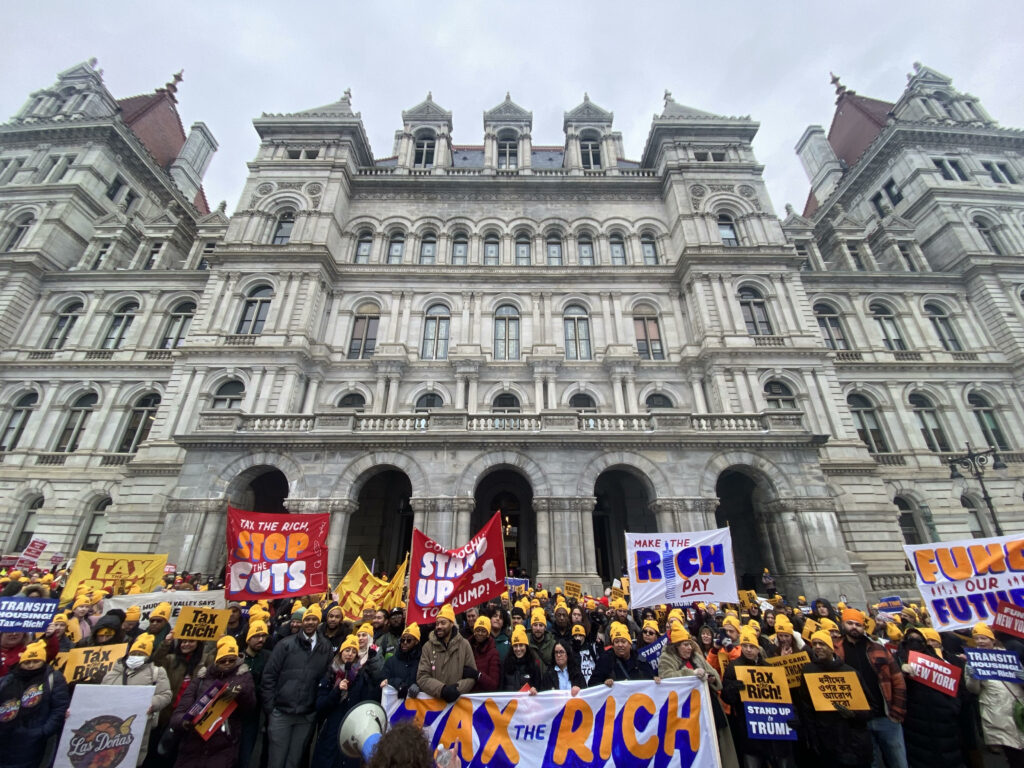
Albany Takeover, February 25, 2026. Photograph courtesy of Charlie Dulik.
But as the musician and historian Lo Faber theorized in his treatise on the plaza, “Rocky’s Last Erection,” Rockefeller had likely been planning the overhaul long before then. The dilettante had once thought “seriously of becoming an architect—possibly a fine one,” per a letter he’d written to his family during college. But in practice, this interest became what “Rocky” called his “edifice complex”: an obsession with building, which had already yielded Rockefeller Center, the United Nations headquarters, and five new campuses for the new state university system. Not long after Rocky began reimagining Albany’s central plaza, he would join up with his brother, David, to raise the World Trade Center.
The project he had in mind for Albany was going to be a massive expense, at least two hundred and fifty million on the low end—a sum that, per state law, required both legislative approval and a ballot referendum. The public, however, was unlikely to get on board for an undertaking that would seize several neighborhoods’ worth of land, evict its residents, and lay waste to more than a thousand buildings. The city’s longstanding mayor (and Rockefeller’s boyhood yacht-club rival), Erastus Corning 2nd (his preference over “II”), slammed the project as “something that might be expected of a dictatorship,” that would “look most spectacular on postcards” but “in fact, hurt the people of Albany.” Unable to convince the state’s electorate to approve the necessary funding, Rockefeller instead managed to get the legislature to sign off on a smaller sum in the name of “slum clearance.” They gave him just a fraction of the cost—twenty million dollars to seize some hundred acres of land at the center of the city and begin razing the area.
Almost overnight, more than seven thousand residents found themselves with neither homes nor community institutions; three hundred and fifty businesses, four churches, and twenty-nine bars were shuttered. As evicted Albanians scattered across the metro area (Rockefeller vetoed a housing project for displaced residents), the state struggled to make progress. The twenty million dollars it had allocated was barely enough to cover the demolition and groundbreaking. To fund the rest, Rockefeller finagled a financing scheme through Albany County and its political machine, a patronage mill tightly controlled by Corning. The county, less responsive to democratic input, would issue bonds far beyond state debt limits, and lease the land back to the state. In return, for the next forty years, the state paid the county rent on the new buildings in an amount equal to the cost of retiring the bonds, before finally assuming control of the Plaza in 2001. Corning, once a stalwart opponent of the development, flipped upon realizing an opportunity for historic graft. He insured the property through his own company, deposited the bonds in a bank at which he served as director, and arranged a process by which excavated land was used to fill a ravine he owned, leveling it out for development. On his deathbed, the tallest tower in the complex—and in the state, outside of New York City—was renamed for him.
Rockefeller, a son of near-infinite wealth, concerned himself less with accounting and more with aesthetics, where his influences were as diverse as his power was unchecked. It was Rockefeller who supposedly designed the Egg, inspired at breakfast one morning to place a half-grapefruit on top of a small pitcher of cream. (In another version of the story, per the Times Union, he was looking at an egg, which he “laid sideways in an egg cup.”) He pushed architects to design one of the office buildings as an International Style interpretation of Pharaoh Hatshepsut’s temple in Egypt. He draped the atrium of the Legislative Office Building, known as the Well, in green marble; he decorated one end with a sixty-foot abstract relief of writhing figures and the other with a shimmering waterfall. In a rare loss, his dream of a monumental arch across the plaza was scrapped. What connects these disparate designs more than any particular visual theme is an aesthetic language of domination, stripped to its barest elements.
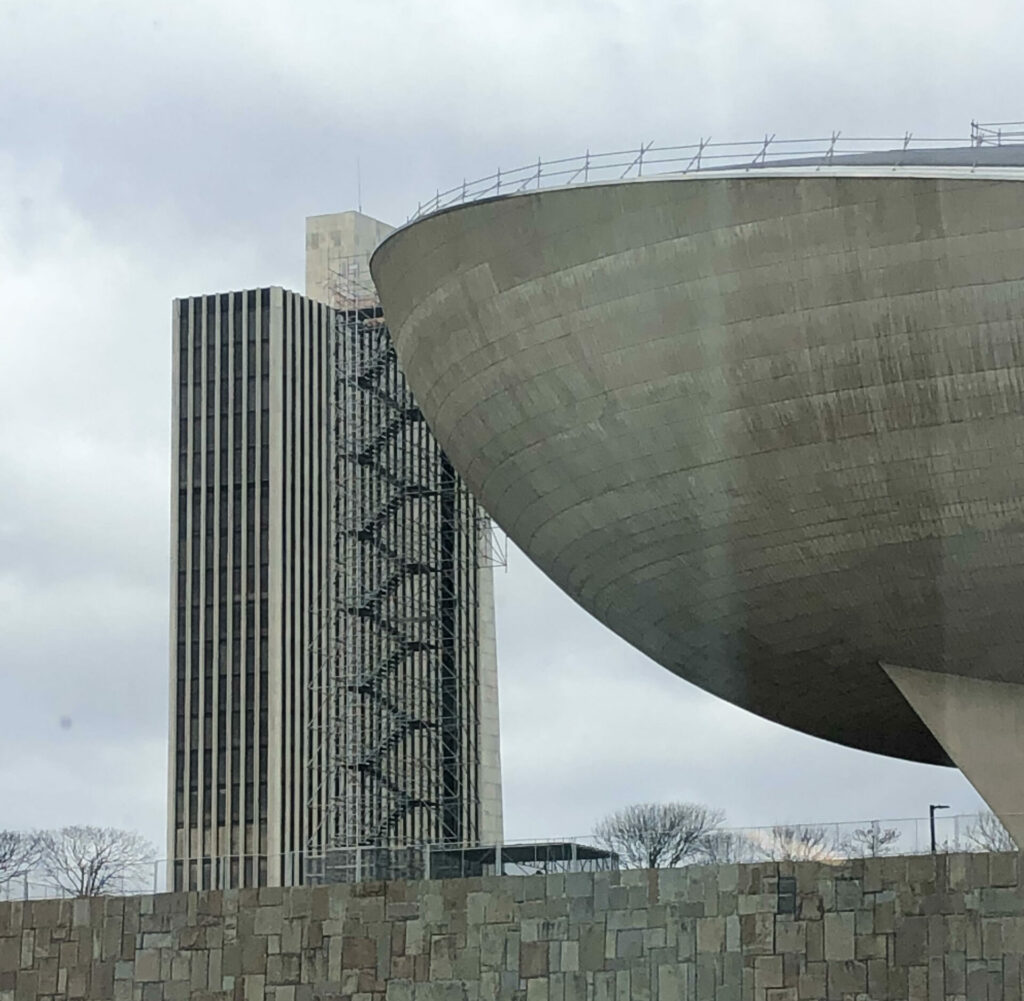
The Egg, 2026. Photograph courtesy of Charlie Dulik.
The plaza is also connected in a less visible sense—by a network of underground tunnels spanning just under two miles. These interiors, like those of the Well, were where Rockefeller granted the otherwise spare complex some ornamentation. The governor had mandated that it serve as a showcase for modern art, and he funneled some $2.6 million into what art historians have called “the greatest collection of modern American art in any single public site that is not a museum.” The tunnels, which now hold McDonald’s and Auntie Anne’s in between Rothkos and Pollocks, provide such efficient paths for travel that the aboveground square lies mostly empty, barren but for days with large protests, like the one that brought me to town in February.
At the time of publishing, the state’s budget is several weeks overdue. (Hochul has never passed a budget on time, and averages about a three-week delay each year.) Weeks after the Albany Takeover, however, the governor blinked in the face of public pressure and agreed to back a tax on second homes in New York City worth more than five million dollars. (In further architectural intrigue, the State Assembly is currently holding out for one million dollars to renovate their private lounge.) The pied-à-terre tax aims to raise half a billion dollars yearly—not an amount to sneeze at, but only a fraction of the city’s overall budgetary needs. The coming weeks (and years) will reveal if New York City’s young executive will be able to leverage an initial trickle of money into a flood of funding. As I left Albany, I looked out the bus window in the dwindling daylight and caught my final glimpses of Empire State Plaza and the Capitol. If the day’s journey imparted any lesson, it’s that in Albany, there’s always a way of finding money for what’s deemed important, no matter how much it clashes with what’s standing in the way.
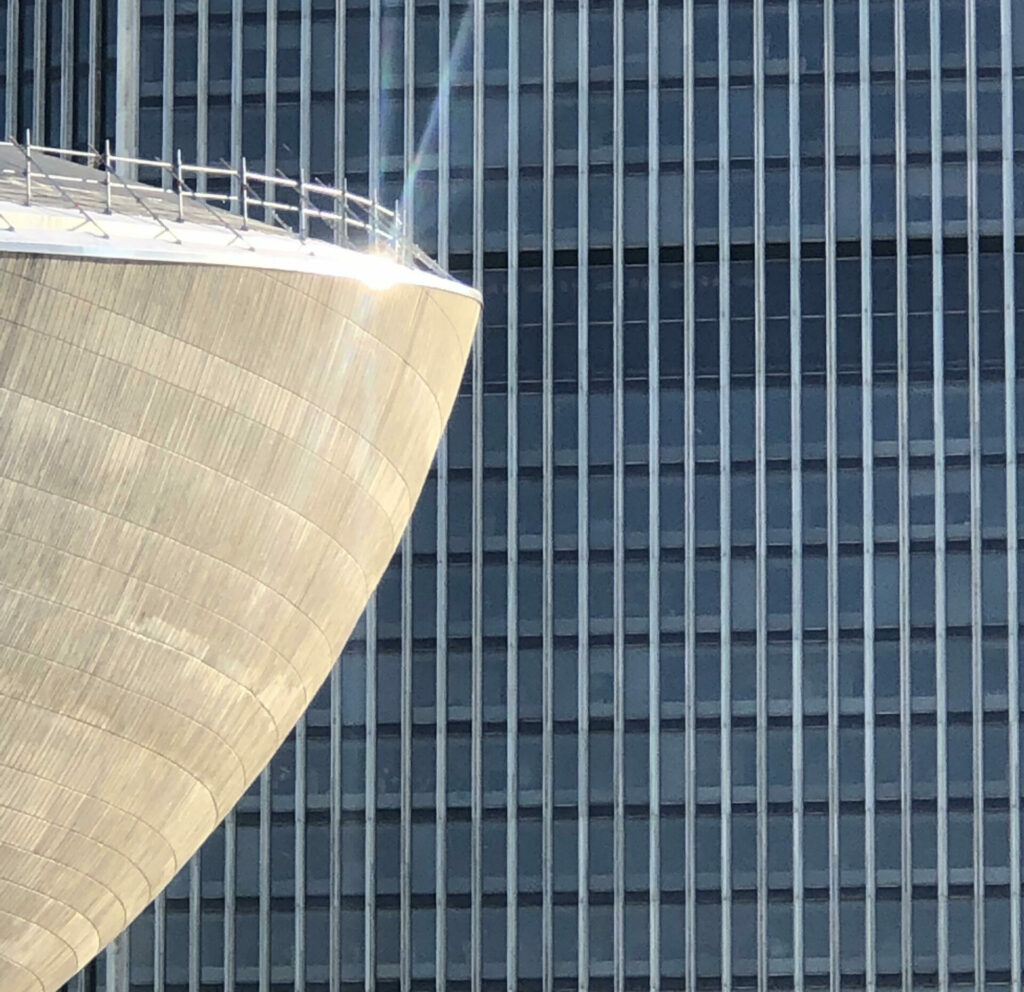
The Egg, 2019. Photograph courtesy of Charlie Dulik.
Charlie Dulik is a tenant organizer in New York City.















 English (US) ·
  French (CA) ·
  French (FR) ·