

 3 months ago
33
3 months ago
33
PROTECT YOURSELF with Orgo-Life® QUANTUM TECHNOLOGY
Orgo-Life the new way to the future Advertising by AdpathwayAs someone immersed in competitive gaming, I’ve seen how important the esports broadcasting and casting ecosystem is. While players focus on mechanics and strategy, broadcasters and casters bring the excitement to audiences worldwide. Commentary can elevate tournaments, help players gain recognition, and even shape careers. In this section, I’ll cover how broadcasting works, the roles involved, and what skills are critical for success.
You can open Table of Contents show
Understanding Broadcasting and Casting Roles
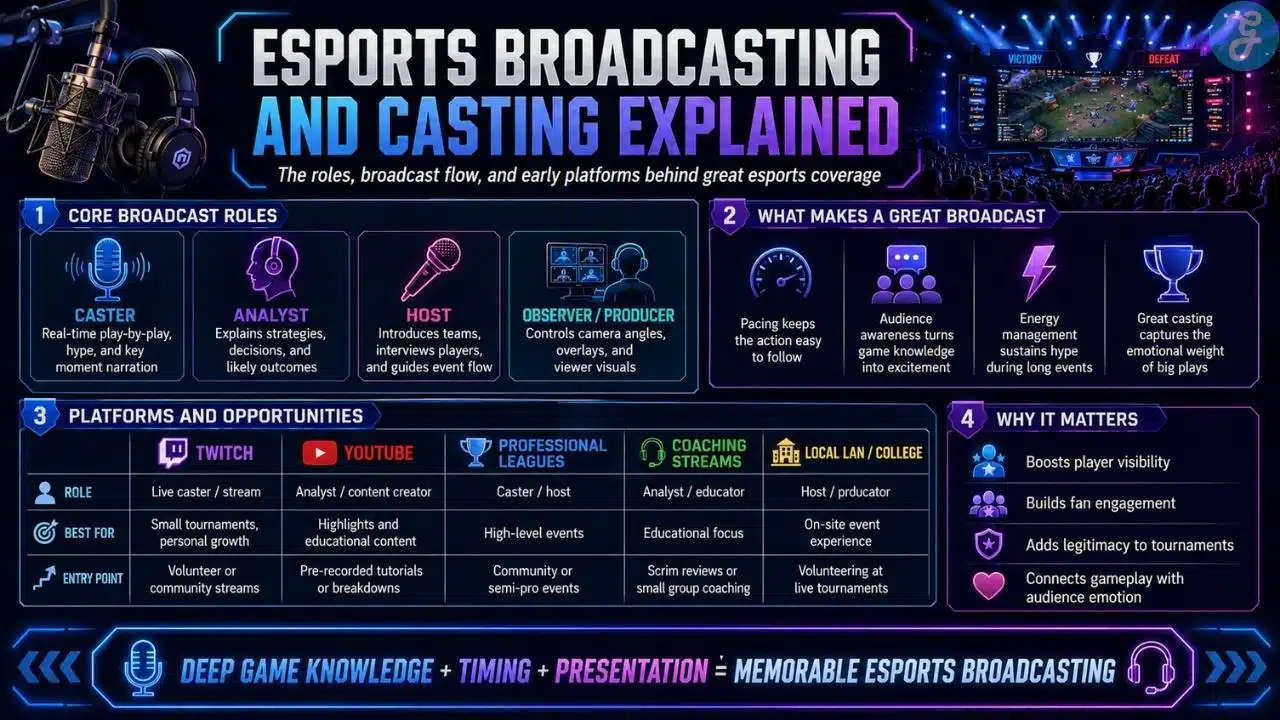
Broadcasting in esports isn’t a single role. From my experience, several positions work together to deliver a smooth, engaging experience:
-
Caster: Provides real-time play-by-play narration and highlights key moments.
-
Analyst: Breaks down strategies, explains decisions, and predicts in-game outcomes.
-
Host: Introduces teams, interviews players, and maintains event flow.
-
Observer/Producer: Controls camera angles, overlays, and visuals for viewers.
Knowing these roles helps aspiring broadcasters or players understand the structure of esports events. Moving past the job titles, the actual execution on the microphone requires a completely different level of talent.
The Magic on the Mic: What Makes a Great Broadcast
You can have all the game knowledge in the world, but professional casting requires mastering pacing, audience awareness, and raw energy management. When done right, a caster does not just explain the game; they become part of its history.
I will never forget sitting in the crowd during the grand finals of a major tournament a couple of years back. Our hometown underdogs were down to a literal sliver of health against the reigning world champions, backed completely into a corner. The stadium was dead silent until our mid-laner pulled off an impossible, pixel-perfect counter-engage.
Right at that exact second, the play-by-play caster’s voice cracked from absolute hype, screaming, “They have stood up to the gods, and the gods are bleeding!”
The absolute explosion from the crowd gave me full-body goosebumps. That moment made me realize that great casting is not about dryly stating what is happening on screen, because its true purpose is capturing the emotional gravity of the play and transferring it directly into the lungs of the audience.
Finding the right platform to practice that kind of delivery is where the real journey begins.
Platforms and Opportunities
The esports broadcasting and casting industry offers multiple career paths, from freelance commentary to full-time team positions. I’ve seen aspiring casters succeed by combining online and offline opportunities.
Choosing a platform depends heavily on your experience, target audience type, and the specific level of exposure you want to hit early on.
| Platform / Organization | Role | Best For | Entry Point |
| Twitch | Live caster/stream | Small tournaments, individual growth | Volunteer or community streams |
| YouTube | Analyst / content creator | Highlights, educational content | Pre-recorded tutorials or breakdowns |
| Professional Leagues | Caster / host | High-level events | Community or semi-pro events |
| Coaching Streams | Analyst / educator | Educational focus | Scrim reviews or small group coaching |
| Local LAN / College | Host / producer | On-site events | Volunteering at live tournaments |
Once you map out where you want to start, the broader benefits of stepping behind the microphone quickly become clear.
Benefits of Working in Broadcasting
From my own perspective, entering broadcasting provides:
-
Direct engagement with the esports community.
-
Networking with teams, players, and sponsors.
-
Insight into professional tournament environments.
-
Opportunities for career growth into content creation or team roles.
-
Development of communication and analytical skills.
Starting Your Broadcasting Journey
I always advise beginners to start small and grow experience gradually:
-
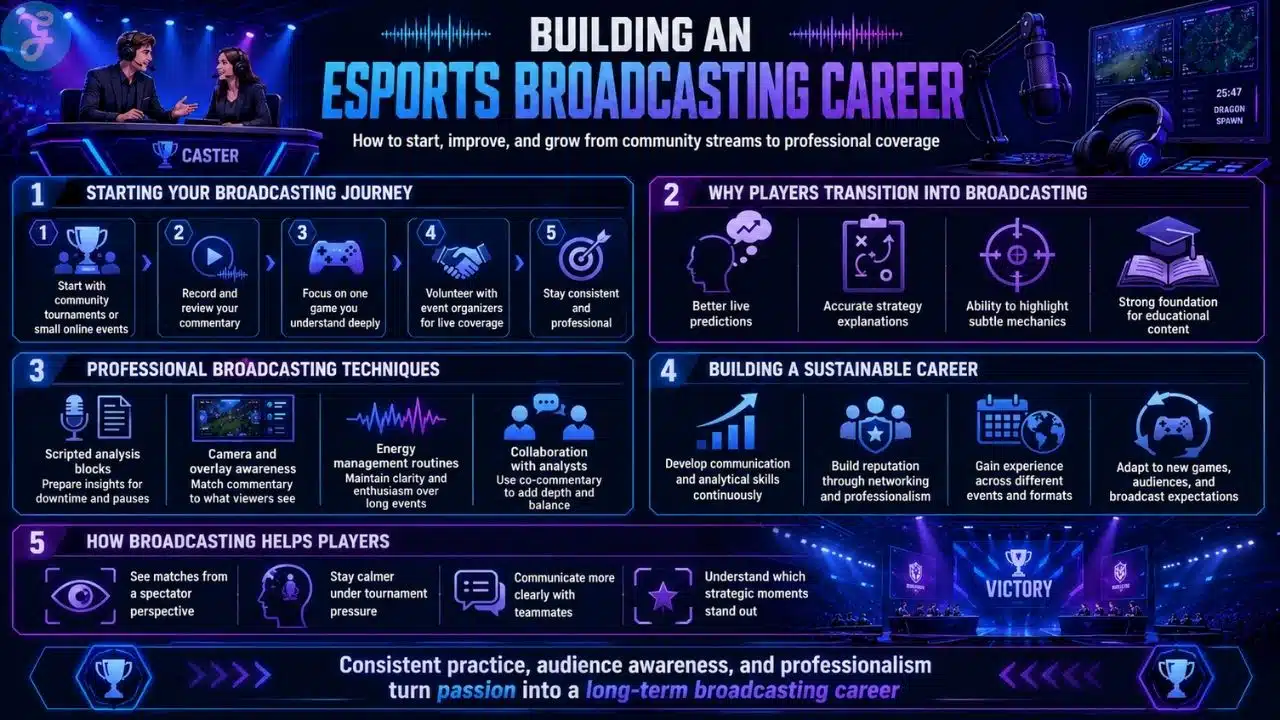
Begin with community tournaments or small online events.
-
Record and review your commentary to improve timing, clarity, and insight.
-
Focus on a specific game you know deeply.
-
Volunteer with event organizers for live coverage.
-
Maintain consistency and professionalism to build credibility.
Transitioning From Player to Broadcaster
Many players transition into broadcasting because understanding the gameplay deeply makes analysis and commentary easier. Being a player helps with:
-
Providing predictions during live matches.
-
Explaining strategies accurately to viewers.
-
Highlighting subtle mechanics.
-
Creating educational content for other players.
Advanced Techniques for Professional Broadcasting
Professional broadcasters refine their craft using methods such as:
-
Scripted analysis blocks: Preparing insights for downtime in matches.
-
Camera and overlay awareness: Aligning commentary with visuals effectively.
-
Energy management routines: Maintaining focus and enthusiasm for multi-hour events.
-
Collaboration with analysts: Enhancing broadcast quality with co-commentary.
These practices ensure that broadcasts are engaging, informative, and professional.
Why the Esports Broadcasting and Casting Industry Matters
The esports broadcasting and casting field is essential for the growth of the industry. Quality commentary increases player visibility, builds fan engagement, and legitimizes tournaments. From my perspective, broadcasts also help players understand how the game is perceived by viewers, which can improve their own competitive performance.
Building a Sustainable Broadcasting Career
A long-term career in broadcasting requires:
-
Continuous development in communication and analytical skills.
-
Networking and reputation management.
-
Experience across different tournaments and events.
-
Adaptability to new games, formats, and audience expectations.
By following these practices, I’ve seen up-and-coming talent evolve from messy community streams all the way to professional league coverage, proving that consistent effort and passion are the keys to longevity in the field.
Applying Broadcasting Insights as a Player
Even as a competitive player, understanding broadcasting and casting has improved my gameplay. It helps me:
-
Recognize how matches are interpreted by audiences.
-
Stay composed under high-pressure tournament conditions.
-
Communicate more effectively with teammates.
-
Understand the strategic elements emphasized during commentary.
Final Thoughts on Esports Broadcasting and Casting
Mastering esports broadcasting and casting is about combining deep game knowledge with communication, timing, and presentation. Whether you aim to be a caster, analyst, or host, structured practice, audience awareness, and professionalism make the difference. From my experience, learning the nuances of broadcasting also makes you a smarter player, as you start seeing the game from both a competitor’s and a spectator’s perspective.













 English (US) ·
  French (CA) ·
  French (FR) ·