

.png) 9 hours ago
7
PROTECT YOURSELF with Orgo-Life® QUANTUM TECHNOLOGY
Orgo-Life the new way to the future Advertising by AdpathwayAt the Monroe County detention center on Stock Island in the Florida Keys, most of the prisoners do the type of work you’d typically imagine people doing in jail. Preparing meals in the kitchens, cleaning the common areas, working in the laundry, and so on.
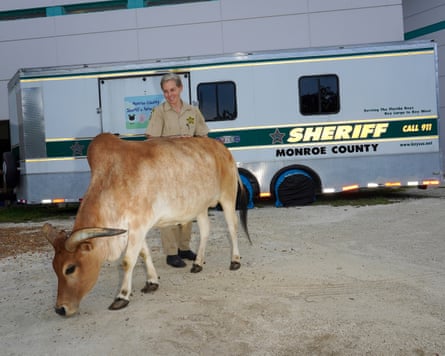
But for about five prisoners at a time the work looks a little more exotic. They’re working in the jail’s on-site zoo, taking care of animals including a capybara, a kinkajou, a zebu and an ostrich.
The zoo was started in 1994, after a sheriff’s deputy noticed that ducks living near the jail were often getting hit by cars while crossing a highway. He gathered a group of prisoners and relocated the flock to a disused area beneath the jail, which sits on stilts as it is in a hurricane-prone area.
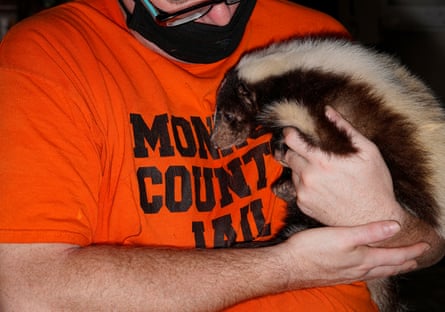
Word of the rescue spread, and people started showing up at the jail to drop off rescued or unwanted animals. “People started bringing in a goat, a pig, a cow, pets they’d gotten that they didn’t want or couldn’t keep,” said Jeanne Selander, the zoo’s supervisor. “We got a blind horse from the Miami area that had been abandoned, and then the sheriff thought, ‘Well, there’s a need for this.’”
The Monroe County detention center is the only correctional facility in the world with its own zoo. There was, briefly, another one. In Venezuela, a gang took over a prison and installed various resort-style amenities for the prisoners, including a pool, night club, and a zoo, with big cats, monkeys and flamingoes. But the Venezuelan government forcefully retook control of that prison a few years ago. Several of the zoo’s animals were reportedly killed in the battle for the prison and the ones that survived were relocated.
-
Jeanne Selander, the supervisor of the zoo at the Monroe County detention center, with Thunder the Zebu in September 2026
-
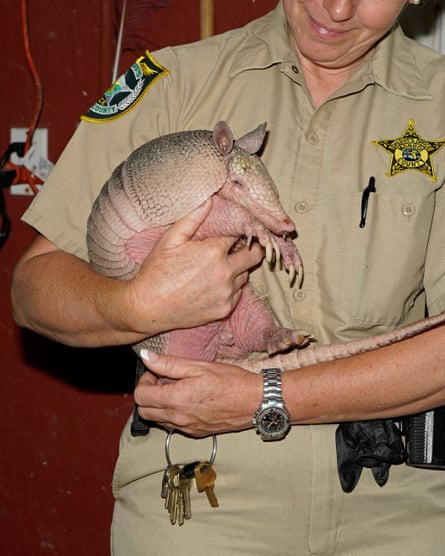
Selander holds an armadillo in November 2021
According to Selander, all of the animals in her zoo were either rescued, donated or confiscated. Rocky the fox was rescued from a fur farm in Minnesota. Jack the ostrich was donated as a tax write-off by a breeder that was unable to sell him because he’s blind in one eye. Harriet Houdini, a red-tailed boa constrictor, was donated by a school after the teacher that kept her as a class pet retired. “I had some alligators one time that came from a raid on a crack house,” said Selander.
-
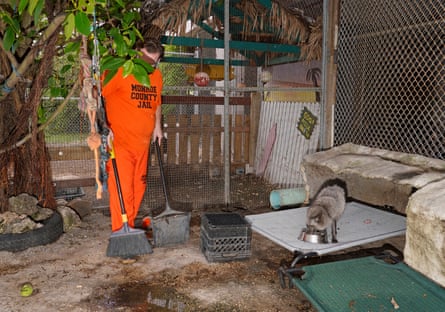
A prisoner cleans out the fox enclosure at the Monroe County detention center in July 2021
But the zoo doesn’t accept all of the animals it is offered. Selander said she previously declined a camel and a bear as they presented too much of a risk to the residents.
You are unable to see the zoo from the inside as the building’s windows are frosted. Selander said that, when she is upstairs in the jail, the prisoners will ask her about the sounds they can hear coming from outside. She has been told that, from inside the jail, the peacock can sound like a woman screaming.
-
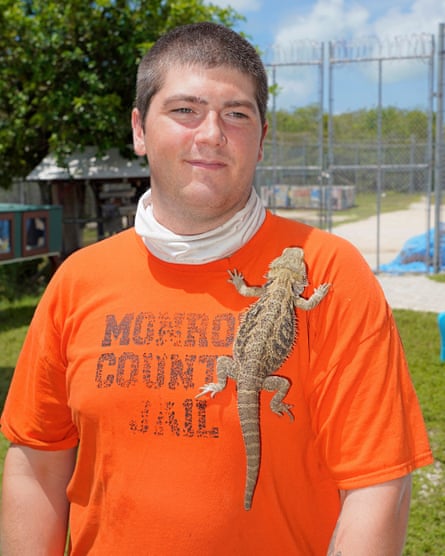
Peter Faraco looks after a lizard at the zoo back in 2021, when he was serving his sentence.
The prisoners that work on the zoo spend around six hours a day feeding and cleaning the animals, and performing maintenance tasks. Those selected are typically low-level offenders and are not allowed to have charges for violence or animal abuse. “It’s kind of hard to get down [to the zoo] because if you have a high bond or you’re in any way shape or form a risk to run away, they’re not going to let you come outside,” said Peter Faraco, a former inmate who worked on the zoo in 2021.
Inside the jail, prisoners sleep on concrete bunk beds with no pillows. “Stuck in them cells all day, or in the kitchen; it’s not that nice,” said Rodney Cox, who previously worked on the zoo. “There’s no air.”
-
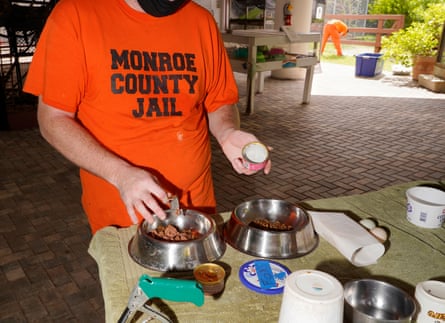
A then-inmate prepares food for the foxes at the on-site zoo of the Monroe County Detention Center in July 2021
Boredom is also an issue. “It’s a lot of time,” said Nicholas Sheldrake, a current inmate who is working in the zoo. “It’s just very boring. Watching the same TV shows and movies over and over, hoping a football or baseball game or something comes on.”
The zoo offers a respite for the prisoners that get to work there. “I love it down here,” said Sheldrake. “It makes my time go by fast. Nobody bothers me. I love working with the animals and talking to them.”
-
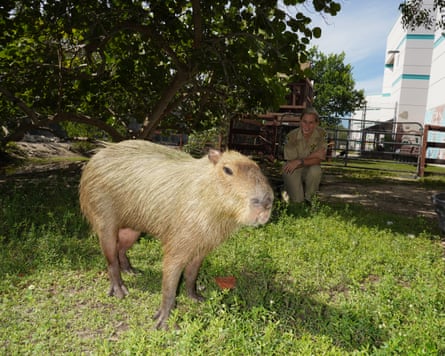
Selander in the enclosure of Simon the capybara in September 2026
“And we can see stuff like birds and trees,” he added.
It is important to Selander that the zoo not look like it is part of a jail, as she hopes to make it appealing to visitors on the zoo’s regular open days. She has planted trees around the property, and had inmates paint murals of animals on the walls and support pillars. “People will come in, they’re like, ‘You don’t even realize you’re at a jail,’” she said.
-
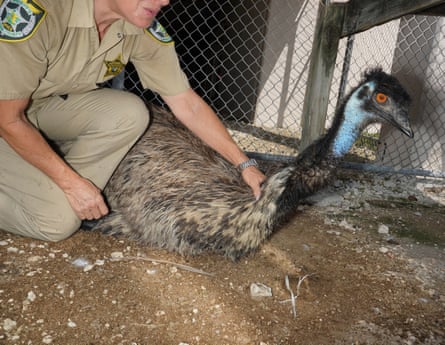
Selander strokes Kramer the emu in September 2026. The emu is named due to his resemblance to the Seinfeld character
In the 20 years she has worked there, she said, the number of visitors on open days has grown from about a dozen to more than 300.
Studies have shown that access to animals can have a positive effect on incarcerated people, leading to improvements in mental health, as well as a decrease in reoffending after release.
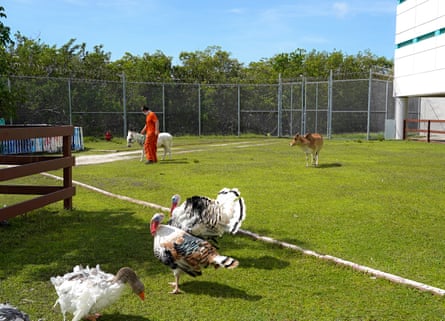
-
Peter Faraco, a then-inmate in the Monroe County detention center, with several animals in the jail’s on-site zoo in July 2021
There are animal programmes of various kinds in prisons around the world. There are prisoners in Chile living alongside cats, and in New Zealand training service dogs, and in the UK receiving equine therapy, and in South Africa raising birds. Selander said that she believes working on the zoo has had a positive effect on the prisoners she has worked with, and has, over the years, received positive feedback from her workers.
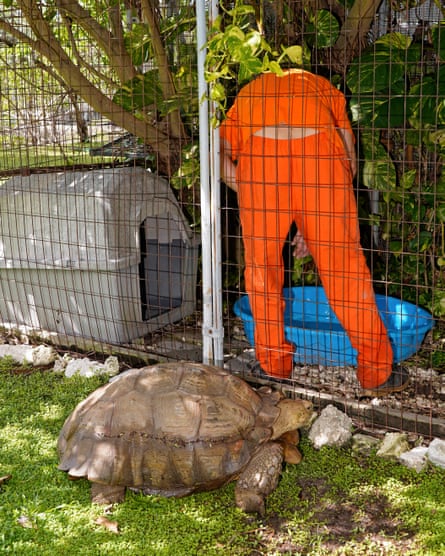
-
Albert, an African spurred tortoise, wandering the grounds of the zoo.
She was recently out for brunch and her server was a man who’d worked at the zoo. “He was like, ‘I wanted to thank you, Miss Jeannie … Being able to be on the farm and have peace while I served my time just made it so much easier,’” she said.
Selander said that it’s not uncommon for former incarcerated zoo workers to come back and visit during open days to see the animals. Some will bring their family members. “One of the greatest compliments is that the inmates want to come back to visit,” she said. “What a compliment. Who wants to come back to jail?”














 English (US) ·
 French (CA) ·
 French (FR) ·