

 2 months ago
30
2 months ago
30
PROTECT YOURSELF with Orgo-Life® QUANTUM TECHNOLOGY
Orgo-Life the new way to the future Advertising by Adpathway6 min readNew DelhiUpdated: Jul 23, 2026 03:38 PM IST
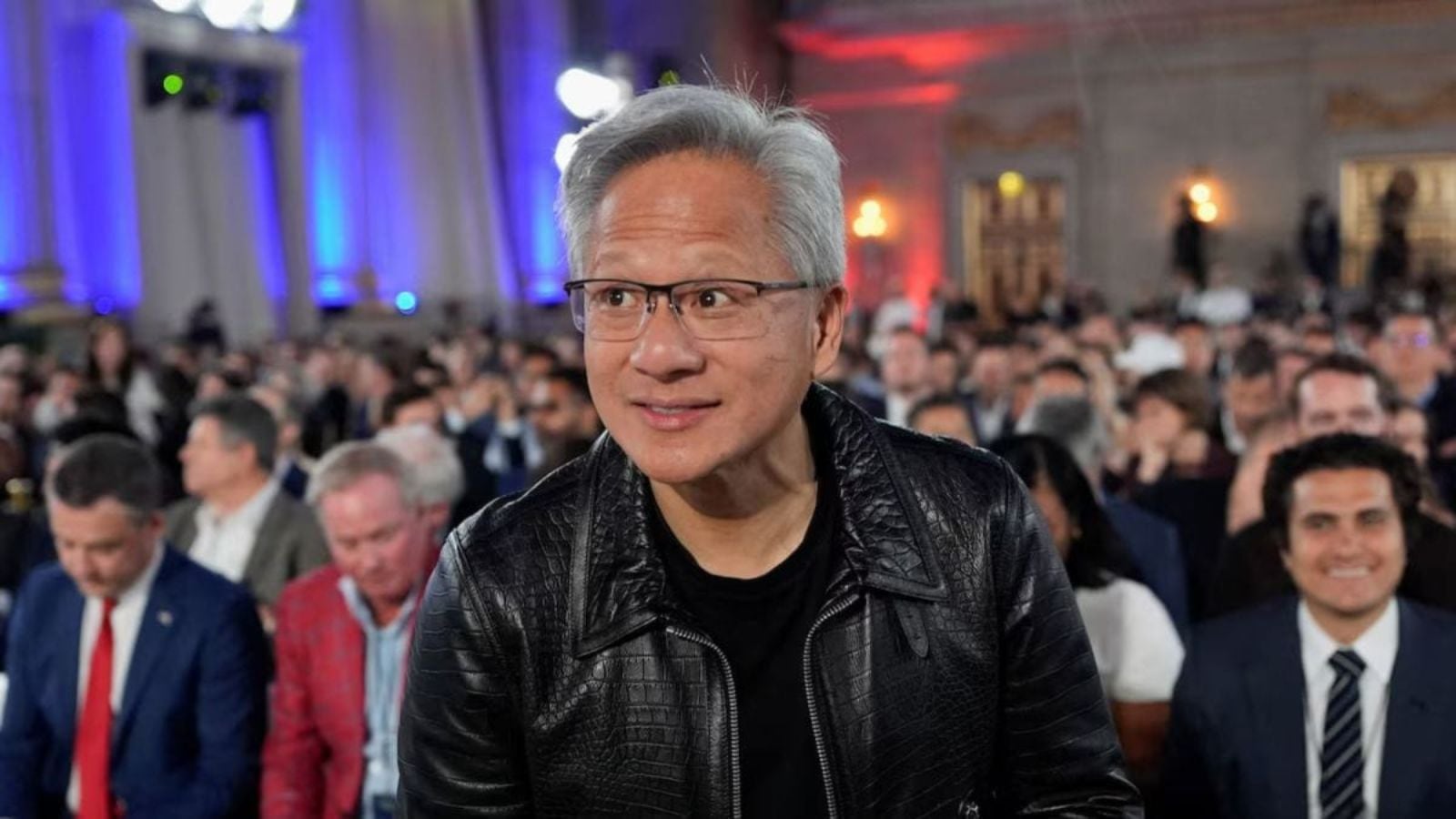 Nvidia has its own family of Nemotron models developed in-house and made open-weight. (Image: Reuters)
Nvidia CEO Jensen Huang has joined a growing chorus of US tech leaders backing open-weight AI models, arguing that developers should be free to use them, including those released by Chinese AI companies.
“These Chinese models are excellent. Open-source models that are excellent should be used,” Huang was quoted as saying in an interview by Axios. Huang’s argument is that cheaper and more accessible models could lead to broader adoption which ultimately drives up demand for chips that Nvidia provides as well as data centres.
“Free AI should be great for hardware. Free AI should be great for chips. Free AI should be great for data centers,” he added.
However, the recent remarks from the CEO of a company that has possibly been the biggest beneficiary of the generative AI boom stand in sharp contrast to what the Trump administration is considering.
Michael Kratsios, a top Trump administration tech official, on Wednesday, July 22, accused Chinese startup Moonshot AI “stealing proprietary US technology and undermining American research” to develop Kimi K3, an open-weight LLM that is said to achieve performance on par with leading AI models from US rivals such as Anthropic and OpenAI.
Notably, US Treasury Secretary Scott Bessent said on Wednesday in a separate post on X that he was considering adding Moonshot AI to a trade blacklist and imposing sanctions on it.
The new wave of Chinese open-weight AI models are not only challenging US-developed, frontier AI models on performance but also reportedly undercutting them on cost. Moonshot AI’s Kimi K3 for instance, is priced at $3 per million input tokens and $15 per million output tokens. As a result, over 30-46 per cent of enterprise token usage on Chinese open-weight AI models is by US businesses via LLM gateway platforms such as OpenRouter, according to a report by CNBC.
Story continues below this ad
Unlike Claude Fable 5 or GPT-5.6 Sol, the weights of models like Kimi K3 and GLM 5.2 are freely available for outside developers and companies to download from platforms such as Hugging Face, modify and deploy them on their own servers. For context, Nvidia has its own family of Nemotron models developed in-house and made open-weight.
On the potential security threats posed by Chinese open-weight models, Huang dismissed such concerns and said that companies can customise those models and run them inside secure environments given that they are released under an open-source licence. He added that openness makes AI more secure because outside researchers can inspect models and identify weaknesses.
“If everything just becomes one single model, one single point of attack, one single source of failure, I think the world is much, much more vulnerable,” Huang further said. While he believes that AI companies should face consequences for violating privacy or contracts, he also said, “Distillation, learning from AI, learning from other sources of knowledge, is fundamental to intelligence.”
This is not the first time Huang’s stance on an AI-related issue has significantly differed from the position of the US government. In the past, the prominent tech leader has been vocal in his opposition to Washington’s tightening restrictions on advanced AI chip exports to China for fear that it would only accelerate Beijing’s push toward semiconductor self-sufficiency while US companies are forced to concede the market to local chipmakers such as Huawei.
Story continues below this ad
To be sure, Huang continues to favour US companies over Chinese firms in the AI race. “There’s no scenario where China runs US companies off the road,” he said.
What other tech CEOs have said
In the past few weeks, Coinbase CEO Brian Armstrong and Airbnb CEO Brian Chesky have publicly spoken about their companies’ use of Chinese open-weight AI models such as Kimi, Z.ai’s GLM-5.2, and Alibaba’s Qwen.
Even OpenAI president Greg Brockman recently acknowledged that Beijing-based Moonshot AI had developed a competitive new AI model. “It’s a pretty good model. There’s no question about it,” Brockman said in an interview on Tuesday, July 21, according to a report by Bloomberg.
When asked whether Moonshot AI may have illicitly extracted results from OpenAI’s models to improve its own model through a technique known as distillation, Brockman replied that it was too early to tell. “This is something we do always monitor for,” he added.
Story continues below this ad
Meanwhile, Silicon Valley founder and investor David Sacks, who also serves as the co-chair of the US President’s Council of Advisers on Science & Technology, has opined that US-developed frontier AI models are being held back due to overly restrictive guardrails.
“There’s no reason to limit American models on tasks that Chinese models handle without issue. We’re only making ourselves less competitive,” Sacks said.
Kimi K3 just fixed 15 critical security bugs that Codex and Fable refused because of “cyber guardrails.” There’s no reason to limit American models on tasks that Chinese models handle without issue. We’re only making ourselves less competitive. https://t.co/mSXsXnl9Oy
— David Sacks (@DavidSacks) July 19, 2026
“Hugging Face tried using American frontier models to analyze an AI-powered cyber attack. But the guardrails blocked requests containing real exploit payloads so they switched to GLM 5.2 running locally. The guardrails actually impaired defensive security,” he wrote in a post on X.





















 English (US) ·
  French (CA) ·
  French (FR) ·