

 2 months ago
75
2 months ago
75
PROTECT YOURSELF with Orgo-Life® QUANTUM TECHNOLOGY
Orgo-Life the new way to the future Advertising by AdpathwayGravel suspension forks are inherently less aerodynamic than rigid carbon forks. With two large stanchions sitting directly in the airflow, it’s fair to wonder how much drag they create. So, how big is the aerodynamic penalty compared to the sleek fork blades found on a typical gravel bike?
Dylan Johnson took his Felt Breed gravel bike to the wind tunnel to test a range of fork models. Using the stock rigid fork as the baseline, he could quantify the aerodynamic penalty associated with each fork.
Let’s check it all out!
The Gravel Suspension Forks On Test
Cane Creek Invert
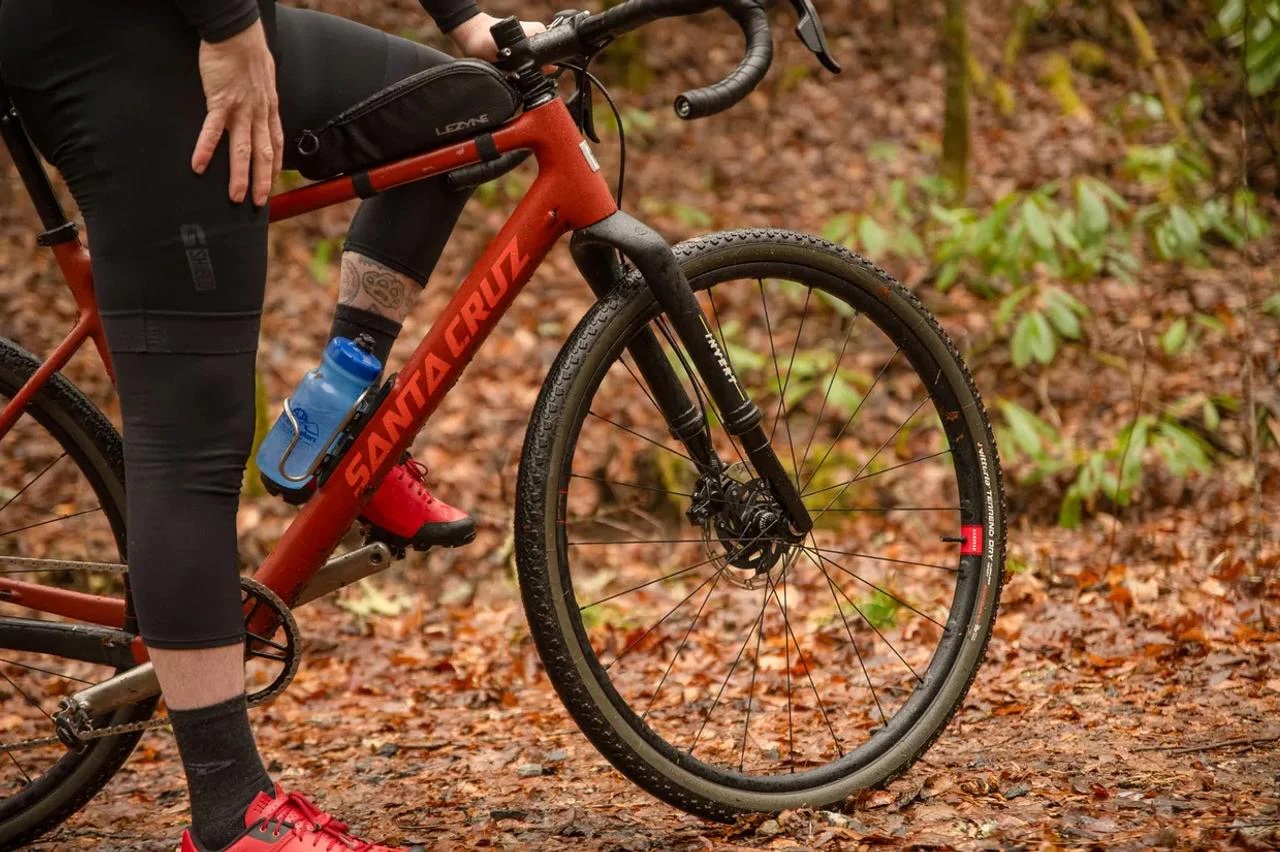
The Cane Creek Invert is an upside-down gravel suspension fork offering either 30 or 40 mm of travel. It’s the best gravel suspension fork we’ve tested in the lab so far, combining excellent comfort, clean integrated design, and impressively low weight (990 grams!).
What makes the Invert unique is that it doesn’t use a traditional damper to control its movement. As a result, the fork can react extremely quickly to high-frequency chatter on gravel roads, allowing it to track the terrain more effectively than many competing suspension forks.
Our vibration testing backed this up too, showing that the Invert reduces gravel-road vibration better than all other suspension forks we’ve tested. The downside is that the lack of damping becomes more noticeable on larger impacts (such as potholes, rocks, or roots) where it isn’t as good at dissipating big spikes of energy.
Read our review of the Cane Creek Invert HERE.
Fox 32 Taper Cast
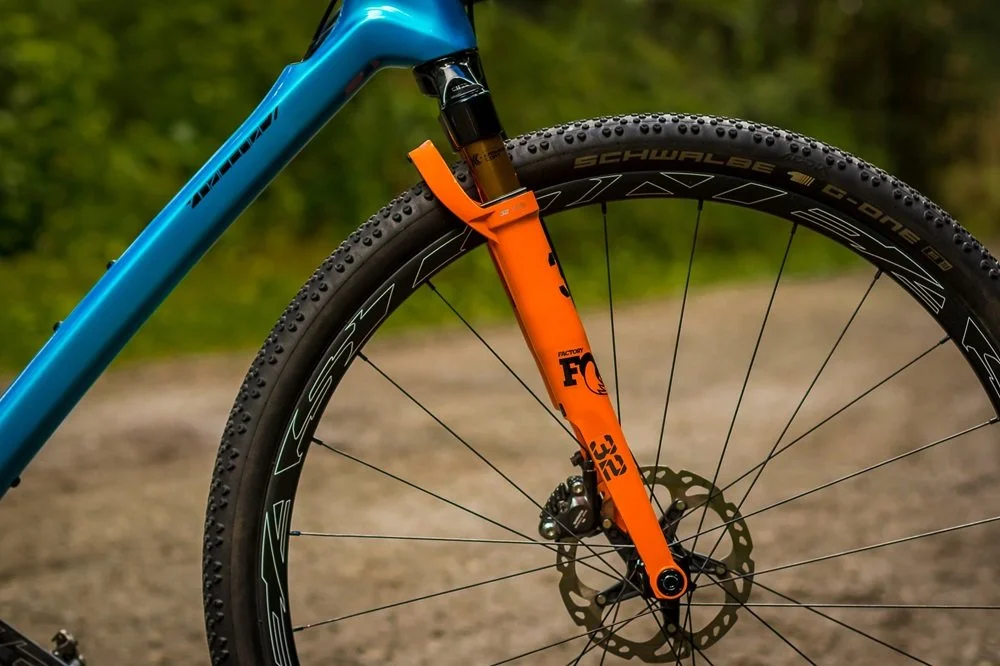
At just over 1200 grams, the Fox 32 TC remains one of the lighter gravel suspension forks on the market.
One of the Fox fork’s interesting design features is its rear-mounted arch, positioned behind the tallest part of the tyre. This layout allows Fox to maximise fork strength and stiffness without a major weight penalty. That makes it the most capable fork in this group, and a better option for heavier riders.
The 32 TC also offers more damping adjustment than most gravel suspension forks. A rebound adjuster sits at the bottom of the fork, while a lever ring at the crown provides three low-speed compression damping modes: open, medium, and firm. Compression damping can then be fine-tuned further using a secondary dial nested inside the lever ring.
The fork is available with either 40 or 50 mm of travel and clears tyres up to 700C x 50 mm. While we haven’t had the opportunity to test the Fox 32 TC ourselves yet, its chassis and adjustability make it one of the higher-performing options available.
Lauf Grit SL
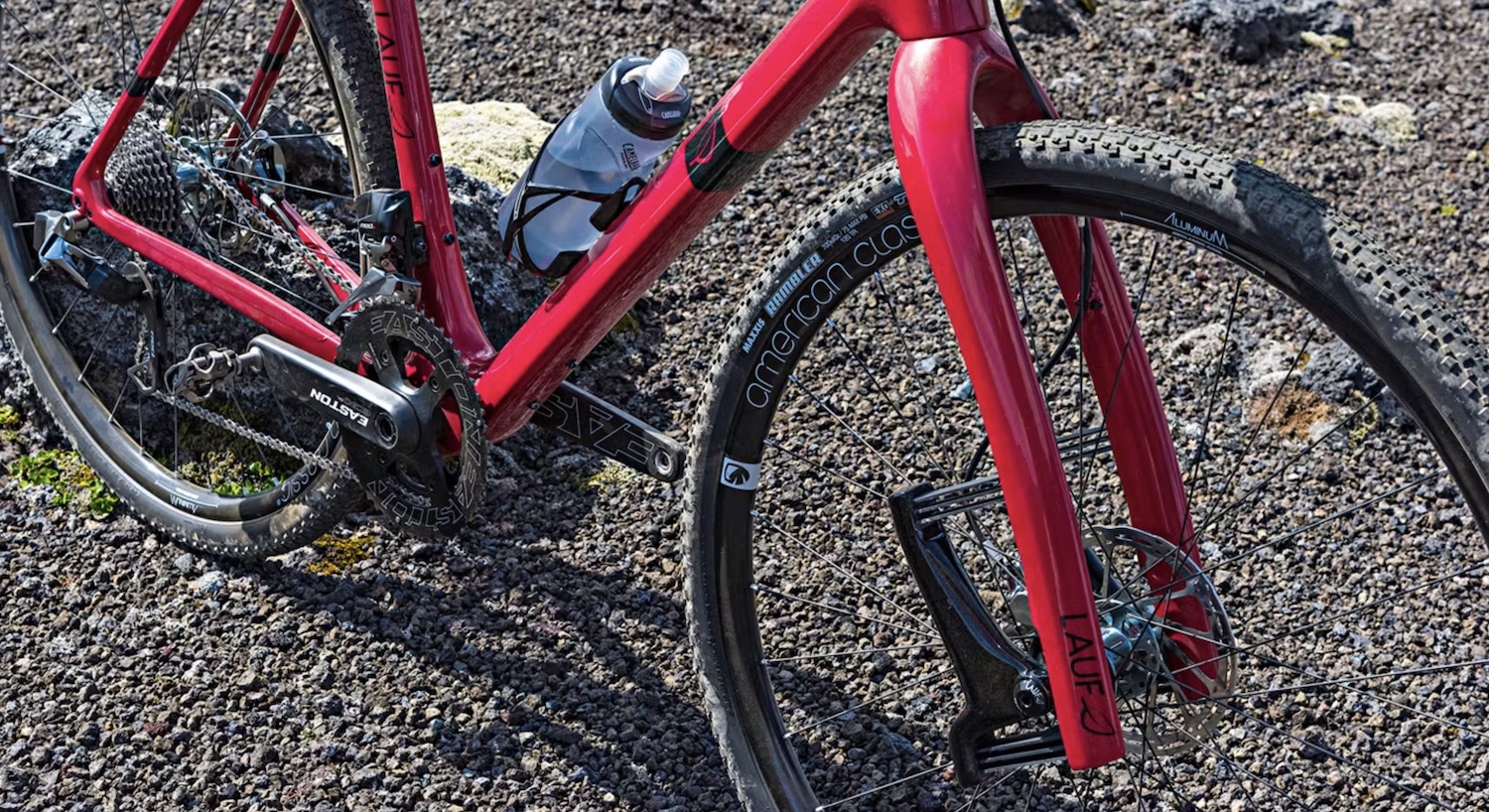
The Lauf Grit SL features one of the most unusual gravel suspension designs on the market, using a carbon structure paired with 12 glass-fibre leaf springs instead of a traditional coil or air spring system.
Because the fork has very little damping, it feels noticeably bouncier than the other forks tested here. In practice, this means it’s less capable of controlling larger impacts, such as rocks or potholes, but it performs pretty well on chattery gravel surfaces. That said, our vibration testing shows it’s not that much better for your comfort than using a suspension stem.
The design brings a couple of advantages compared to more complex fork designs. The first is that the fork is effectively maintenance-free, with no moving parts or springs and dampers to service. The second is weight: the Grit SL comes in roughly 150 to 200 grams lighter than the Cane Creek and Fox alternatives. The question is whether those weight savings outweigh any aerodynamic disadvantages.
Read our review of the Lauf Grit SL HERE.
Wind Tunnel Results
Gravel Suspension Forks
| Rigid Fork | Baseline |
| Cane Creek Invert | +1.5 watts |
| Fox 32 Taper Cast | +3.3 watts |
| Lauf Grit SL | +8.5 watts |
The fastest option in the test was the rigid carbon fork, which isn’t particularly surprising given its much more aerodynamically optimised shape and smoother airflow management.
Not far behind was the Cane Creek Invert, which measured just 1.5 watts slower than the rigid fork at 37 km/h. To put this into perspective, that’s a smaller variation than we see between different wax chain lubricants. In other words, almost negligible in the real world.
The Fox 32 TC came next, trailing the Invert by a further 1.8 watts. Considering the Fox uses a structural arch positioned above the wheel, it makes sense that it would create slightly more aerodynamic drag than the sleeker Invert design.
In last place was the Lauf Grit SL. It tested a substantial seven watts slower than the Cane Creek Invert and 8.5 watts slower than the rigid carbon fork.
Fork Fairings
| No Fork Fairing | Baseline |
| Short Fairing (Rear) | -0.9 watts |
| Short Fairing (F+R) | -0.9 watts |
| Long Fairing (Rear) | +8.1 watts |
The Cane Creek Invert was the fastest suspension fork tested in the wind tunnel, so Dylan wondered, could it be made even faster? Using a few different fork fairing designs, he managed to find a few extra aerodynamic gains.
The most effective fairing type was the shorter ones. Interestingly, the aero benefit was virtually identical whether using just the rear fairing or both the front and rear combination. Once this saving was factored in, the aerodynamic penalty of the Invert compared to a rigid carbon fork dropped to just 0.6 watts.
Surprisingly, the longer fairing performed noticeably worse in the wind tunnel. Dylan speculated that the leading edge of the fairing may have been catching additional airflow, ultimately increasing drag rather than reducing it.
Why Aero Still Matters at Lower Speeds
| Speed | 37 km/h | 25 km/h |
| Race Time | 8:40 hours | 12:48 hours |
| Aero Upgrade Watt Savings | 5.2 watts | 1.6 watts |
| Time Savings Over Course | 3:16 mins | 4:33 mins |
As aerodynamic drag increases with the cube of speed, riders travelling at lower speeds experience significantly less aerodynamic resistance. Because of this, it’s easy to dismiss the aero advantages of different gravel components as largely irrelevant.
But it’s not quite that simple!
In a gravel event over a fixed distance, say the Unbound race distance of 322 km, a slower rider averaging 25 km/h can actually gain more time from aerodynamic improvements than a faster rider averaging 37 km/h.
And here’s why: the slower rider spends far longer exposed to the wind. So even though the raw watt savings are smaller at lower speeds, those savings accumulate over a much longer period of time.
In Dylan Johnson’s example, a 5.2-watt aero saving at 37 km/h works out to roughly 1.6 watts at 25 km/h. However, because the slower rider is on course for roughly four additional hours, the total time saving was greater.
Summary

Gravel suspension forks are remarkably effective at improving comfort, traction, and control, while also reducing fatigue on rough roads during long events. Here at CYCLINGABOUT, we’ve been strong advocates for them for years.
What Dylan Johnson’s wind tunnel testing revealed is that the aerodynamic penalty can actually be surprisingly small, particularly with certain fork designs. In the case of the Cane Creek Invert fitted with a compact fairing, the gap to a rigid fork shrank to just 0.6 watts at 37 km/h, which is essentially negligible in real-world riding.
At that point, the main trade-off becomes weight. You’re carrying roughly an extra 600 grams, but for riders tackling anything rougher than smooth gravel, the gains in comfort, control, and reduced fatigue will likely outweigh that penalty.
The Cane Creek Invert was not only the fastest suspension fork in the aero test, but according to our comfort testing, it can also cut more vibration than other gravel suspension forks. Combine that with its relatively low weight and significantly lower maintenance requirements compared to most traditional suspension forks, and it becomes a very compelling option for gravel riding and racing.
I’d recommend checking out our Cane Creek Invert vibration testing HERE.
















 English (US) ·
  French (CA) ·
  French (FR) ·