

 1 month ago
30
1 month ago
30
PROTECT YOURSELF with Orgo-Life® QUANTUM TECHNOLOGY
Orgo-Life the new way to the future Advertising by Adpathway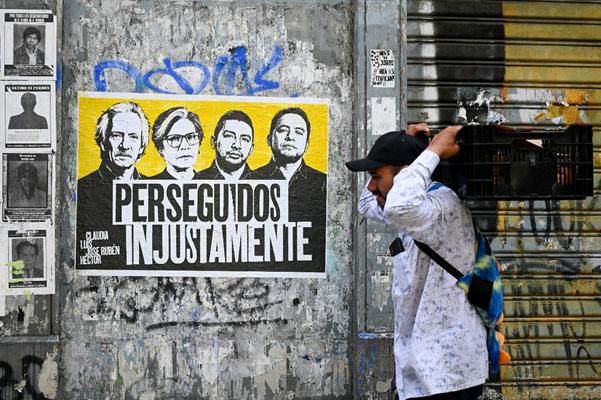 A man walks past a sign reading 'unjustly persecuted' featuring journalist José Rubén Zamora, former CICIG lawyer Claudia González and Maya leaders Luis Pacheco and Héctor Chaclan in a Guatemala City, 12 May 2026. Credit: Johan Ordóñez/AFP
MONTEVIDEO, Uruguay, July 24 (IPS) - José Rubén Zamora, founder of elPeriódico, Guatemala’s now-defunct leading investigative newspaper, spent 1,295 days in detention before a court granted him house arrest on 12 February. He endured long stretches of solitary confinement in a military jail, held in near-constant darkness and subjected to treatment that six UN experts warned could amount to torture. His offence was simply doing his job. For decades, he exposed the corrupt dealings of Guatemala’s economic and political elites. Prosecutors are still trying to send him back to prison.
Police arrested Zamora in July 2022 on a complaint brought by a former banker who was under investigation for financial crimes, following Zamora’s reporting on corruption under then President Alejandro Giammattei. Within months, elPeriódico had shut down following intimidation of its advertisers and criminalisation of its staff. A court convicted Zamora of money laundering in June 2023, and when an appeals court overturned the conviction, a second case kept him in jail anyway. Courts ordered his release several times, and each time appeals chambers reversed those decisions. The Supreme Court transferred a judge who ruled to free him to a court in another part of Guatemala. At least 10 lawyers who took up his defence were forced to abandon it under pressure. Some were prosecuted and jailed.
In May 2024, the UN Working Group on Arbitrary Detention declared Zamora’s detention arbitrary and retaliatory and recommended his immediate release. It took almost two more years for him to be allowed home. In March, the Supreme Court voided the rulings that had returned him to prison, finding they violated due process. The Constitutional Court heard the prosecution’s latest appeal to send him back to jail in June, but has yet to issue its ruling.
The machinery of impunity
Zamora’s ordeal is no aberration; it’s how captured institutions are designed to work. The Guatemalan state has long been in the hands of what Guatemalans call ‘the pact of the corrupt’, a coalition of business leaders, drug traffickers, military officers and politicians that has captured the justice system to guarantee their own impunity. Anyone who threatens that arrangement risks prosecution on fabricated charges, reinforced by coordinated smear campaign. This includes journalists who investigate corruption, judges and prosecutors who pursue it, and Indigenous, land rights and climate activists who mobilise against its consequences. The aim, as a Guatemalan civil society leader put it, is to instil fear so nobody dares question anything. Over 100 people, including around 50 judges and prosecutors, have fled into exile rather than face trumped-up charges.
Because the justice system serves the corrupt pact rather than the law, any serious attempt to dismantle corruption has required external support. In 2006, the UN and the Guatemalan government agreed to establish the International Commission against Impunity in Guatemala (CICIG). Over 12 years, CICIG and the Public Prosecutor’s Office investigated over 70 complex criminal structures and brought charges against more than 1,540 people, including former presidents, ministers, members of Congress and business figures. This challenged the perception that the powerful were untouchable.
But success sealed its fate. When CICIG investigated sitting president Jimmy Morales in 2017, he moved to destroy it, refusing to renew its mandate and appointing a compliant attorney general, Consuelo Porras. President Giammattei reappointed Porras, who prosecuted or forced out dozens of judges and prosecutors who had worked with CICIG. She turned the Public Prosecutor’s Office into an instrument of persecution while dismissing 74 per cent of the complaints filed with it without investigating them. By the time her term ended in May, over 40 states had sanctioned her and some associates. The institution built to prosecute crime had become the state’s key tool for committing it.
New president, same system
Guatemalans elected Bernardo Arévalo in 2023 with a mandate to dismantle this system, but the system has consistently tried to disable him. His unexpected win – he scraped into the runoff largely because the establishment had not seen him as a serious enough threat to block – triggered what civil society described as an attempted electoral coup, with spurious legal complaints, raids on his party’s headquarters and at least two credible assassination plots. It took 106 days of peaceful resistance led by Indigenous authorities to ensure he was sworn in.
But taking office was not the same as taking power. Arévalo’s party had only 23 of 160 congressional seats, and its legal status was subsequently cancelled by judicial order. Congress blocked the legislative change that would have allowed him to dismiss Porras, and the Supreme Court, 13 of whose judges were selected in 2024 through a process stacked with candidates tied to corruption networks, refused to lift her immunity. Throughout Arévalo’s term, the Public Prosecutor’s Office continued to criminalise dissent and repeatedly tried to strip Arévalo of immunity.
A narrow window
But Porras’s term eventually expired, and his successor, Gabriel García Luna, a career judge with no ties to corruption networks, has moved quickly, dismissing prosecutors linked to Porras and closing the special prosecutor’s office that fabricated cases against Zamora and many others. His arrival offers the first genuine opening in eight years. But it’s a narrow one. Congress remains in opposition hands, and the Constitutional Court, the Comptroller General’s Office and the electoral authority are all due for renewal this year. Corrupt interests are well placed to exploit these processes to entrench their grip.
Much now depends on whether Arévalo throws his political weight behind García Luna’s efforts to rebuild the institution Porras weaponised, and whether the bodies up for renewal can be kept out of the corrupt pact’s hands. The clearest sign of change will come if Zamora and the dozens of others criminalised for exposing corruption and defending rights no longer face prosecution, and instead their persecutors face justice.
Inés M. Pousadela is CIVICUS Head of Research and Analysis, co-director and writer for CIVICUS Lens and co-author of the State of Civil Society Report. She is also a Professor of Comparative Politics at Universidad ORT Uruguay.
For interviews or more information, please contact [email protected]
© Inter Press Service (20260724154743) — All Rights Reserved. Original source: Inter Press Service












 English (US) ·
  French (CA) ·
  French (FR) ·