

PROTECT YOURSELF with Orgo-Life® QUANTUM TECHNOLOGY
Orgo-Life the new way to the future Advertising by Adpathway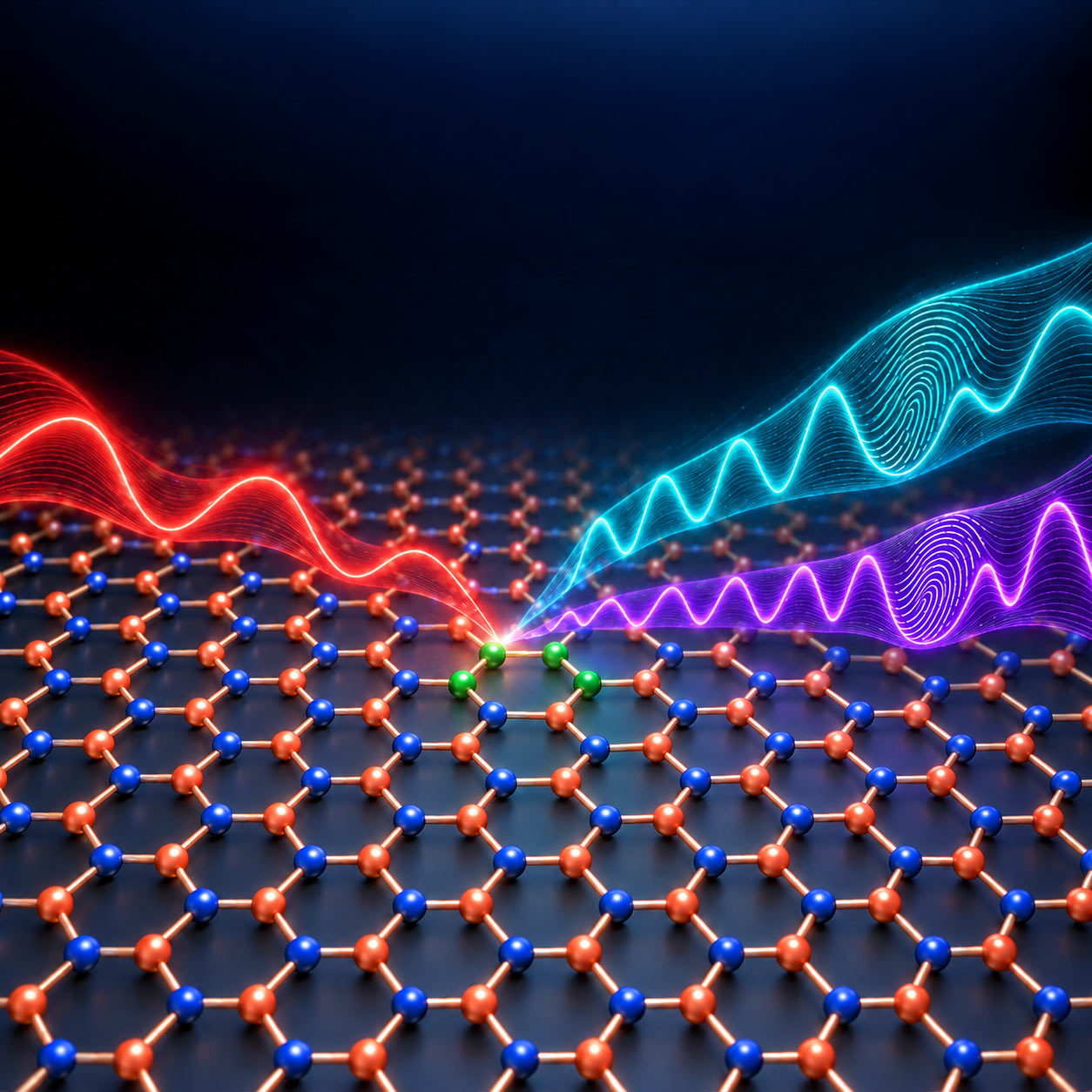 An illustration of atomic defects within hexagonal boron nitride altering light, creating an optical fingerprint. A University at Buffalo-led study predicted the optical fingerprints for 10 known defects within this material, which could have applications for quantum technologies. Credit: Vasili Perebeinos/University at Buffalo
Researchers have uncovered subtle optical signatures that could help distinguish atomic defects in a promising quantum material.
An atomic defect too small to see could leave a recognizable signature in laser light, giving scientists a new way to identify structures that may be useful for quantum technology. Researchers at the University at Buffalo have predicted how different atomic imperfections alter the optical behavior of hexagonal boron nitride (h-BN), a material made of boron and nitrogen atoms arranged in a honeycomb pattern.
Using computer simulations, the team examined 10 types of defects, including missing boron or nitrogen atoms and sites where carbon atoms had taken their place. Some defects were predicted to dramatically increase the light produced at twice or even three times the frequency of an incoming laser. The strength of these signals depended on the light’s polarization, which describes the orientation of its electric field.
How Light Reveals Hidden Atomic Structures
Even defects containing identical atoms can produce different optical responses if those atoms are arranged differently. When the researchers compared two configurations of four carbon atoms, they found that one was predicted to generate strong signals in two polarization directions, while the other produced a strong response in only one.
“These distinctive light responses could eventually allow us to experimentally identify not only which atoms are involved in a defect, but also precisely how they’re arranged,” says co-corresponding author Paras N. Prasad, SUNY Distinguished Professor, Samuel P. Capen Chair in the Department of Chemistry, and executive director of UB’s Institute for Lasers, Photonics, and Biophotonics (ILPB).
The findings, published October 19 in the American Chemical Society’s Nano Letters, could provide a reference for experimentally identifying atomic defects. By comparing measured light responses with the predicted optical fingerprints, researchers may eventually be able to determine which defects are present in a sample.
Identifying Defects for Quantum Technology
Some atomic defects in h-BN can emit single photons, individual particles of light released one at a time. These photons could transmit quantum information in future communication systems and support advanced sensing technologies. However, different defects have different properties, making accurate identification essential for finding useful sources of quantum light.
“Not all atomic defects are created equal. Making it easier to identify defects brings us another step closer to determining which ones have the properties we’re looking for,” says co-corresponding author Vasili Perebeinos, PhD, professor in the Department of Electrical and Computer Engineering in the UB School of Engineering and Applied Sciences.
The simulations could help guide efforts to determine which defects generate quantum light and how to create them at specific locations within a material. Rather than relying on isolated photon emitters, the researchers ultimately hope to build organized arrays of precisely positioned defects.
“The ultimate goal is to create a material where we can precisely control the placement of defects that produce quantum light,” Perebeinos says. “Instead of relying on individual sources of quantum light, we want to create entire arrays of them that could be used in future quantum technologies. That’s the main motivation for studying defects in these materials.”
Reference: “Nonlinear Optical Fingerprints of Defects in Hexagonal Boron Nitride” by Olga Savkina, Davoud Adinehloo, Ivan Zhigulin, Pranati R. Kuntla, Viktor Labuntsov, Cecilia L. A. V. Campos, Alexander Baev, Andrey Kuzmin, Huamin Li, Igor Aharonovich, Paras N. Prasad and Vasili Perebeinos, 19 October 2026, Nano Letters.
DOI: 10.1021/acs.nanolett.6c03684
The work was supported by the U.S. Air Force Office of Scientific Research as part of the Multidisciplinary University Research Initiative (MURI). Support also came from the U.S. National Science Foundation, Australian Research Council, and the University at Buffalo Quantum Institute.
Never miss a breakthrough: Join the SciTechDaily newsletter.
Follow us on Google and Google News.




















 English (US) ·
 French (CA) ·
 French (FR) ·