

 20 hours ago
7
PROTECT YOURSELF with Orgo-Life® QUANTUM TECHNOLOGY
Orgo-Life the new way to the future Advertising by AdpathwayIn 2013, Abdelrahman ElGendy is a 17-year-old fledgling activist as students like him take to Cairo’s streets in protest against a military coup. Only two years earlier, they’d been swept up in the hope of Egypt’s January 25th revolution. During one mass demonstration, in which Abdelrahman is present as a bystander recording the fervor from his car while his Baba, in the driver’s seat, tells him to put your hand inside, police arrive. They brutally attack protestors and drag Abdelrahman and his Baba away.
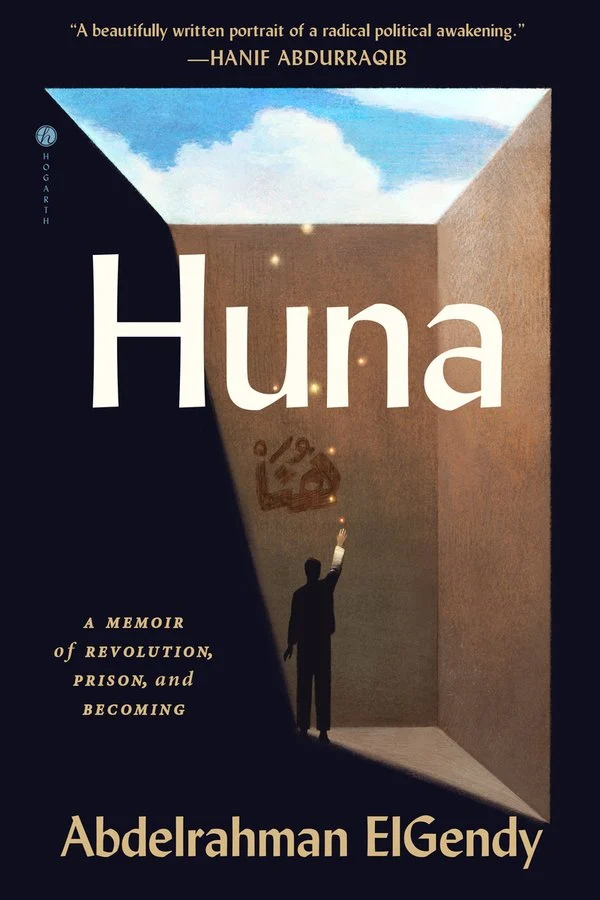
What follows is a journey from a jail cell to a pre-trial detention center, and then from prison to prison, each step marked by a tug of war with hope as the 15-day sentence renews thrice, extends into a 45-day sentence, which also renews, a trial pending, until the verdict arrives: 15 years of incarceration. Abdelrahman’s debut memoir, Huna, is the devastating, rage-inducing account of this incarceration and the grit and heart needed to not merely survive but claw one’s way out of systemic erasure in post-revolution Egypt.
Cloistered between walls and bodies, Abdelrahman learns: First, engineering as part of the bachelors degree he completes; then, how love and guilt can sit in the same room between him and his Baba. He grows: into an inmate who teaches English, Arabic, and more to the young and old; into a young man who looks out for others; a son who watches his mother’s waving hand until it disappears behind the prison gate; and a prisoner seasoned in the lingo of his environment and the politics of survival. In the midst of all of this, Abdelrahman holds onto community, joy, and most of all, tenderness.
In conversation, Abdelrahman told me “[Huna] is not a book about how I survived. This is how I survived.” He thinks writing is a militant act, a way to imagine other futures and help others imagine them as well. We spoke about his love for Arabic and the choice to weave it in the memoir, erasure through archival silences, resisting the “soft occupation” of the American empire, and more.
Bareerah Ghani: There is a touch of tenderness when you introduce Cairo as Al Qahira. You write that outsiders find the city insufferable but those she had birthed would object. How has your relationship to Cairo, and to Egypt, evolved in the aftermath of your incarceration and exile? How have those experiences shaped the way you think about the blurred lines between a country, its people, and the systems of power that govern them?
Abdelrahman ElGendy: I’ve been rereading Avery Gordon’s Ghostly Matters, where she discusses how the ghosts of certain social events and ruptures that are assumed to be of the past still slip into our present and expose its seams and the violent histories that are being suppressed by power. I also think about Christina Sharpe’s In The Wake, where she argues that this myth of a clean break with slavery is sort of a manufactured one; that for Black people, the rupture of enslavement very much structures the present. So when I think of Cairo, of Egypt at large, I think about what it means to live in the wake of the January 25th revolution in 2011 and what ghosts structure modern Egypt.
Our military dictatorship blasts us with this mass gaslighting. That what we experienced in the revolution never really happened, and the very present, brutalized population of political prisoners—over 60,000 today, on whose backs this so-called present-day stability rests—are not there. They’re ghosts. And I’m always thinking about how they’re not, actually—they’re on the other side of the wall, but they’re being intentionally ghostified, so to speak.
In prison, you think a lot about that idea of erasure and forgetfulness, people just forgetting you exist. You’re ghostified.
I think about all the massacres, like the Rabaa Massacre and the massacres of the January 25th Revolution, how they still structure our present in Egypt. And yet, there’s severe repercussions and state repression for anyone who dares question this clean break with the past or invoke the revolution. When the price, not even of action, but just of memory, is so high, it’s sad—and understandable, too—that so many people eventually condition themselves to buy into this myth. It’s more comfortable and safer. So you become sort of complicit in the erasure of our revolutionary past and our bloody, carceral present—not necessarily, again, because you’re evil, but mostly out of a need for survival.
For me, on top of it being impossible on a safety level to return to Egypt anymore, it’s also impossible for me to live a life where I am not haunted by these ghosts of what we lost. And also, even more, I guess, by all the ghosts of what could have been in that moment of revolutionary rupture, which was so violently ripped away from us before we were massacred, locked up, or exiled. These ghosts, to me, are the source of both my wistfulness and that tenderness that you mentioned toward Cairo and Egypt. I feel like it’s a curse that will follow me. I will always see these ghosts lurking in every corner of the country as long as I live.
BG: In your memoir, you mention Radwa Ashour as a literary influence. She made you ask, “Where do our untold stories go? If they never find an ear, do they cease to exist? Do we?” I would love for you to talk about that literary awakening while you were amidst a systemic erasure yourself, and how witnessing can be an act of preservation.
AEG: In prison, you think a lot about that idea of erasure and forgetfulness, people just forgetting you exist. You’re ghostified. I like to think alongside texts, and with this idea here, I think of Michel-Rolph Trouillot’s Silencing the Past, particularly his idea of archival silences—how silences enter the archive. He speaks a lot about the myth of the factual archive, and how any archive is an act of curation by a curating power that almost always has an agenda. That’s why history is, for the most part, a work of fiction, an approximation of the truth, and sometimes a willful distortion of it that is convenient to power. Archival silences are one of the most lethal tools that power deploys to erase and confine the ghosts of the past it finds inconvenient, and therefore, it suppresses any possibility of the revival of certain histories. And in the process, certain things just become unutterable, even unthinkable, in the present.
In the wake of the genocide, writing in English started to feel more complicit than usual. It was etched on the missiles that were bombing Palestinians in Gaza.
In prison, it was both fascinating and disturbing to watch the history that led to our incarceration, and our very incarceration, being erased in real time in the state newspapers that we smuggled, or state-sponsored TV shows that our families would tell us about in visitation. At one point, I realized that we were inhabiting an archival silence in the making. That, Oh, it’s not even an archival silence in the past. I’m in it, in real time now. I was seeing it being carved out of the archive, and my body and all our bodies. So this is what I was pointing toward in that line of inquiry, when I ask, Do we cease to exist? I don’t mean only as Egyptians, but also as prisoners, specifically, because prison is in its very function, an institution of invisibilization, of undesirable and inconvenient bodies. I was imagining writing this book in prison specifically for that reason. Among other things, this memoir is my attempt to speak into this archival silence that is being violently ripped out of our history in real time. I want it to be there when anyone reaches for that part of history and wants to relive it, that, specifically inside prisons, they find this project instead of the silence they would’ve found otherwise. So you read this book, and you know that we were there, we struggled, we cried, we broke, we loved, and we found all those ways to hold and be held.
BG: I love the way Arabic is interwoven in the text. You write about your love for Arabic poetry, teaching the language to other prison mates. But you also mention feeling shame about going to an Arabic-speaking school, making the effort to rid your tongue of an accent. Did that impact your affinity with Arabic? I’m curious about your relationship with the language and its linguistics.
AEG: I’ve always loved Arabic. Specifically standard, Fusha (الفصحى) Arabic, which is the literary Arabic. I had this deep love for it because it was the language of literature, and I grew up in its abundance in poetry and literature. It is what fed my coming to writing. Initially, I wrote in Arabic exclusively, before writing in both languages. I still publish in Arabic. Not as consistently, though. It always mattered to me that I have one leg in Arabic and speak to its audience. I don’t think that that relationship has ever wavered.
I was very interested in what it means for a language of tenderness to hold violence.
The tension I explore in the book is how, as a kid and a teenager, I did feel a bit embarrassed and ashamed of my Arabic language education, as opposed to being at an international school under an American or British system. And to me, that was not a language issue, it was a colonialism and class issue, where, in such a post-colonial context, the language that I love so much, Arabic, was a marker of a lesser class and a lesser education, whereas English marked an elite education, and a fast track to upward mobility, social prestige, travel abroad, and scholarships. As a kid, you sometimes internalize these things—despite your love for all the linguistic aspects of Arabic, you understand that it comes attached to this world perceived as inferior. Whereas English comes attached to a more elite world that, as a kid, tends to dazzle your eyes and you just want to be included. I ended up being in this weird place where I went out of my way to master both languages and move comfortably between them. I grappled with that, actually; in the wake of the genocide, writing in English started to feel more complicit than usual. It was etched on the missiles that were bombing Palestinians in Gaza.
In 2024, I wrote a piece which began and emerged from this line, “When I reach for Arabic, I reach for radical love, and when I reach for English, I reach for currency.” And that has always been true for me, even before I had language for it. It just took me a long time to articulate how I’m relating to both these languages, and the sense of complicity that comes with voluntarily reaching for English, because I’m not diasporic. I grew up my whole life in Egypt. So I’ve been very concerned with the ways in which I can trouble that, and make my invocation of Arabic within an English text like this, be an act of agitation. That it attempts to force a confrontation with the positionality of both the author and the reader, and whose language, and therefore whose world, is always expected to accommodate and cater to the other.
BG: As a bilingual, I feel like I’m a different person in each language. Sometimes, I’m using syntax and rhythm that comes from Urdu in English. I’m curious if the languages mix for you when you’re writing.
AEG: Definitely. Whenever I have a visceral reaction to anything, my instinct is always to reach for Arabic and not for English. That piece I mentioned was moved by this frustration of constantly being forced to reach for English because that’s what’s legible, and what, again, bears currency when I try to articulate certain realities. So there’s this violence constantly. Even the middle finger—in Egyptian, we kind of throw it at people. We don’t just raise it—which feels docile, doesn’t satisfy the rage I’m feeling. Something gets lost in translation there.
I’ve been thinking a lot about that in terms of poetry. I’ve been frustrated with bad translations of Arabic poetry that I love and grew up with, because they tend to arrive much weaker in English. In contemporary American poetry, if something is too explicit about its meaning and intent, it almost reads like it’s not sophisticated enough. In Arabic, that’s not really the purpose. It’s about the most stunning way in which you can present this very straightforward idea when you play with the syntax and so on.
In translating, much of my work is to be in conversation with the poet and to listen to what they were trying to invoke using the toolkit of Arabic, and then thinking, what toolkit do I have in English that I can use? Maybe: How do I play with line breaks in the English poem to evoke the same emotional response that Arabic evokes through some other tool, such as perhaps rhythm? That was so interesting because I started also thinking about myself—how I’m a different poem in Arabic than I am in English. I move differently, speak differently, express myself differently. It’s a very disorienting but also rich experience moving between these two worlds and sometimes existing in both simultaneously.
BG: The result is gorgeous and haunting. I especially love when you talk about Ayman, his “coconut smile” and how he made you laugh. And the moments of communal singing. Can you talk about those moments of seizing joy, how they can be acts of resistance and the role of community in all that?
AEG: I was hyper-aware of the way the Arab prison memoir as a genre is typically received in English—mostly as a testimony of suffering meant to translate violence of a distant and unfamiliar third world country for a Western reader, who is presumed to stand safely outside it and also be morally superior to it. I didn’t want to write torture porn, which is sometimes the price of entry. So I took a careful approach to how violence is depicted in this book.
I was very interested in what it means for a language of tenderness to hold violence, and what it means to let violence emerge through the study of relations, whether between prisoner and other prisoners, prisoner and family, prisoner and jailer, or the prisoner and themselves. What kind of bonds form or break inside this brutality? You can see the violence through that.
I think it’s our role, as writers and makers of language, to insist on agitation, to ensure that our defeat is never complete.
In “Venus in Two Acts,” one of her seminal essays, Saidiya Hartman asks, “How does one revisit the scene of subjection without replicating the grammar of violence?” So, writing this book, every time I found myself getting too close to a spectacular display of violence, I tried to slow down and think about what the most interesting and ethical way would be to approach that violence. If you’re reading closely, you’ll notice that each time violence peaks, language fragments and almost always veers into a poetic register—you could see this as distracting from the violence, which is intentional. For example, the prison welcome party, where we’re brutally beaten and tortured, I see my father get hit for the first time, and also Ayman—it was one of the most violent days in my prison experience. While writing every part of that scene, I kept thinking, What does it mean to tell a torture scene through the touching hands of prisoners? Me and Baba’s hands are touching throughout the running and escaping. Somehow, the hand touch becomes the main event and the violence is secondary to it. It’s kind of the atmosphere in which the hand touching happens.
I try not to embrace words like joy, resistance, resilience when I speak about the book. I think it is very keen on studying and showing the ability to retain one’s tenderness in conditions that are designed to callous them. It also insists on portraying the wide spectrum of emotions and erosion and decay that happens to one’s soul in prison. In prison, you have to kill yourself enough to survive it, or it will end you. But the challenge is to kill yourself just enough. I wanted to depict all the ways in which we could exit with that sliver of tenderness and capacity for wonder still intact, that we could nurture outside of prison one day. And to me, Ayman, Baba, and all those relationships were part of that. They were the thing that allowed me to retain the last bit of myself that I didn’t have to kill.
BG: In prison, a friend, Adel, calls the American Empire a “soft occupation” that upholds the Egyptian dictatorship and sustains itself because, “You cannot resist what you cannot see.” That resonated with me. I too have witnessed the American hand in the Pakistani deep state. When invisible infiltration of this nature runs deep, what can resistance look like?
AEG: In her lecture on June Jordan, Solmaz Sharif describes the American Empire as a nation that loves the myth of the clean break. And as Adel and I discussed in those stolen chats on the cell block staircase, this is also its preferred mode of foreign control and domination, as long as it can afford it. I think it’s our role, as writers and makers of language, to insist on agitation, both materially but also, and more importantly here, in language and memory to ensure that our defeat is never complete, that our struggle remains unfinished. That we understand what we are seeking, and the lineages that have been seeking the same horizon of liberation before us, and we keep that seeking alive, even if the endless pursuit is all we will ever know.
How can we, through writing, keep poking more holes into this state-sponsored clean break myth to allow the ghosts of all the violences that structure our present, to keep slipping through? We have to insist on the ghosts haunting us, because they allow us to also imagine the otherwise futures that once could have been, and maybe still could be.
Take a break from the news
We publish your favorite authors—even the ones you haven't read yet. Get new fiction, essays, and poetry delivered to your inbox.




















 English (US) ·
 French (CA) ·
 French (FR) ·