

PROTECT YOURSELF with Orgo-Life® QUANTUM TECHNOLOGY
Orgo-Life the new way to the future Advertising by Adpathway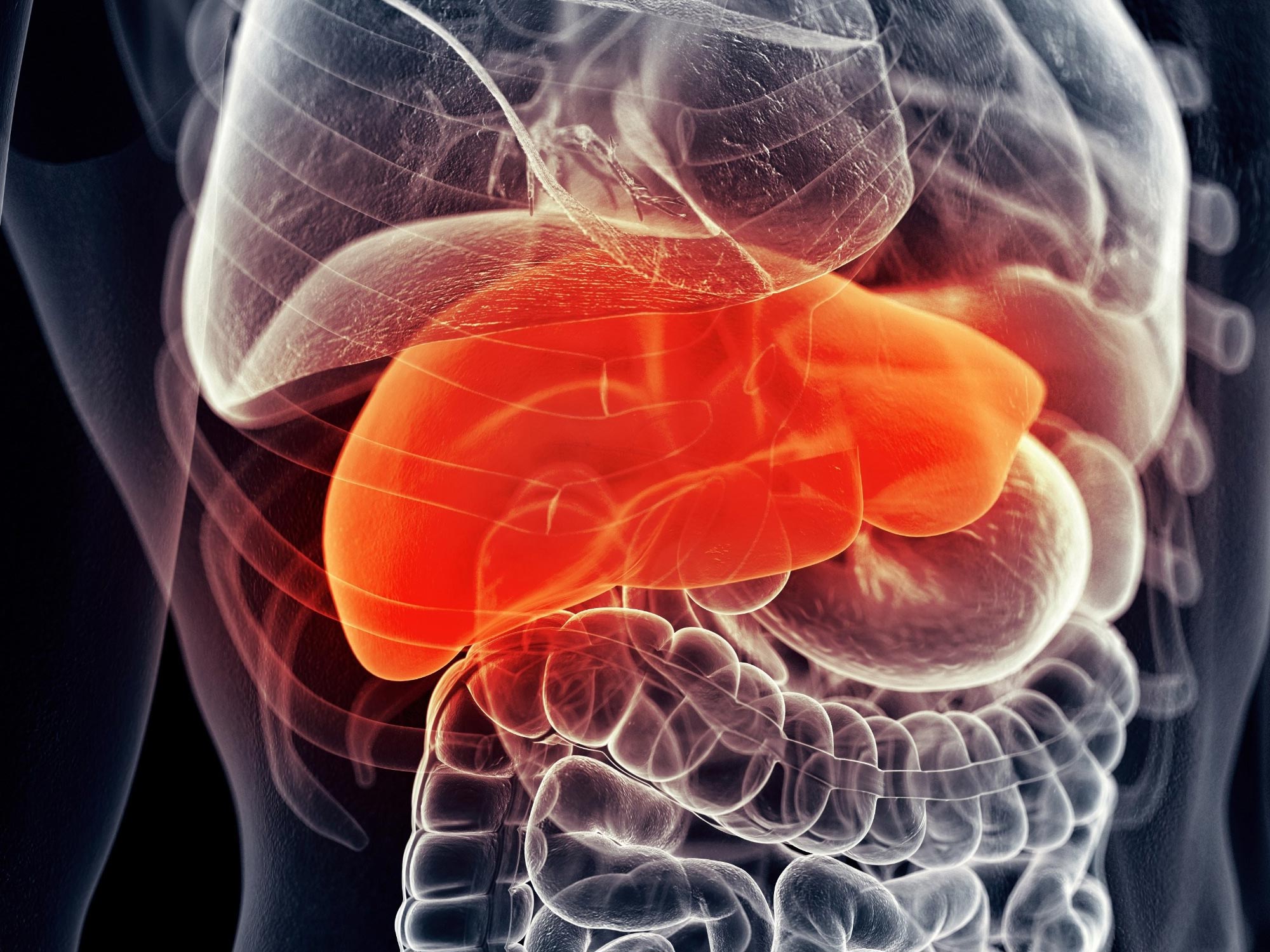 Researchers have identified a key factor associated with greater reductions in liver fat, highlighting the potential importance of sustainable dietary habits. Credit: Stock
A clinical trial suggests that improving liver health may require less attention to strict fasting schedules and more emphasis on developing eating habits that people can sustain.
For people using intermittent fasting to reduce fat in the liver, finding a meal schedule that helps them lose weight may be more important than eating at specific times of the day. A new clinical trial found that people who lost at least 5% of their body weight experienced the greatest reductions in liver fat, with no clear advantage to eating earlier or later in the day.
Led by the University of Granada (UGR) and the Public University of Navarra, the multicenter study was published in JHEP Reports and involved 197 adults aged 30 to 60 with overweight or obesity. The research forms part of the doctoral dissertation of Antonio Clavero Jimeno, a predoctoral researcher at the University Joint Institute for Sport and Health (iMUDS) at UGR.
 Pictured, from left to right, are Manuel Dote Montero and Antonio Clavero Jimeno, co-lead authors of the study, along with Jonatan Ruiz and Idoia Labayen, principal investigators of the study. Credit: University Of Granada
Comparing three intermittent fasting schedules
The researchers conducted a secondary analysis of a clinical trial previously published in Nature Medicine. That trial found that participants who practiced intermittent fasting lost an average of 3 to 4 kilograms (6.6 to 8.8 pounds) more than those who received only nutritional recommendations, regardless of their eating schedule. Eating earlier in the day, which in Spain often amounts to skipping dinner, also produced specific improvements in certain measures of blood sugar regulation.
To investigate whether these eating schedules offered additional benefits for liver health, the researchers compared three forms of time-restricted eating (TRE), a type of intermittent fasting that confines food consumption to specific hours of the day.
Participants were randomly assigned to four groups: standard care, early eating (approximately 9 a.m. to 5 p.m.), late eating (2 p.m. to 10 p.m.), and a self-selected eating window (12:20 p.m. to 8 p.m. on average). Over 12 weeks, all four groups received the same nutritional education program based on the Mediterranean diet and healthy lifestyle habits.
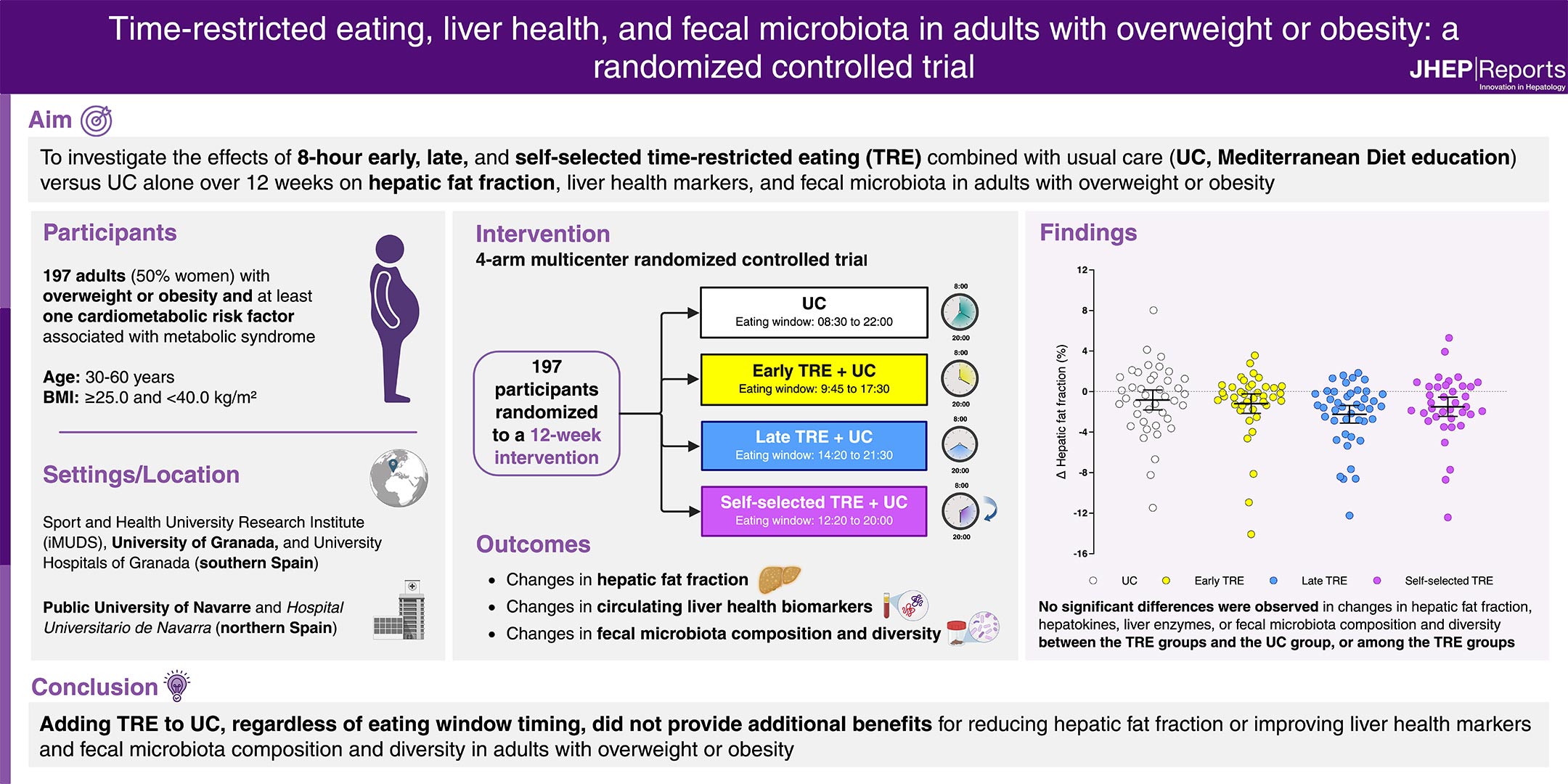 The study’s results reveal that incorporating a time-restricted eating (TRE) regimen into the nutrition education program based on the Mediterranean diet does not provide additional benefits for reducing liver fat. Credit: University of Granada
Meal timing offers no clear liver advantage
The researchers used magnetic resonance imaging (MRI) to measure liver fat and examined liver stiffness, liver enzymes, circulating proteins involved in liver metabolism, and other indicators of liver health.
Although liver fat decreased in all three intermittent fasting groups, none experienced statistically significant improvements beyond those achieved through standard care. The timing of meals also made no significant difference to other measures of liver health or the composition and diversity of microorganisms living in the gut.
The significance of losing 5% of body weight
Approximately 40 to 45% of participants practicing intermittent fasting lost at least 5% of their body weight. Reaching this threshold was associated with significantly greater reductions in liver fat, and most participants who achieved it belonged to the fasting groups. Greater reductions were also observed among people who already had hepatic steatosis, an excessive accumulation of fat in the liver, at the beginning of the study.
“The results do not suggest that intermittent fasting is ineffective, but rather that choosing an early, late, or self-selected fasting window does not appear to provide any additional benefit for liver health,” explain Manuel Dote Montero and Antonio Clavero Jimeno, the study’s first authors.
For the researchers, “the most important factor seems to be choosing a strategy that facilitates clinically significant weight loss and can be sustained over time.”
References: “Time-restricted eating, liver health, and fecal microbiota in adults with overweight or obesity: A randomized controlled trial” by Manuel Dote-Montero, Antonio Clavero-Jimeno, Adrián Cortés-Martín, Amaya Lopez-Pascual, Elisa Merchán-Ramírez, Alba Camacho-Cardenosa, Mara Concepción, Maddi Osés, Alejandro López-Vázquez, Francisco J Amaro-Gahete, Juan J Martin-Olmedo, Lucas Jurado-Fasoli, Alejandro De-la-O, Patricia V García Pérez, Julio Gálvez, Alba Rodriguez-Nogales, Federico Garcia, Carmen Mbongo Habimana, Marcos Jiménez Vázquez, Víctor Manuel Alfaro-Magallanes, Matías A Avila, Jose L Martín-Rodríguez, Rafael Cabeza, Manuel Muñoz-Torres, Idoia Labayen and Jonatan R Ruiz, 7 July 2026, JHEP Reports.
DOI: 10.1016/j.jhepr.2026.101956
“Effects of early, late and self-selected time-restricted eating on visceral adipose tissue and cardiometabolic health in participants with overweight or obesity: a randomized controlled trial” by Manuel Dote-Montero, Antonio Clavero-Jimeno, Elisa Merchán-Ramírez, Maddi Oses, Jon Echarte, Alba Camacho-Cardenosa, Mara Concepción, Francisco J. Amaro-Gahete, Juan M. A. Alcántara, Alejandro López-Vázquez, Rocío Cupeiro, Jairo H. Migueles, Alejandro De-la-O, Patricia V. García Pérez, Victoria Contreras-Bolivar, Araceli Muñoz-Garach, Ana Zugasti, Estrella Petrina, Natalia Alvarez de Eulate, Elena Goñi, Cristina Armendariz-Brugos, Maria T. González Cejudo, Jose L. Martín-Rodríguez, Fernando Idoate, Rafael Cabeza, Almudena Carneiro-Barrera, Rafael de Cabo, Manuel Muñoz-Torres, Idoia Labayen and Jonatan R. Ruiz, 7 January 2025, Nature Medicine.
DOI: 10.1038/s41591-024-03375-y
Never miss a breakthrough: Join the SciTechDaily newsletter.
Follow us on Google and Google News.
















 English (US) ·
 French (CA) ·
 French (FR) ·