

 11 hours ago
13
11 hours ago
13
PROTECT YOURSELF with Orgo-Life® QUANTUM TECHNOLOGY
Orgo-Life the new way to the future Advertising by AdpathwayTake a look at the essential concepts, terms, quotes, or phenomena every day and brush up your knowledge. Here’s your knowledge nugget on the RBI’s new specified non-financial assets (SNFAs) rules.
The Reserve Bank of India (RBI) has introduced the concept of specified non-financial assets (SNFAs) in the event of loan defaults and mandated that disposal of such assets should primarily be through public auctions under SARFAESI Act principles and prohibited resale to the original borrower or related parties.
1. SNFAs refer to immovable properties that banks acquire when borrowers fail to repay loans. Such assets include residential buildings, commercial properties, industrial land or other real estate accepted by banks in settlement of outstanding debt.
2. The RBI has issued the Third Amendment Directions, 2026 to establish a comprehensive framework for how banks should acquire, value, manage and dispose of non-financial assets obtained from defaulting borrowers.
3. According to the new directions, banks may acquire an SNFA only after a borrower’s loan has been officially classified as a non-performing asset (NPA). The acquisition must involve either full or partial settlement of the bank’s outstanding exposure.
4. The amendment also requires every commercial bank to formulate a detailed internal policy governing the acquisition and disposal of SNFAs. The policy must specify eligibility criteria, approval procedures, and recovery efforts to be attempted before acquiring property.
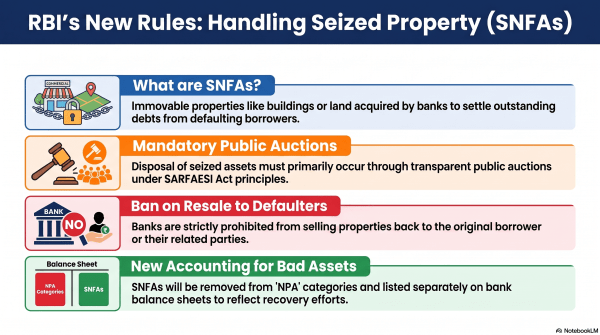 Infographics created using NotebookLM
5. Under the revised norms, banks are prohibited from selling repossessed properties back to the original borrower or any related parties, even if the property later ceases to be classified as an SNFA.
Story continues below this ad
6. SNFAs will no longer be counted as part of gross NPAs, net NPAs or stressed assets. Instead, they will appear separately in bank balance sheets under the category “non-banking assets acquired in satisfaction of claims.”
When does a loan become a Non-Performing Asset (NPA)?
1. All advances given by banks are termed “assets”, as they generate income for the bank by way of interest or installments. However, a loan turns bad if the interest or installment remains unpaid even after the due date — and turns into a nonperforming asset, or NPA, if it remains unpaid for a period of more than 90 days.
2. According to a July 2014 RBI circular, all advances where interest and/or installment of principal remains due for more than 90 days, would be classified as a “nonperforming asset”.
3. Before a loan account turns into an NPA (non-performing assets), banks are required to identify incipient stress in the account by creating a sub-asset category called special mention accounts (SMA). An account is transferred to this category once the earliest signs of sickness or irregularities in loan repayment are identified.
There are three types of SMAs:
Story continues below this ad
• SMA-0: When principal or interest payment is not overdue for more than 30 days but account is showing signs of incipient stress
• SMA-1: When principal or interest payment overdue between 31-60 days
• SMA-2: When principal or interest payment overdue between 61-90 days.
4. According to the RBI, banks should classify their NPAs into the following broad groups:
Story continues below this ad
(i) Sub-standard Assets: If it remained NPA for a period less than or equal to 12 months.
(ii) Doubtful Assets: If it has remained NPA for more than 12 months.
(iii) Loss Assets: Asset considered uncollectible and of little value but not written off wholly by the bank.
BEYOND THE NUGGET: What is the Sarfaesi Act?
1. Securitisation and Reconstruction of Financial Assets and Enforcement of Security Interest (Sarfaesi) Act of 2002 was brought in to guard financial institutions against loan defaulters. The Central Government constituted the Narasimham Committee and the Andhyarujina Committee to propose this new legislation.
Story continues below this ad
2. To recover their bad debts, the banks under this law can take control of securities pledged against the loan, manage or sell them to recover dues without court intervention. The law is applicable throughout the country and covers all assets, movable or immovable, promised as security to the lender.
3. Before the law was enacted in December 2002, banks and other financial institutions were forced to take a lengthy route to recover their bad debts. The lenders would appeal in civil courts or designated tribunals to get hold of ‘security interests’ to recovery of defaulting loans, which in turn made the recovery slow and added to the growing list of lenders non-performing assets.
4. The Act comes into play if a borrower defaults on his or her payments for more than six months. The lender then can send a notice to the borrower to clear the dues within 60 days. In case that doesn’t happen, the financial institution has the right to take possession of the secured assets and sell, transfer or manage them.
5. The defaulter, meanwhile, has a recourse to move an appellate authority set up under the law within 30 days of receiving a notice from the lender. According to a 2020 Supreme Court judgment, co-operative banks can also invoke Sarfaesi Act.
Post Read Question
Consider the following statements:
Story continues below this ad
1. When a principal or interest payment is overdue between 61-90 days, it is categorised as SMA-1.
2. SNFAs refer to immovable properties that banks acquire when borrowers fail to repay loans.
3. The Andhyarujina Committee recommendations laid the legal groundwork for the SARFAESI Act of 2002.
Which of the statements given above is/are correct?
(a) 1 and 2 only
(b) 2 and 3 only
(c) 1 and 3 only
(d) 1, 2, and 3
Answer Key
(b)
(Sources: RBI’s new SNFA rules: Banks barred from selling assets to loan defaulters, What is the Sarfaesi Act, invoked against telecom provider GTL?, RBI)
Story continues below this ad
Subscribe to our UPSC newsletter. Stay updated with the latest UPSC articles by joining our Telegram channel – IndianExpress UPSC Hub, and follow us on Instagram and X.
🚨 Click Here to read the UPSC Essentials magazine for July 2026. Share your views and suggestions in the comment box or at manas.srivastava@indianexpress.com🚨

















 English (US) ·
  French (CA) ·
  French (FR) ·