

 1 month ago
26
1 month ago
26
PROTECT YOURSELF with Orgo-Life® QUANTUM TECHNOLOGY
Orgo-Life the new way to the future Advertising by AdpathwayTake a look at the essential events, concepts, terms, quotes, or phenomena every day and brush up your knowledge. Here’s your UPSC Current Affairs knowledge nugget for today on the World Environment Day focusing on major environmental lessons from the last year. Notably, it is a high-value topic for UPSC Mains GS as well as Essay writing.
On June 5, the Republic of Azerbaijan will host the global commemoration of World Environment Day 2026 in Baku. Hosted by the United Nations Environmental Programme (UNEP), World Environment Day marks a day to raise awareness and action about the environmental catastrophes of the modern world. World Environment Day 2026 focuses on climate change—on the urgent signals the Earth is sending and the signals we choose to send back. This year’s theme is “Inspired by Nature. For Climate. For Our Future.”
In this context, let’s understand the major environmental lessons from last year.
Read the article. Then crack the quiz.
Q1 of 6
What is the primary mechanism by which AMOC distributes heat across the globe?
Wind-driven surface currents carrying warm air masses poleward Warm surface water flowing north, cooling, sinking, and returning south as a deep cold current Tidal forces pushing nutrient-rich water from the ocean floor to the surface
AMOC carries warm surface water from the tropics northward. In the Arctic, the water cools, becomes denser, and sinks deep into the ocean — then drifts back south as a cold deep-water current, redistributing vast amounts of heat across the globe.
Next \2192
Q2 of 6
Why is the recent slowdown in Arctic sea ice loss NOT considered good news by scientists?
It indicates that ocean salinity levels are rising to dangerous levels globally The slowdown is temporary and may be followed by faster-than-average melting within 5-10 years Cold Arctic air is now pushing further south, disrupting monsoon patterns
The slowdown is driven by internal climate variability, not a reversal of warming. Scientists expect it to last only another 5-10 years, after which melting may accelerate beyond the long-term average. GHG emissions continue unabated.
Next \2192
Q3 of 6
Why does rising ocean temperature threaten marine life even when oxygen is present at the surface?
Warmer water dissolves oxygen faster, reducing its availability at all depths Higher temperatures increase ocean stratification, preventing oxygen from mixing into deeper, cooler waters Marine heat waves lower the salinity needed for fish to regulate their body temperature
Warmer surface water is lighter and sits atop cooler, denser water — strengthening stratification. This makes it harder for oxygen and nutrients to mix downward, threatening marine ecosystems that depend on well-mixed, oxygenated water.
Next \2192
Q4 of 6
Despite adding 582 GW of renewable energy in 2024, why has it not reduced fossil fuel dependence globally?
Renewable energy is too expensive to replace coal and gas in developing countries Most renewable energy is generated in regions far from major consumption centres Renewables are mainly meeting rising electricity demand, not replacing existing fossil fuel use
Global electricity demand has grown three times since 1990. Renewable additions are largely absorbed by new demand growth rather than displacing coal or gas — meaning fossil fuel consumption has not meaningfully declined at the global level.
Next \2192
Q5 of 6
What is the core economic logic behind the Tropical Forest Forever Facility (TFFF)?
It imposes carbon taxes on countries that fail to meet deforestation reduction targets It provides technology transfers to help developing countries switch from timber to solar energy It invests capital and pays returns to countries for keeping existing old-growth forests intact
The TFFF is designed to flip the economics of deforestation: currently, clearing land for crops is financially incentivised. The TFFF raises investment capital, deploys it in a portfolio, and channels annual returns to tropical forest nations as payment for conservation.
Next \2192
Q6 of 6
What does India's 2035 NDC commit to regarding non-fossil fuel electricity capacity?
At least 50% of installed electricity capacity from non-fossil fuel sources At least 60% of installed electricity capacity from non-fossil fuel sources At least 70% of installed electricity capacity from non-fossil fuel sources
India's 2035 NDC raises the non-fossil fuel electricity target to 60%, up from the 50% target set for 2030. It also commits to a 47% reduction in emissions intensity on 2005 levels and a carbon sink of 3.5-4 billion tonnes CO2-equivalent.
Next \2192
Indian Express InfoGenIE
Key Takeaways:
#1 A key ocean current is collapsing
— Scientists are increasingly alarmed about the stability of a vast system of ocean currents in the Atlantic, after new research suggested it could weaken far more severely than previously thought.
— The Atlantic Meridional Overturning Circulation (AMOC), which regulates climate across much of the globe, may slow by up to 59% by 2100, with potentially devastating consequences for weather systems as far away as the Indian subcontinent.
— This matters because the AMOC is a “climate tipping point”. Just like a chair tilted past its balancing point, once the AMOC crosses a certain threshold, it could irreversibly collapse into a new, sluggish state. If it does, the consequences would be catastrophic, triggering extreme sea-level rise in North America and severe weather disruptions globally.
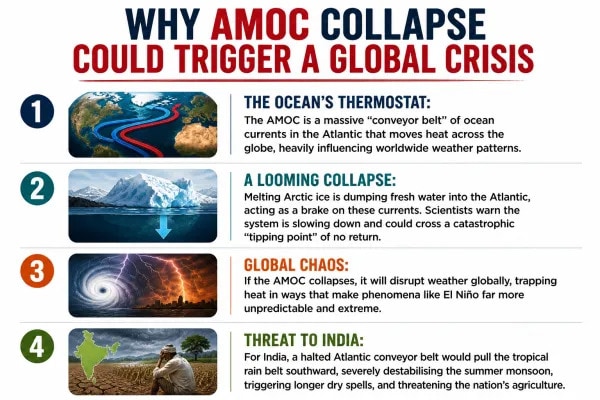
— The findings have particular significance for India, where hundreds of millions of people depend on the summer monsoon for their agricultural livelihoods and water supplies.
Story continues below this ad
The AMOC is a large system of ocean currents. It is the Atlantic branch of the ocean conveyor belt or thermohaline circulation (THC), and it distributes heat and nutrients throughout the world’s ocean basins. It carries warm surface waters from the tropics towards the Northern Hemisphere. As it reaches the freezing Arctic, the water cools, becomes denser, and sinks several kilometres into the deep ocean. It then drifts back south as a cold deep-water current before eventually rising to the surface to warm up and restart the loop. This slow machinery moves vast amounts of heat across the globe.
#2 The melting of Arctic sea ice has slowed down. This is not ‘good news’
— For more than half a century, the melting of sea ice in the Arctic has been among the most well-known indicators of climate change. But a new study has revealed that the pace of sea ice loss has slowed down in the past 20 years.
—This does not mean that the Arctic sea ice is rebounding. The slowdown is only temporary and may continue for another five to 10 years, after which the sea ice may melt faster than the long-term average, the study said.
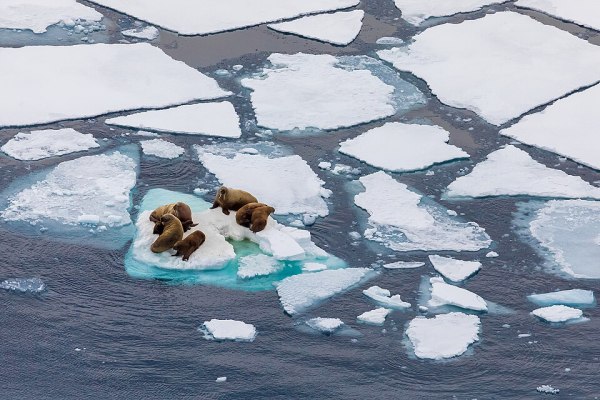 Research has shown that the region has lost more than 10,000 cubic kilometres of sea ice since the 1980s. (Photo: NASA)
— The loss of sea ice in the Arctic would have far-reaching consequences. It will exacerbate global warming, lead to further rise of sea levels, and present unprecedented challenges to ecosystems that are dependent on sea ice.
— The research titled ‘Minimal Arctic Sea Ice Loss in the Last 20 Years, Consistent With Internal Climate Variability’, was published in the journal Geophysical Research Letters last year in August.
Story continues below this ad
— Notably, it has long been established that human activities — primarily, the burning of fossil fuels that emit heat-trapping greenhouse gases (GHG) — have led to a rise in global temperatures. In the Arctic, this warming has led to the melting of sea ice.
— Humans continue to release unprecedented levels of GHG into the atmosphere, and mean global temperatures continue to rise. There is thus no indication that the slower Arctic sea ice melting implies that climate change is also slowing down.
#3 Earth’s oceans were warmer than ever in 2025
— The Earth’s oceans absorbed more heat in 2025 than in any year since modern measurements began in the 1960s, according to a new study. They absorbed an additional 23 zettajoules’ worth of heat last year, which was significantly higher than the 16 additional zettajoules absorbed in 2024.
— Energy is usually measured in joules. A zettajoule is one sextillion joules. That means the 23 zettajoules the oceans absorbed last year can be written as 23,000,000,000,000,000,000,000.
Story continues below this ad
— The analysis, ‘Ocean Heat Content Sets Another Record in 2025’, was published in the journal Advances in Atmospheric Sciences on January 9.
— Higher ocean temperatures can have irreversible consequences for marine ecosystems. For instance, warmer oceans lead to an increase in ocean stratification — the natural separation of an ocean’s water into horizontal layers by density, with warmer, lighter, less salty, and nutrient-poor water layering on top of heavier, colder, saltier, nutrient-rich water. Usually, ocean ecosystems, currents, wind, and tides mix these layers.
— The rise in temperatures, however, has made it harder for the water layers to mix with each other. Due to this, oceans are able to absorb less carbon dioxide from the atmosphere, and the oxygen absorbed is not able to mix properly with cooler ocean waters below, threatening the survival of marine life.
— Warmer oceans cause marine heat waves (MHWs), which occur when the surface temperature of a particular region of the sea rises to 3 or 4 degrees Celsius above the average temperature for at least five days.
Story continues below this ad
— According to several studies, higher ocean temperatures may also result in more frequent and more intense storms like hurricanes and cyclones.
#4 Increasing renewable energy alone can’t solve the climate crisis
— The world added about 582 gigawatts (GW) of renewable energy capacity in 2024, representing an increase of 15% over the previous year, according to a report by the International Renewable Energy Association (IRENA). This was the largest annual increase in renewable energy capacity in any single year.
— As of July 2025, the installed capacity of renewable energy across the globe stands at more than 4,442 GW, and around 30% of the world’s electricity is produced from renewable sources.
— The report by IRENA, which was released on July 10 last year, also said that at the current rate of growth, the world would come close to achieving its target of tripling renewable energy installed capacity by 2030. This target is considered crucial for limiting global warming and was part of the agreement made at the COP28 meeting in Dubai in 2023.
Story continues below this ad
— The rapid growth of renewable energy might give the impression that the world has made good progress on meeting its climate objectives. However, renewable energy has not even begun to replace fossil fuels at the global level.
— As of now, it is catering mainly to the rising electricity demand, which has increased three times since 1990 and is projected to grow even higher.
#5 Need of a new fund to protect world’s tropical forests
— Deforestation is a big challenge and one of the primary reasons for deforestation is that there is more global market value for dead forests than when they are alive. For instance, the benefits of standing forests, such as temperature reduction and wildlife habitat, are taken for granted. Meanwhile, clearing the land for monocultures of crops like soy is financially incentivised.
— In a bid to conserve the world’s tropical forests, a new fund was launched on the sidelines of the COP30 climate summit in Belém, Brazil. Known as the Tropical Forest Forever Facility (TFFF), the fund aims to raise and invest $125 billion, channeling returns to developing countries that conserve their forests.
Story continues below this ad
— The TFFF is designed to pay for the conservation of the world’s major tropical forests, which provide a range of ecosystem services, including carbon storage.
— The TFFF is an investment fund designed as a permanent, self-financing vehicle through which net returns will be awarded to up to 74 developing tropical forest countries for keeping their existing old-growth forests intact.
— The fund will look to raise $25 billion from wealthy governments and philanthropists, and an additional $100 billion in private investment. Then, the amount will be invested into a mixed portfolio of investments, including public and corporate market bonds, with annual returns used as a reward to tropical forest nations for conserving their forests.
— Note that payments to countries will be based on satellite remote sensing data that track forest canopy cover annually in a low-cost and transparent manner.
Story continues below this ad
BEYOND THE NUGGET: India’s new climate targets
— India on March 25 revealed its climate targets for 2035, promising to make further progress on cutting the carbon intensity of its economy, expanding the deployment of renewable energy and creating carbon sinks from forests and trees.
Under this 2015 pact, every country is obligated to decide upon, and implement, a set of climate actions that help the global fight against climate change. These are referred to as nationally-determined contributions, or NDCs— emphasising the fact that countries themselves decide the nature and scale of climate actions.
— India said it would ensure that at least 60% of its electricity installed capacity in 2035 was based on non-fossil fuel sources, up from the 50% target it had set for 2030.
— It has promised to attain at least a 47% reduction in emissions intensity, or emissions per unit of GDP, on 2005 levels, which is two percentage points more than its current target of 45% for 2030.
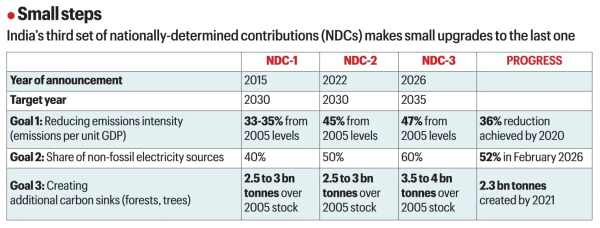
— It has promised to create a carbon sink that is at least 3.5 to 4 billion tonnes of CO2-equivalent larger than what existed in 2005.
— With the relatively modest upgrade in targets, India also seems to be reiterating its position that while it remains fully committed to climate action, it would not allow international pressure to dictate the pace of those actions.
Post Read Question
With reference to the Atlantic Meridional Overturning Circulation (AMOC), consider the following statements:
1. It circulates water from north to south and back in a long cycle within the Atlantic Ocean.
2. It carries nutrients necessary to sustain ocean life.
3. It operates only in the surface layers of the ocean without any deep-water movement.
Which of the statements given above is/are correct?
(a) 2 only
(b) 2 and 3 only
(c) 1 and 2 only
(d) 1 only
🚨 Click Here to read the UPSC Essentials magazine for May 2026. Share your views and suggestions in the comment box or at manas.srivastava@indianexpress.com🚨
Subscribe to our UPSC newsletter. Stay updated with the latest UPSC articles by joining our Telegram channel – Indian Express UPSC Hub, and follow us on Instagram and X.


















 English (US) ·
  French (CA) ·
  French (FR) ·