

PROTECT YOURSELF with Orgo-Life® QUANTUM TECHNOLOGY
Orgo-Life the new way to the future Advertising by Adpathway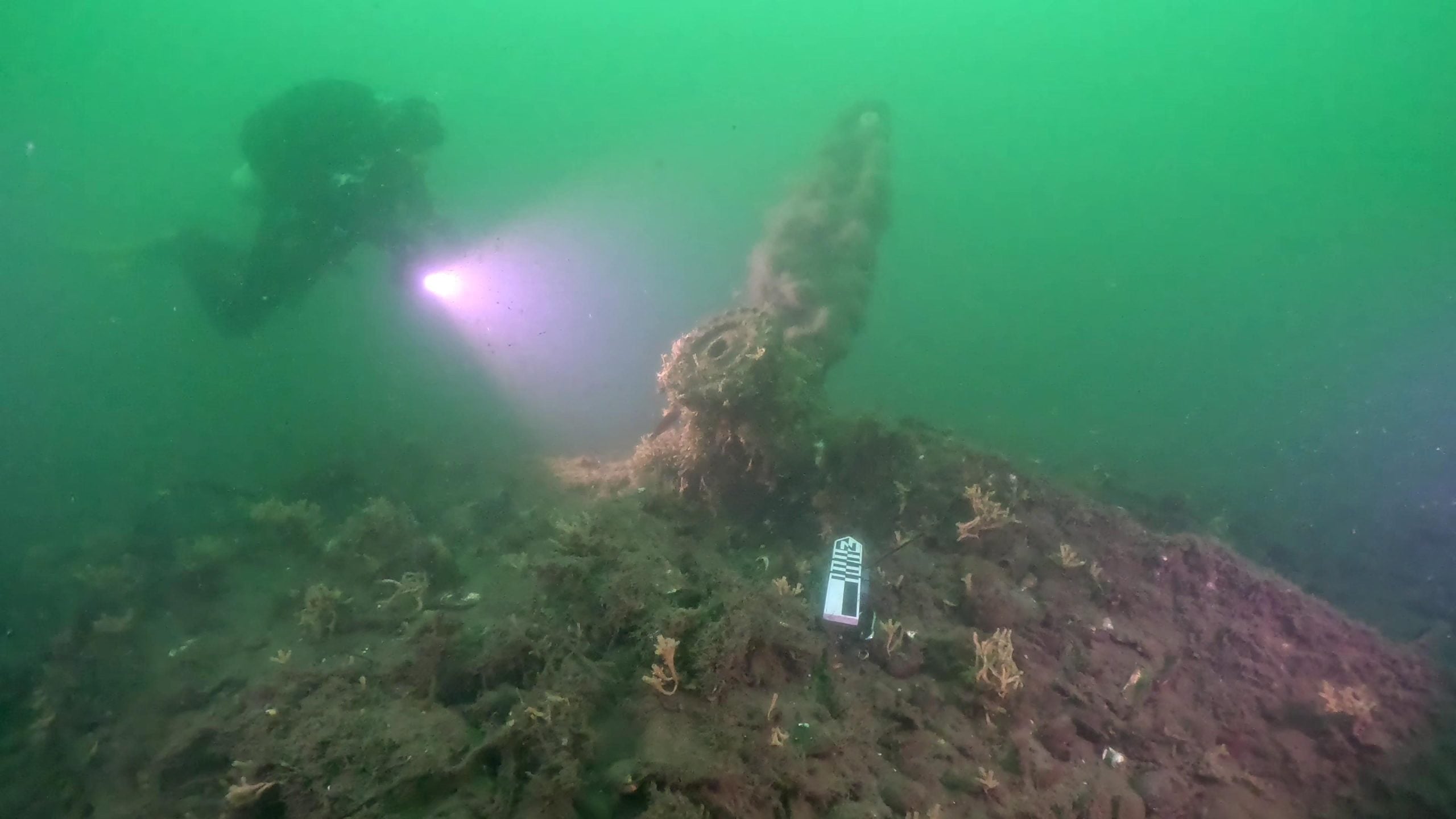 With visibility less than 10 feet, the dive team got its first up-close look at the wreckage of the B-17 Flying Fortress that crashed off the coast of Denmark in 1943. This 3-blade propeller was among the most easily identifiable parts of the aircraft. Credit: Jens Lindström
Underwater archaeologists have located a World War II B-17 in the Baltic Sea, and recovered artifacts may help identify the missing crew.
When World War II ended, many families celebrated the return of loved ones. Others were left with unanswered questions, learning that relatives were among the thousands still missing in action.
One of those unresolved cases involves the crew of a four-engined B-17 Flying Fortress that went down in the Baltic Sea in 1943 during intense fighting against Nazi forces. More than 80 years later, researchers from Texas A&M University have located the wreck as part of an investigation aimed at identifying the aircraft and its crew. The goal is to provide long-overdue answers to the families of those who never came home.
The project is led by Texas A&M nautical archaeologist Dr. Piotr Bojakowski and carried out in partnership with the U.S. Defense POW/MIA Accounting Agency (DPAA). In July, the team traveled to Denmark and launched their mission from Kiel Bay, Germany, to document and confirm the remains of the military aircraft resting on the seafloor.
Their work supports the DPAA’s ongoing global mission to account for roughly 81,000 American service members who remain missing from past conflicts. It also reinforces Texas A&M’s reputation as a leader in underwater archaeology and maritime research.
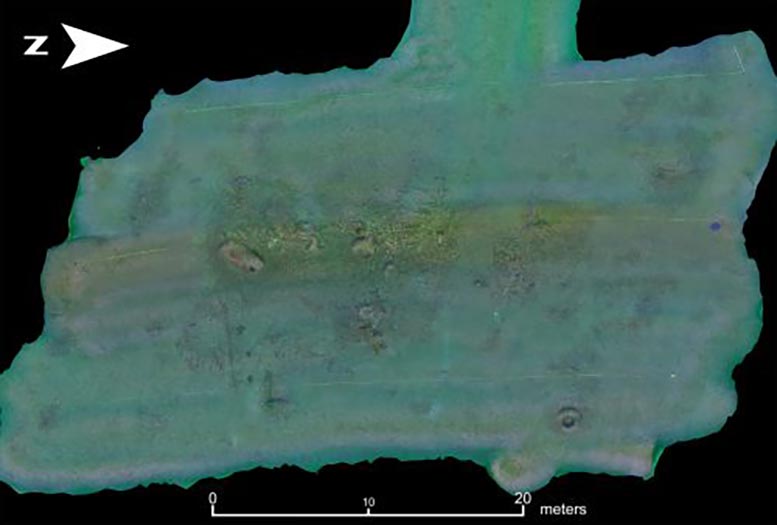 An ortho photogrammetry image (an image stitched together from hundreds of individual smaller images) of the wreckage of the B-17 Flying Fortress. Credit: Jens Lindström and Piotr Bojakowski
“I’ve worked on many archaeological sites and underwater sites, but I always have a special preference for World War II and military sites,” Bojakowski said. “We want to investigate the case not just as an archaeological site; we want to understand what happened and bring closure to the families. It is a unique experience that requires a lot of archaeological work and careful investigation of all individual pieces to provide the best answers.”
Divers and Remote Sensing Confirm the Wreckage
To locate the wreck, the researchers relied on advanced marine survey tools, including side-scan sonar imaging and magnetometry metal detection. They mapped a one-square-kilometer section of the Baltic Sea where the aircraft had first been reported by a local diver in 2001 and later brought to the DPAA’s attention. After identifying unusual signals on the seafloor, the team marked them as targets for closer inspection and deployed a remotely operated vehicle to determine whether the shapes represented natural features or debris from the downed bomber.
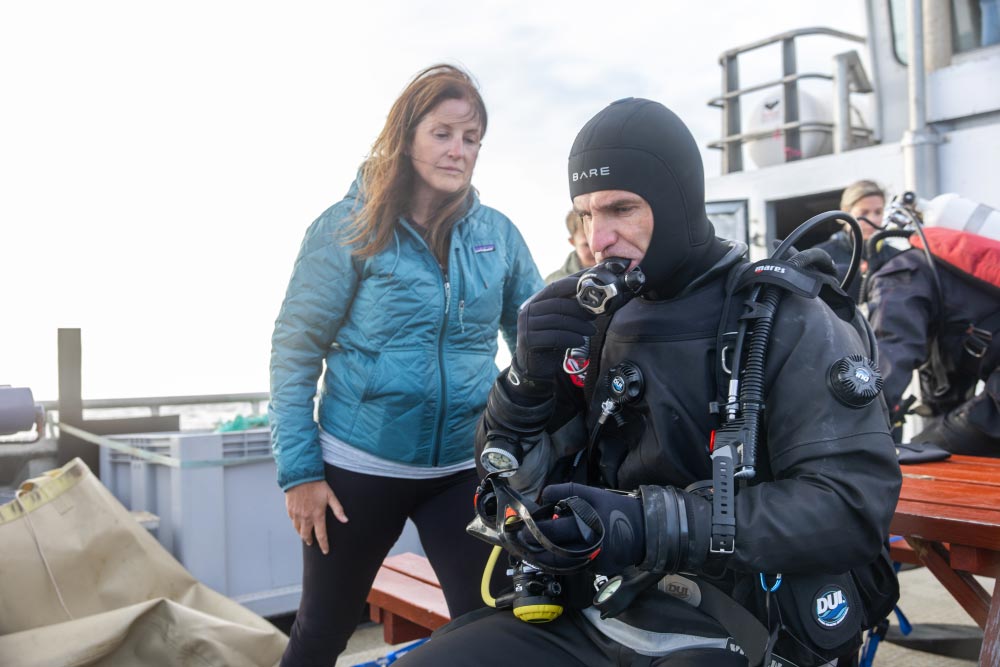 Katie Custer Bojakowski and Piotr Bojakowski. Credit: Chris Jarvis
An image resembling part of an airfoil prompted Bojakowski, members of his team, and volunteers from the Nordic Maritime Group to dive to the site to confirm the findings. There, buried under years of sediment and marine growth, lay the remains of the downed bomber.
“It’s an exciting process to see a crash site underwater,” Bojakowski said. “Even though it’s in ruins, you begin to visualize the entire aircraft with the engine and wings and fuel tanks. You slowly start piecing everything together in a way that makes sense and understand what happened.”
To their astonishment, two of the aircraft’s .50-caliber machine guns had been knocked loose on impact, and the team was able to recover them to the surface. After cleaning sea concretion, the serial numbers of each machine gun became clearly visible.
Shot on location by Chris Jarvis with the Texas A&M University College of Arts and Sciences, this video offers a first look at the underwater wreckage of a B-17 Flying Fortress, which is part of an ongoing archaeological research expedition. The project aims to uncover new insight into the aircraft’s final mission and honor the crew who served aboard. Credit: Chris Jarvis
Uncovering the Past to Heal the Present
Katie Custer Bojakowski, an instructional assistant professor of anthropology and member of the research team, said obtaining the machine gun’s serial numbers is a significant step toward conclusively identifying the B-17 crew.
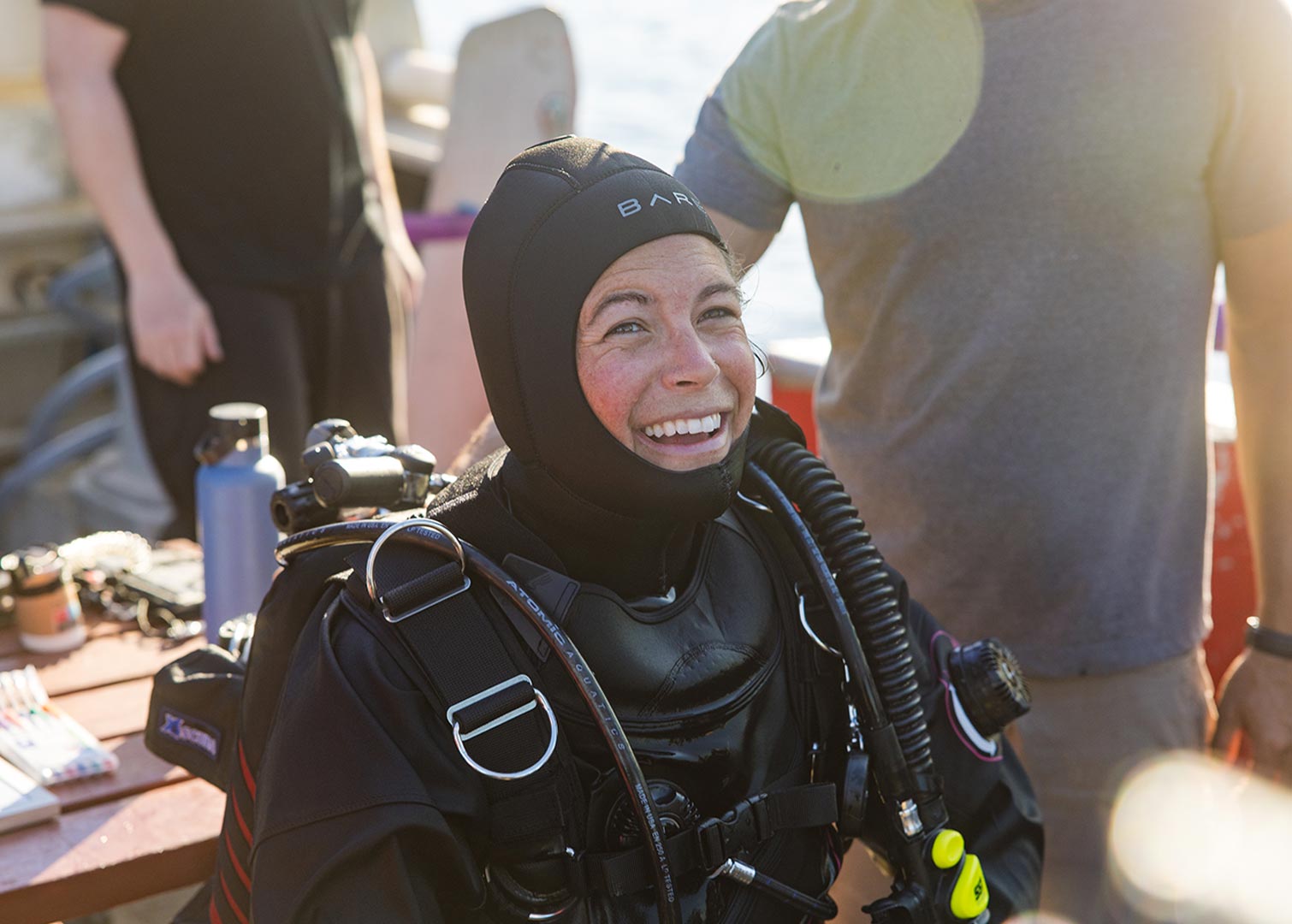 Nautical Archaeology graduate student Bethany Becktell ’26 after a dive to explore the B-17 wreckage. Credit: Chris Jarvis
“On the aircraft wreckage, it’s really important to find the machine guns,” she said. “They are a controlled item in the military and so are not only stamped with a serial number, but their location on any given aircraft was also tightly controlled throughout the war.
“As more archival research is done on the serial numbers, we’ll have a positive identification of the aircraft, and then a positive identification of the people who were known to be lost on the aircraft.”
Bojakowski emphasized the power of partnership in research operations, noting that their success depends on collaboration and the combined expertise of many partners.
“There’s not one single individual or agency that can start and finish this entire investigative process and research,” Bojakowski said. “It takes a lot of individuals, a lot of science, a lot of experiences and a lot of people. As an R1 institution, we have the best facilities and students to continue investigating underwater sites and be part of a bigger scientific process.”
Never miss a breakthrough: Join the SciTechDaily newsletter.
Follow us on Google and Google News.





















 English (US) ·
  French (CA) ·
  French (FR) ·