

PROTECT YOURSELF with Orgo-Life® QUANTUM TECHNOLOGY
Orgo-Life the new way to the future Advertising by Adpathway New brain-imaging research suggests that important changes in memory processing may begin by middle age. Credit: Shutterstock
Binghamton researchers are examining brain patterns across different ages to identify where memories become mixed up.
Memory errors do not always mean the brain failed to reactivate an earlier memory. In older adults, researchers found a more unexpected pattern: stronger reactivation of a memory pattern in the hippocampus was associated with a greater likelihood of recalling the wrong details.
The finding comes from a Binghamton University study examining how memory changes across adulthood. The researchers also found signs that some hippocampal processes begin to decline by middle age, rather than only later in life.
“We’re seeing a big decline in memory accuracy from the 20- to 30-year-old age group, to people in their 50s. Some of these hippocampal processes already start to decline by midlife,” said Binghamton Associate Professor of Psychology Ian McDonough. “That suggests middle age is really a transition point.”
 Binghamton University Associate Professor of Psychology Ian McDonough. Credit: Binghamton University
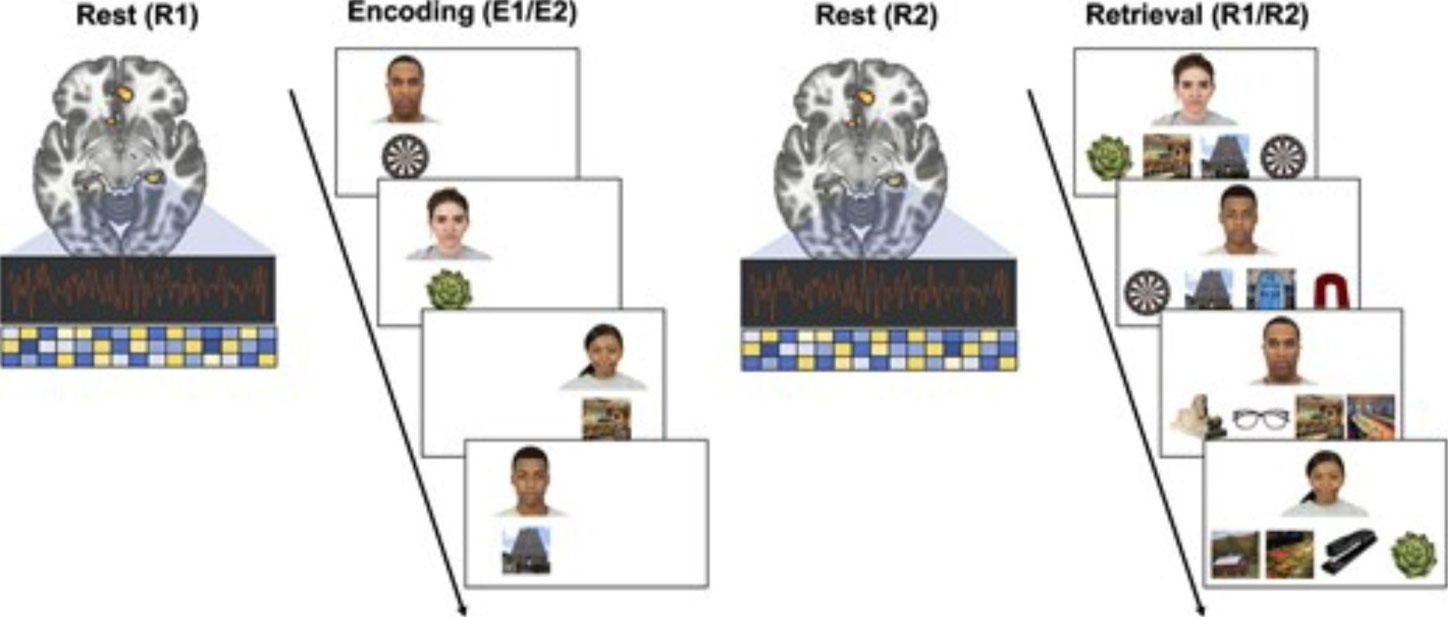
McDonough and postdoctoral associate Destaw Mekbib studied approximately 60 adults ages 18 to 74. Participants first viewed faces paired with different objects and scenes. After a five-minute rest, they saw the faces again and had to choose the object or scene originally paired with each one while an MRI scanner measured activity in the hippocampus, a brain region involved in memory.
The task required more than recognizing something as familiar. Participants had to remember the specific link between two pieces of information, such as which object had appeared with a particular face.
Familiarity can blur specific memory links
That distinction became especially important among middle-aged participants. They often remembered seeing an object or scene before but paired it with the wrong face.
“It becomes hard because now all of these images on the screen during the test seem familiar,” McDonough said. “They know they’ve seen all of these before, but now what they have to remember is that specific link. And that’s where, as people age, they start to really show these errors.”
 Binghamton University Associate Professor of Psychology Ian McDonough. Credit: Binghamton University
The researchers were interested in whether information remains consistent as memories move through different stages. A new memory is first encoded, then replayed by the hippocampus over a short period as it stabilizes, and later retrieved when it is needed.
Strong reactivation can accompany memory errors
The researchers initially expected memory errors in older adults to be associated with weaker hippocampal reactivation. Instead, the results showed a more complicated pattern.
When younger adults made mistakes, their brains did not strongly reactivate the original memory patterns associated with encoding, which matched the researchers’ expectations.
Older adults were different. Even when they chose the wrong object or scene, their brains could show strong reactivation of hippocampal patterns associated with the original learning experience.
“The more they reactivate the hippocampus that’s consistent with encoding, the more likely they are to make these memory errors,” McDonough said. “So instead of that reactivation pattern being associated with better memory, it’s associated with those errors.”
The study does not yet explain why stronger hippocampal reactivation can accompany memory errors in older adults. McDonough said future studies could examine encoding, consolidation, and retrieval within individual people and explore how brain stimulation after learning affects memory.
Middle age emerges as a transition point
The findings also point to middle age as an important period for memory research, rather than treating aging mainly as a comparison between young and older adults.
“This is one of a growing list of studies highlighting that the period of middle age is really important for memory functioning and shouldn’t be ignored. For a long time, most studies have been focused on young adults versus older adults,” McDonough said.
Following people through middle age over many years could help researchers determine when different aspects of memory begin to change and identify when those shifts occur across different regions of the brain.
“We really don’t have a good scientific understanding of what is happening in middle age, because the brain is not declining uniformly across this time, with some regions declining faster than others,” McDonough said. “Finding when those tipping points are is going to be important.”
Reference: “Aging shifts hippocampal reactivation from selective reinstatement to category-level misbinding during episodic memory” by Destaw B Mekbib and Ian M McDonough, 10 August 2026, Cerebral Cortex.
DOI: 10.1093/cercor/bhag114
Funding was provided by The University of Alabama through startup funds to I.M.M., the University of Alabama College Academy of Research, Scholarship, and Creative Activity to I.M.M., and the University of Alabama, Birmingham/The National Institutes of Health, Grant/Award Number: P30AG031054.
Never miss a breakthrough: Join the SciTechDaily newsletter.
Follow us on Google and Google News.



















 English (US) ·
  French (CA) ·
  French (FR) ·