

 3 hours ago
8
PROTECT YOURSELF with Orgo-Life® QUANTUM TECHNOLOGY
Orgo-Life the new way to the future Advertising by Adpathway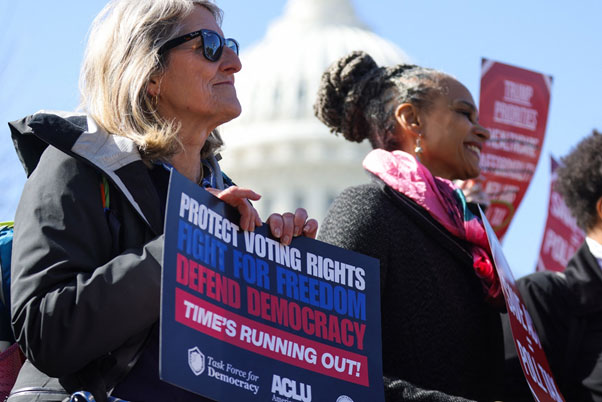 People protest against proposed federal voter ID and proof-of-citizenship mandates outside the US Capitol in Washington, DC, on 18 March 2026. Credit: Bryan Dozier/NurPhoto via AFP
MONTEVIDEO, Uruguay, November 3 (IPS) - In the run-up to the US midterms, armed federal agents have been knocking on the doors of voters suspected of being non-citizens. Republican-led states have redrawn electoral districts in their party’s favour, removing power from Black voters. Federal agencies have invaded people’s privacy, combing voter rolls for non-citizens while finding hardly any.
The USA increasingly resembles a competitive authoritarian regime, where elections take place and the opposition can win, but the incumbent abuses state power to stack the odds against rivals. The CIVICUS Monitor, which tracks civic freedoms worldwide, downgraded the USA’s civic space to obstructed last December, after placing it on its Watchlist of countries experiencing rapid decline.
For the first time since 2002, the Organization for Security and Co-operation in Europe (OSCE) will not observe a US federal election. On 23 September, the body announced it had not received an invitation, putting the USA on a par with Belarus and Russia, which failed to allow OSCE observers for their latest national elections. Meanwhile, the Carter Center, which has observed over 100 elections worldwide, mostly in fragile and fledgling democracies, is training and deploying volunteer observers in the USA, having first observed a US election in 2020, when it monitored the presidential recount in the US state of Georgia in the face of Donald Trump’s attempt to overturn his defeat.
Manufactured majorities
Gerrymandering has a long history in US politics, but 2025 brought the first coordinated national gerrymandering campaign. Trump pressured Republican-led states to redraw their maps mid-decade, and several complied. Democrats hit back where they could, and now nine states are voting under new maps that could hand Republicans up to 15 extra seats compared with six for Democrats. This means Republicans could lose a significant share of the vote without it costing them a corresponding number of seats.
In practice, partisan and racial gerrymandering are hard to separate. In the South, where Black voters overwhelmingly back Democrats, maps drawn to eliminate Democratic seats often do so by breaking up districts with substantial numbers of Black voters. It is illegal to dilute minority votes, but the Supreme Court has made it easier to get away with it. On 29 April, it struck down a Louisiana map drawn to comply with the Voting Rights Act, ruling that voters must now prove lawmakers intended to discriminate. Louisiana promptly eliminated a majority-Black district. The Justice Department has pledged to review similar districts nationwide.
Voters under suspicion
The administration has built its election agenda on the false claim that large numbers of non-citizens vote. The Justice Department demanded complete voter registration lists from 49 states and the District of Columbia and sued the 31 jurisdictions that refused. All 26 judges who had ruled by mid-October threw out the lawsuits. On 9 October, in a case brought by Common Cause, a federal judge struck down the department’s voter roll collection programme.
The hunt has turned up almost nothing. Trump claimed in July that the Department of Homeland Security (DHS) had found nearly 16,000 non-citizens registered in Nevada. DHS later confirmed only 185, and Nevada officials found they were all citizens. A database DHS overhauled so states could run bulk checks on voter rolls has made numerous mistakes, leaving some Texan citizens unable to vote in the March primary. Across seven states with 35 million voters, it flagged roughly 4,200 people, around 0.01 per cent of the electorate. A federal judge ruled the overhaul unlawful, but the Supreme Court paused the ruling, and over half the states kept using the database.
The administration has also tried to restrict postal voting, ordering the Postal Service to deliver ballots only to voters on lists compiled by DHS, and has sued to stop California counting over 20,000 postal ballots. Courts have blocked both for this election.
Intimidation has extended to voters’ homes. Armed DHS agents have gone door to door to question people suspected of voting while ineligible, including naturalised citizens. The DHS stepped up the operation as early voting began, but on 21 October a federal judge ruled that it likely amounted to voter intimidation and barred agents from questioning people until the polls close, a ban an appeals court has kept in force. However, fear has had an impact. In Minnesota, an organisation serving African immigrant communities reported a single new registration this year, compared with hundreds ahead of previous elections.
The decentralised system that withstood Trump’s attempt to overturn his 2020 defeat is under strain. Earlier this year, Trump urged Republicans to ‘nationalize’ voting, arguing that states run elections as agents of the federal government. But the US Constitution says otherwise. The administration has cut close to 1,000 staff from the federal agency that helps election officials fend off cyberattacks, despite warnings of potential foreign interference. Meanwhile, threats and harassment have helped push turnover among local election officials to its highest level in at least 25 years.
Civil society on guard
Civil society is resisting and has won most of its court battles, including those that halted the voter data programme, kept postal voting restrictions on hold and stopped door-to-door visits. The Vote Safe initiative is placing trusted community figures at polling places in four states to reassure voters, and Common Cause has trained over 400 volunteer observers in Texas alone.
This work is, however, under attack. Federal agents have raided a voter registration group’s office without explanation, and the Justice Department has indicted the Southern Poverty Law Center. Funders and financial institutions have distanced themselves from targeted groups, in some cases cutting off donations or banking services. Major law firms have largely stepped back from challenging the administration, leaving most litigation to civil society and small firms.
Civil society is keeping up its work despite the pressure, and that work won’t stop when the polls close. Whether Trump will accept results he doesn’t like is an open question. If results are challenged, the records kept by thousands of volunteer observers may prove vital to ensuring voters’ choices are respected.
Inés M. Pousadela is CIVICUS Head of Research and Analysis, co-director of and writer for CIVICUS Lens and co-author of the State of Civil Society Report. She is also a professor of Comparative Politics at Universidad ORT Uruguay.
For interviews or more information, please contact [email protected].



© Inter Press Service (20261103071045) — All Rights Reserved. Original source: Inter Press Service















 English (US) ·
 French (CA) ·
 French (FR) ·