

 2 months ago
33
2 months ago
33
PROTECT YOURSELF with Orgo-Life® QUANTUM TECHNOLOGY
Orgo-Life the new way to the future Advertising by AdpathwayThe first Nova Scotian of African descent to be appointed to the province's judiciary, now retired, is joining the federal government's newly formed Advisory Council on Rights, Equality and Inclusion, after scathing criticism directed at Ottawa for its initial omission of a Black representative.
Council had no Black representation when initial members were announced

Raffy Boudjikanian · CBC News
· Posted: Jun 26, 2026 7:05 PM EDT | Last Updated: 9 hours ago

Listen to this article
Estimated 4 minutes
The audio version of this article is generated by AI-based technology. Mispronunciations can occur. We are working with our partners to continually review and improve the results.

The first Nova Scotian of African descent to be appointed to the province's judiciary is joining the federal government's newly formed Advisory Council on Rights, Equality and Inclusion, after scathing criticism directed at Ottawa for its initial omission of a Black representative.
Corrine Sparks, whom the federal government describes as "a national leader in judicial education," will be part of a body tasked with fighting racism and hate, according to a news release issued by the Canadian Heritage department on Friday.
She retired from Nova Scotia's Family Court in December 2021, after more than three decades of service in the judiciary.
Sparks, who was named an officer of the Order of Canada on Friday, too, was the first Black woman to serve as a judge in the country.
Black advocates call out Carney government for excluding them from diversity council
Chair of Carney's new faith advisory council defends its mandate and membership
The federal government announced the council in February, after saying it was dissolving the Offices of the Special Representative on Combatting Islamophobia and Special Envoy on Preserving Holocaust Remembrance and Combatting Antisemitism.
Then, earlier this month, Ottawa released the names of the first members of the council, as Prime Minister Mark Carney delivered a speech about antisemitism from a Toronto synagogue and said the body's initial mandate would address the rise of anti-Jewish hatred in the country.

Black advocates called out the government a couple of days later for not including anyone from their communities in the council.
"We're tired of being an afterthought, tired of having to raise our voices to be heard and seen fully," said former MP Jean Augustine, the first Black woman elected to the House of Commons, in a news conference at the time.
Amnesty International's representative for English-speaking Canada, Ketty Nivyabandi, had said the decision indicated fighting racism is a lower priority for Carney than it was for his predecessor Justin Trudeau.

"It undermines the council's very credibility from the outset, and it reproduces the very inequities it is meant to address," she said.
At the time, Canadian Identity Minister Marc Miller's office said the government was still holding consultations about the council's makeup, and that it was not finalized.
On Friday, the government also added Donald Bolen, the Archbishop of Regina, to the council.
Questions over mandate still persist
Nicholas Marcus Thompson, co-chair of the National Employment Equity Council, which also raised the initial concerns about the omission, welcomed Sparks' appointment to the government body but noted that its mandate still does not mention combatting anti-Black racism.
"We cannot continue to be an afterthought and be treated with such scant courtesy," he said in an interview with CBC News.
In its release on Friday, the government does not directly mention anti-Black racism. However, it says the council will be using Canada's Anti-Racism Strategy and Action Plan on Combatting Hate — documents last updated under the Trudeau government that include sections on anti-Black racism — as guides in tackling "racism and hate in all their forms."
The action plan described Black people the "targets of the greatest number of police-reported hate crimes targeting a race or an ethnicity," accounting for 37 per cent of such crimes in 2023.
"This is the third opportunity the government has had to recognize the 400-year history of anti-Black racism in this advisory council," Thompson said, referring to the initial announcement of the council's formation in February and the roster unveiled earlier in June.
"Anti-Black racism shouldn't be hidden behind a hyper-link to another strategy," he said. "It belongs in the council's mandate in plain language."
Thompson said he is not opposed to the council's mandate specifically naming other forms of hatred, such as antisemitism, but wants it expanded to include anti-Black racism.
Thompson said Black advocacy groups will consult with communities this summer before deciding on their next steps.
CBC News has reached out to the Department of Canadian Heritage for comment.
ABOUT THE AUTHOR
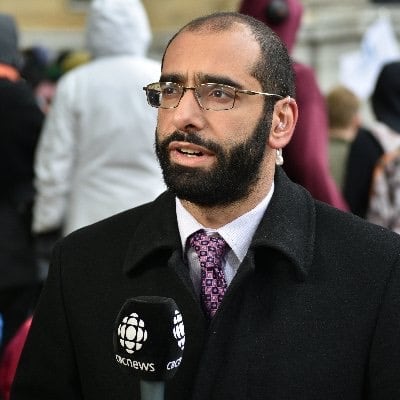
Raffy Boudjikanian is a senior reporter with the CBC's Parliamentary Bureau in Ottawa. He has also worked in Edmonton, Calgary and Montreal for the public broadcaster.









 English (US) ·
  French (CA) ·
  French (FR) ·