

PROTECT YOURSELF with Orgo-Life® QUANTUM TECHNOLOGY
Orgo-Life the new way to the future Advertising by Adpathway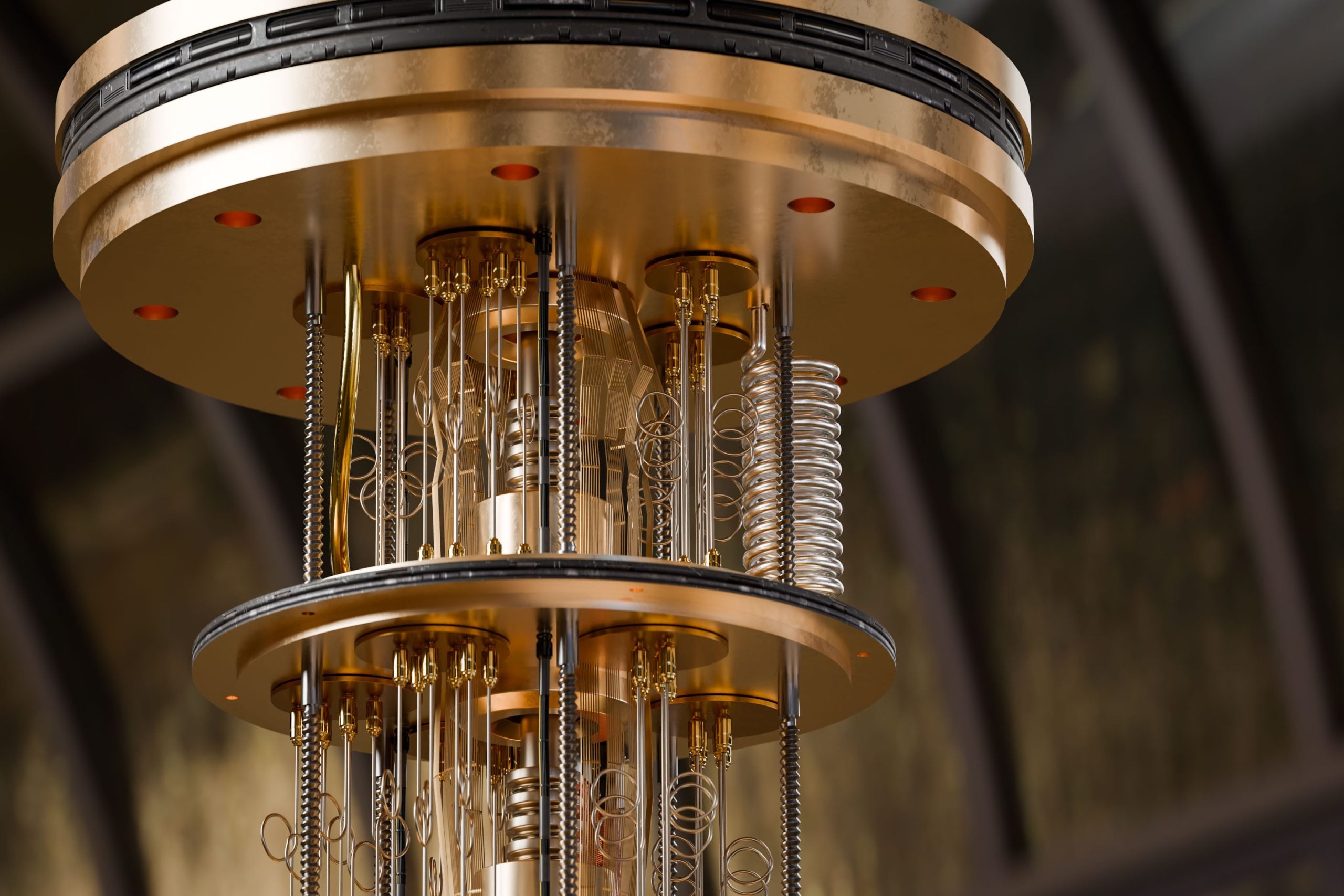 A quantum computer’s cooling system keeps its quantum chips at temperatures close to absolute zero. Only under these conditions can the chips exhibit the quantum properties that make quantum computing possible (artistic impression). Credit: B. Schröder/HZDR
How even small but frequent disruptions can cause quantum computers to fail.
Quantum computers are expected to tackle difficult tasks more quickly and with less energy than current supercomputers, including molecular simulations and complex logistics planning.
Progress toward that goal depends partly on increasing the number of qubits, the basic units that store and process quantum information. Yet scaling up may introduce a problem that has received far less attention.
Researchers at the Helmholtz-Zentrum Dresden-Rossendorf (HZDR) report in the New Journal of Physics that the quantum Zeno effect could, in extreme cases, bring calculations almost to a standstill as qubit numbers rise, much like a conventional computer freezing.
Adiabatic designs face a hidden limit
“The quantum Zeno effect is a previously overlooked obstacle to a certain class of quantum computers,” says Dr. Gernot Schaller, head of Quantum Technologies at HZDR’s Institute of Theoretical Physics. The concern applies to adiabatic quantum computers, which keep their qubits in the ground state, meaning the lowest available energy state.
To perform a calculation, an adiabatic computer slowly reshapes the qubits’ energy landscape. The adjustment must proceed gradually enough for the qubits to remain in the ground state as it changes. When the process ends, that final ground state contains the answer to the original problem.
“Adiabatic algorithms are considered robust and can be executed by quantum computers largely independently of the hardware that is used,” explains Institute Director Prof. Ralf Schützhold. The same approach can therefore operate with qubits built from solid-state superconductors or with individual ions held inside electromagnetic traps. Both types of hardware are already being used to test adiabatic algorithms, which can be programmed relatively simply and elegantly.
More qubits amplify environmental disruption
“However, a quantum computer can only function properly if its qubits are not disturbed too much,” Schützhold emphasizes. Engineers protect qubits by shielding them from electromagnetic radiation and cooling them close to absolute zero, or minus 273.15 degrees Celsius.
These precautions help preserve superposition, the ability of a qubit to occupy possible states between zero and one. They also protect entanglement, the highly sensitive quantum connection between qubits. Together, superposition and entanglement allow quantum computers to process certain complicated problems with exceptional speed.
“But despite all these measures, environmental impacts on the qubits can never be fully eliminated,” says Schützhold. The theoretical model developed by his group indicates that adiabatic systems become more vulnerable to these disturbances as additional qubits are connected.
With more linked qubits, the system must track increasingly small changes in its energy landscape. “This is where the quantum Zeno effect kicks in,” says Schaller. At that point, even weak influences from the surrounding environment can alter the qubits’ quantum states. “Each disturbance acts like an unwanted measurement, slowing down the system’s evolution,” says Schaller. “In the worst case, a calculation could even freeze completely.”
A baking comparison helps illustrate the effect. A cake must remain undisturbed in the oven long enough to rise properly. Repeatedly opening the door to inspect it interrupts the process and can leave the cake flat or cause it to collapse. In a similar way, each disturbance interrupts the natural development of a quantum state. When these interruptions happen often enough, the system may fail to reach the intended final state, and the calculation can nearly stop.
Active protection could prevent freezing
Quantum computer designers may be able to reduce the threat by improving protection from heat and electromagnetic radiation. In the baking comparison, stronger shielding would be like locking the oven door so it cannot be opened repeatedly.
Schützhold also points to active methods that could help preserve the computation. “Using the spin-echo method, we can apply coherent pulses to reduce the coupling of qubits to their environment.” In the oven analogy, this would resemble briefly increasing the temperature each time the door opens to counteract the resulting heat loss.
“Our study shows that we can only develop powerful quantum computers when we factor in environmental impacts from the very beginning,” Schützhold summarizes.
Reference: “Quantum Zeno effect versus adiabatic quantum computing and quantum annealing” by Naser Ahmadiniaz, Dennis Kraft, Gernot Schaller and Ralf Schützhold, 29 May 2026, New Journal of Physics.
DOI: 10.1088/1367-2630/ae6e68
Funded by the Deutsche Forschungsgemeinschaft (DFG, German Research Foundation) through the Collaborative Research Center SFB 1242 ‘Nonequilibrium dynamics of condensed matter in the time domain’ (Project-ID 278162697).
Never miss a breakthrough: Join the SciTechDaily newsletter.
Follow us on Google and Google News.



















 English (US) ·
  French (CA) ·
  French (FR) ·