

PROTECT YOURSELF with Orgo-Life® QUANTUM TECHNOLOGY
Orgo-Life the new way to the future Advertising by Adpathway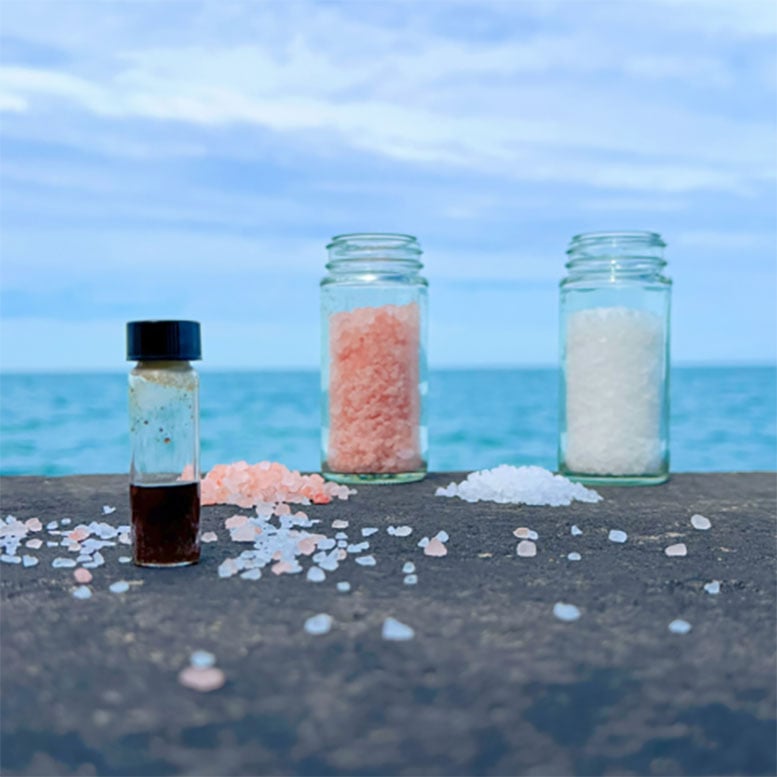 The molten-salt method allows scientists to stabilize the formation of nanocrystals. Left: the molten salt mixture; right, table salts. Credit: Ruiming Lin
A molten salt method developed by researchers at UChicago and Argonne could enable more durable materials for printed electronics and flexible devices.
Nanocrystals have become so valuable to science and technology that research involving them earned the 2023 Nobel Prize in Chemistry. Yet despite their potential, researchers have only been able to produce these microscopic crystals from a relatively narrow selection of materials.
Chemists at the University of Chicago and Argonne National Laboratory have now developed a method for making nanocrystals from metal nitrides, a technologically important class of materials that had resisted conventional synthesis. Published in Nature, the work could create new opportunities for flexible lighting, printed electronics, medical implants, and other devices.
“We were able to show how to make a series of nearly a dozen materials that could not be synthesized by traditional methods,” said Ruiming Lin, graduate student at UChicago and first author on the new paper.
Nanocrystals could make nitrides flexible
Metal nitrides already play important roles across modern technology and manufacturing. Gallium nitride, for example, is used throughout contemporary lighting systems, including LED bulbs and laptop displays.
Producing these materials as nanocrystals could greatly expand how they are used. Instead of being limited mainly to rigid films, metal nitride nanocrystals might eventually be mixed into polymers, deposited with inkjet printers, or incorporated into fabrics and other flexible products.
“This expands the boundaries of the field beyond what were previously fundamental constraints, and lays the foundation for the use of nitrides as nanomaterials,” said Dmitri Talapin, the Ernest DeWitt Burton Distinguished Service Professor of Chemistry and Molecular Engineering at UChicago, a scientist at Argonne and the senior author on the paper.
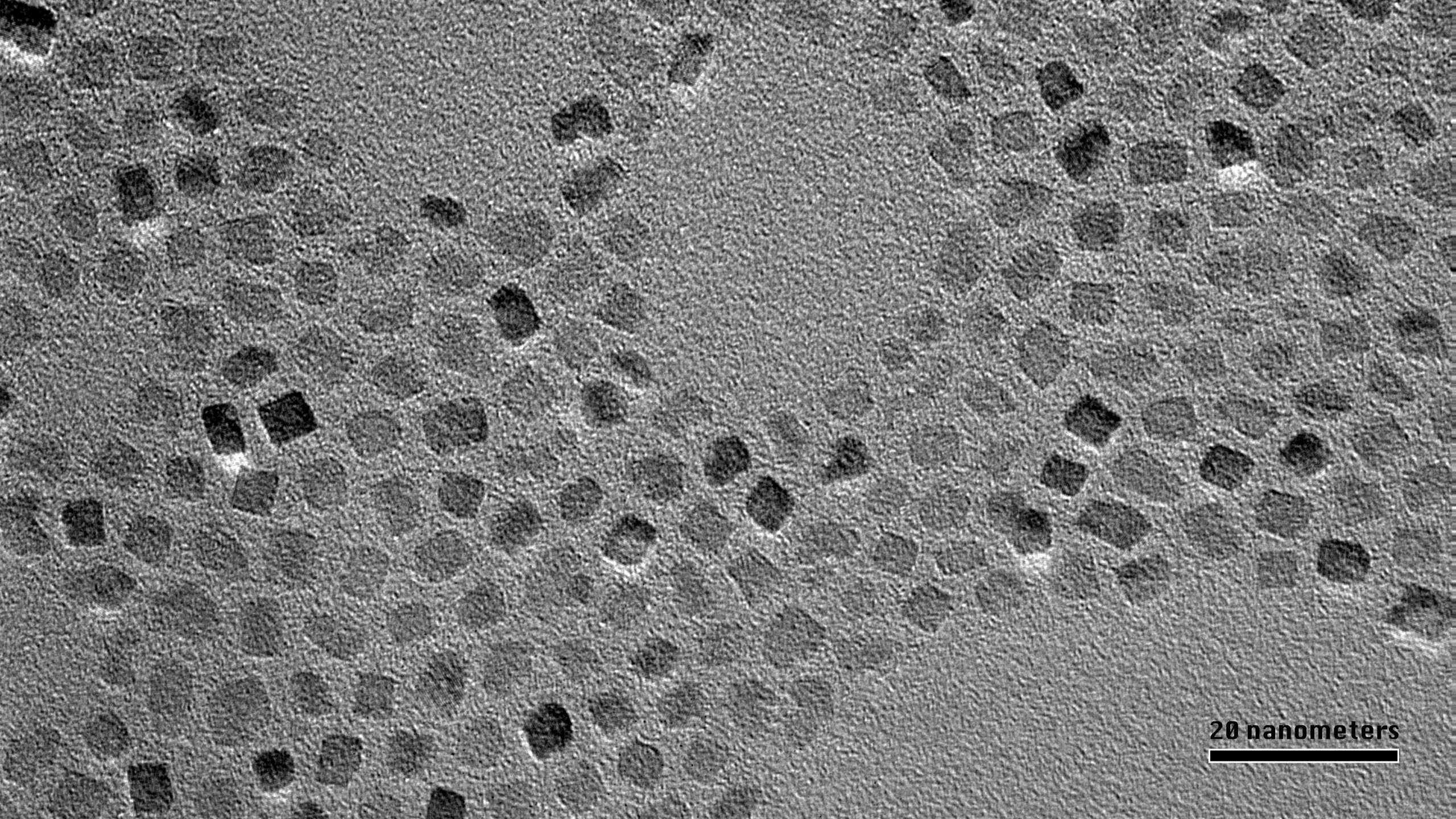 University of Chicago chemists have shown how to make nanocrystals from a useful class of materials known as metal nitrides—a previously impossible task. Above, an electron microscope image of the crystals, which are so small that billions could fit on your fingernail. Credit: Ruiming Lin
Nanocrystals are crystals reduced to an extremely small scale, with millions or even billions able to fit on a fingernail. Materials at this size can display properties that differ from those of larger structures, including producing intense light or accelerating chemical reactions.
In principle, researchers should be able to create nanocrystals from almost any substance. In practice, however, many useful materials have remained inaccessible.
Lin and other members of Talapin’s laboratory set out to overcome that limitation.
Strong bonds prevent crystals from forming
The researchers concentrated on metal nitrides, compounds formed from metals and nitrogen. These materials are generally durable, compatible with biological tissue, and resistant to both heat and corrosion.
Those qualities make metal nitrides valuable for applications such as electronics. But the same chemical stability that makes them useful also makes them exceptionally difficult to form into nanocrystals.
As a crystal develops, its ions must repeatedly rearrange before settling into the correct structure, much like partners changing places during a square dance. In metal nitrides, the bonds are so strong that the ions behave more like tightly connected tango partners who resist switching.
“If bonds cannot break during this process, that’s a death sentence for nanocrystals,” said Talapin. “Once you make an incorrect bond, everything goes south.”
Molten salts loosen stubborn bonds
Solving the problem required two advances.
Talapin’s laboratory first drew on an earlier finding that molten salts could serve as the liquid medium needed to stabilize nanocrystals as they formed. Further experiments then identified a specific combination of temperature and ammonia pressure that allowed the strong bonds between metal and nitrogen atoms to break and reform more easily.
“This process is very unusual—it goes against every bit of common sense in the field,” said Talapin. “We had to entirely rethink the approach.”
Nearly a dozen nitrides become accessible
Using the method, the researchers produced nanocrystals from gallium nitride and nearly a dozen other related materials. These included titanium nitride, which is used in medical implants; niobium nitride, an important industrial superconductor; and molybdenum nitride, a widely used catalyst.
Because these materials are both useful and comparatively inexpensive, turning them into nanocrystals could make them suitable for a much wider range of technologies.
“I remember the first time I looked through the electron microscope and saw those crystals,” said Lin. “You always hope something you discovered will wind up in applications. I think there will be many uses.”
Reference: “Ammonia pressure controls colloidal metal nitride synthesis in molten salts” by Ruiming Lin, Vikash Khokhar, Ningxin Jiang, Wooje Cho, Zirui Zhou, Di Wang, Justin C. Ondry, Zehan Mi, James Cassidy, Alex M. Hinkle, Alexander S. Filatov, John S. Anderson, Richard D. Schaller, De-en Jiang and Dmitri V. Talapin, 15 July 2026, Nature.
DOI: 10.1038/s41586-026-10801-3
Funding: U.S. Department of Energy, Samsung QD Cluster Collaboration, National Science Foundation, Air Force Office of Scientific Research.
Never miss a breakthrough: Join the SciTechDaily newsletter.
Follow us on Google and Google News.
























 English (US) ·
  French (CA) ·
  French (FR) ·