

PROTECT YOURSELF with Orgo-Life® QUANTUM TECHNOLOGY
Orgo-Life the new way to the future Advertising by Adpathway Scientists searching for dark matter have found an unusually compelling event inside the LUX-ZEPLIN detector, which sits nearly a mile underground in South Dakota. Credit: Stock
A mysterious signal deep underground may offer LUX-ZEPLIN its most intriguing clue to dark matter yet.
For nearly a century, scientists have been trying to identify dark matter, the mysterious material believed to account for about 85% of all matter in the universe. Despite its enormous influence on galaxies and cosmic structure, dark matter has never been observed directly, leaving its true nature among the biggest unanswered questions in physics.
A new analysis from the LUX-ZEPLIN (LZ) experiment has now produced an especially intriguing result. Researchers recorded a single particle interaction that is difficult to account for using the known background signals produced by ordinary matter. Although the finding falls well short of the statistical standard needed to announce a discovery, it is the strongest dark matter hint LZ has reported so far.
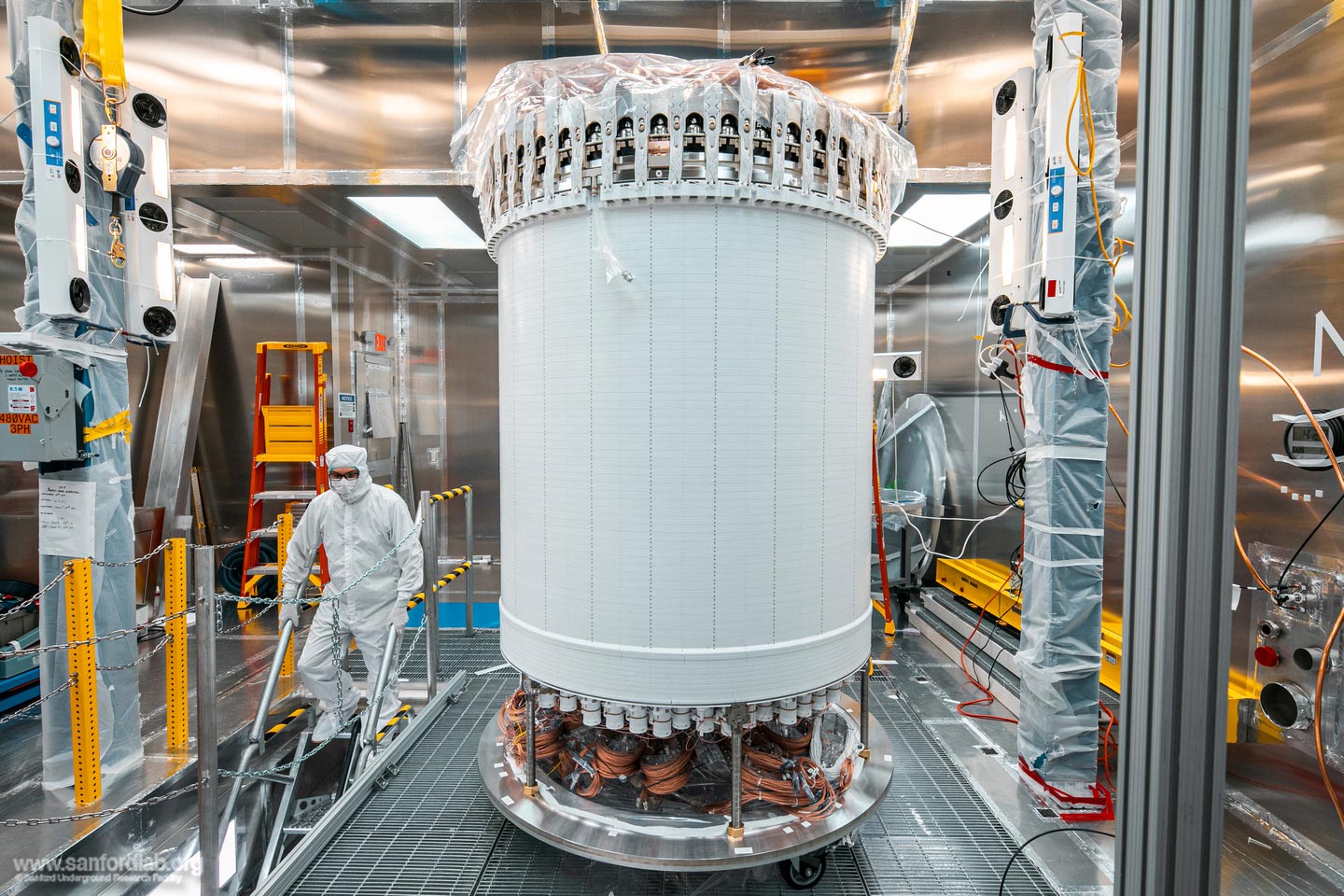 LZ’s central detector, the time projection chamber, in a surface lab clean room before installation underground. Credit: Matthew Kapust/Sanford Underground Research Facility
A Dark Matter Detector Deep Underground
LZ brings together 250 scientists and engineers from 39 institutions. Managed by the U.S. Department of Energy’s Lawrence Berkeley National Laboratory (Berkeley Lab), the detector operates nearly one mile underground at the Sanford Underground Research Facility (SURF) in South Dakota.
At its core are 10 tonnes of extremely pure liquid xenon. Scientists use this material to watch for possible encounters with dark matter particles, particularly hypothetical particles known as WIMPs, or weakly interacting massive particles.
The latest findings were presented during a scientific talk at the 2026 TeV Particle Astrophysics conference in Japan. The paper is expected to be posted on the online repository arXiv and submitted to Physical Review Letters.
“We’re very intrigued to see this event in the data, in the region where we expect dark matter to show up and the competing backgrounds are very low,” said Rick Gaitskell, a professor at Brown University and the spokesperson for LZ. “With only one event, we don’t want to get ahead of ourselves. We are not claiming to have seen dark matter. But we have seen something interesting that we want to share with the scientific community for their input.”
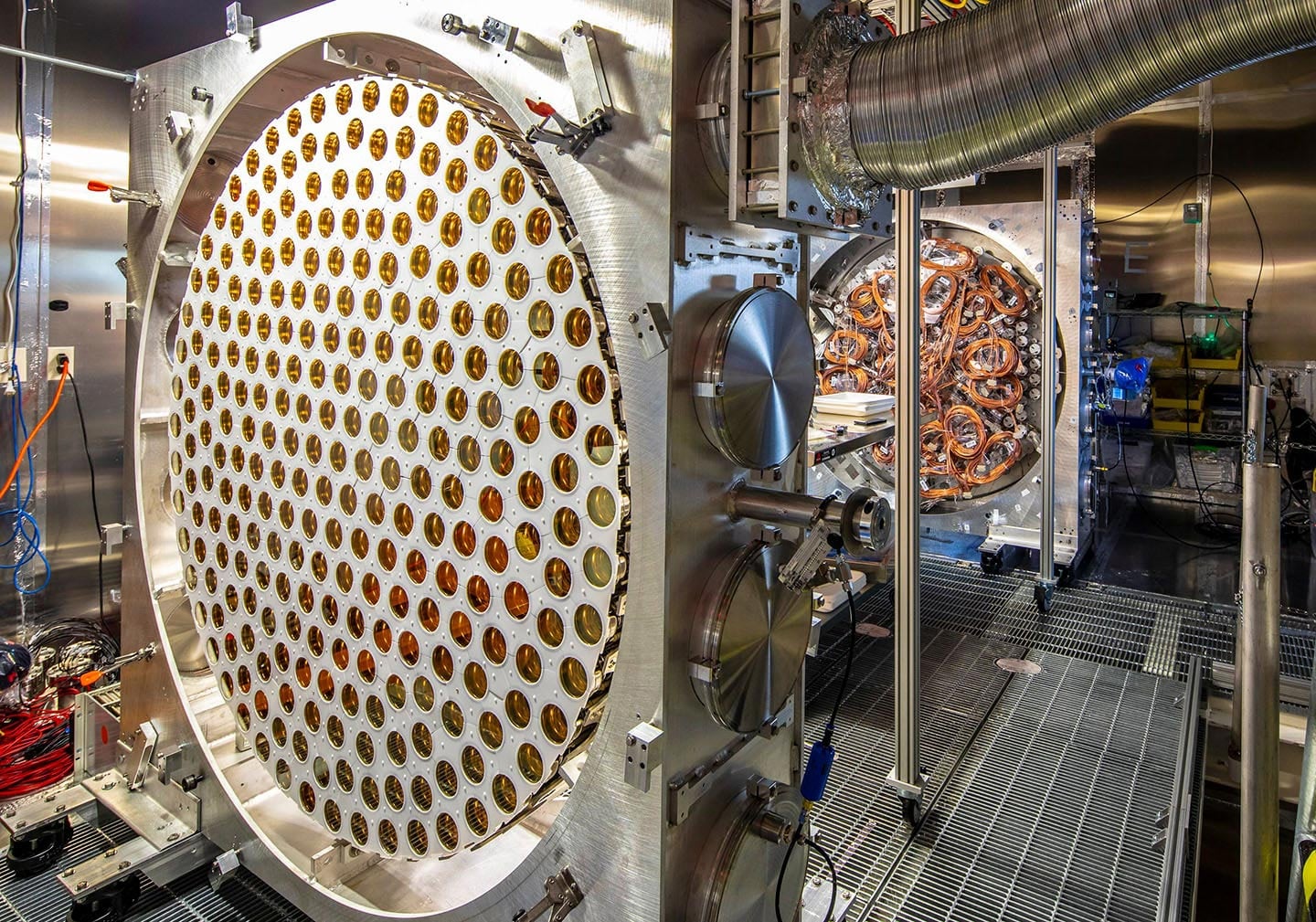 To search for dark matter, LZ uses photomultiplier tubes (shown here before installation in the detector) to capture light from particle interactions. Credit: Matthew Kapust/Sanford Underground Research Laboratory
Expanding the Search for WIMPs
The LZ team examines its experimental observations in separate batches. For this analysis, researchers studied 220 live days of data gathered between March 2023 and April 2024.
Scientists had already examined the same dataset for faint signals produced by the simplest possible forms of WIMP interactions. This time, they broadened the search to include other potential WIMP interactions capable of releasing greater amounts of energy inside the detector. LZ is particularly well suited to detecting these types of events while keeping the risk of false positives low.
“This was a detailed study in a region we hadn’t explored within this dataset, and we spent months of additional effort to understand all the possible causes of background events,” said Sam Eriksen, a senior research associate at the University of Bristol in the U.K. and lead author of the study. “We understand our detector and the backgrounds so well that even a single outstanding event, like the one we found, is important. We expect dark matter events to be extremely rare, so only a handful could mark the first detection of WIMP dark matter.”
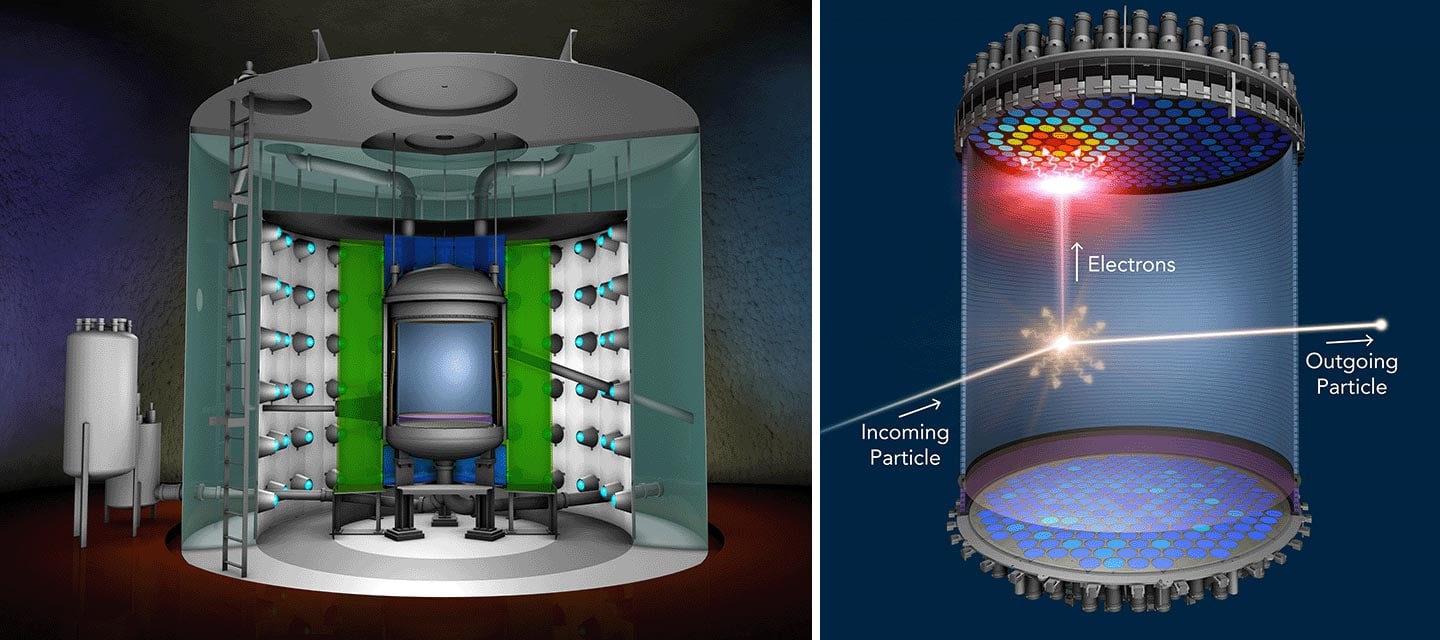 LZ uses a cylindrical chamber full of liquid xenon to search for dark matter. It is surrounded by additional layers to detect or block background particles (left). When a WIMP collides with a xenon atom (right), it emits a flash of light and electrons. The light is detected at the top and bottom of the liquid xenon chamber. An electric field drifts the electrons to the top of the chamber, where they generate a second flash of light. Credit: Greg Stewart/SLAC National Accelerator Laboratory
What the Mysterious Event Could Mean
If dark matter really produced the unusual event, the responsible WIMP would probably have a mass of at least 200 GeV/c2 (gigaelectronvolts), making it more than 200 times as massive as a proton.
Such a result would also point toward a particular kind of interaction between WIMPs and ordinary matter that goes beyond the simplest models scientists have traditionally searched for.
For now, however, the evidence is not strong enough to qualify as a discovery. Particle physicists generally require a result to reach “5-sigma” significance before making that claim. The new LZ analysis stands at 2.6 sigma, corresponding to about a 0.5% chance that known background processes could account for the event.
More observations will help determine whether the signal becomes increasingly significant or eventually disappears into the statistical background. LZ has already collected the world’s largest dataset for dark matter searches and will continue gathering WIMP data at SURF, giving researchers much more information to work with.
How LZ Searches for Invisible Matter
Dark matter cannot be seen directly, so LZ searches for indirect evidence of a particle collision. When energy is deposited inside the detector, the liquid xenon can produce characteristic flashes of light that sensitive instruments record.
The challenge is separating a potential dark matter interaction from signals generated by ordinary particles. LZ uses several layers of protection and analysis to accomplish this.
Nearly a mile of rock above the experiment blocks much of the cosmic radiation arriving from space. A surrounding water tank and additional outer detectors help shield the central instrument from background neutrons. Researchers also use sophisticated computational methods to identify different types of particle interactions and eliminate events that imitate the signatures expected from dark matter.
An Outlier That Survived Close Scrutiny
Unexpected events are not unusual in experiments this sensitive. In most cases, closer examination eventually reveals an ordinary explanation. What makes this particular event unusual is that researchers have so far been unable to identify such an explanation.
“Outlier events in the data are not unexpected, but they usually stand out as a background of some kind when you look at them deeper,” said Aaron Manalaysay, a physicist at Berkeley Lab and the chair of LZ’s Institutional Board. “This is the first example in any experiment I’ve worked on of an outlier that appears valid in every way. Of course, we’re still twisting our brains trying to think if there’s a rare background mechanism we could’ve missed, but it’s thrilling to wonder if this could be the first hint of a dark-matter observation.”
Whether that possibility survives further scrutiny will depend on what LZ sees as its dataset continues to grow.
Reference: “Search for dark matter particle interactions in an extended nuclear recoil energy window with the LUX-ZEPLIN (LZ) experiment” by D.S. Akerib, A.K. Al Musalhi, B.J. Almquist, C.S. Amarasinghe, A. Ames, T. Anderson, N. Angelides, H.M. Araújo, J.E. Armstrong, M. Arthurs, A. Baker, S. Balashov, J. Bang, J.W. Bargemann, E.E. Barillier, D. Bauer, K. Beattie, A. Beauchene, T.L. Benson, A. Bhatti, T.P. Biesiadzinski, H.J. Birch, E. Bishop, G.M. Blockinger, B. Boxer, C.A.J. Brew, P. Brás, S. Burdin, M.C. Carmona-Benitez, M. Carter, A. Chawla, J.J. Cherwinka, Y.T. Chin, S. Contreras, M.V. Converse, R. Coronel, A. Cottle, C. Coulson, G. Cox, C.E. Dahl, I. Darlington, S. Dave, J. Delgaudio, S. Desai, S. Dey, L. de Viveiros, L. Di Felice, C. Ding, J.E.Y. Dobson, E. Druszkiewicz, S. Dubey, C.L. Dunbar, S.R. Eriksen, S. Fayer, N. Fieldhouse, S. Fiorucci, H. Flaecher, E.D. Fraser, T.M.A. Fruth, P.W. Gaemers, R.J. Gaitskell, A. Geffre, J. Genovesi, C. Ghag, J. Ghamsari, A. Ghosh, S. Ghosh, R. Gibbons, S. Gokhale, J. Green, M.G.D.van der Grinten, J.J. Haiston, C.R. Hall, T. Hall, R.N. Hampp, S.J. Haselschwardt, M.A. Hernandez, S.A. Hertel, G.J. Homenides, M. Horn, T. Horoho, D.Q. Huang, W. Hulse, D. Hunt, E. Jacquet, R.S. James, K.R. Jenkins, A.C. Kaboth, A.C. Kamaha, D. Khaitan, A. Khazov, J. Kim, Y.D. Kim, D. Kodroff, Q.C. Kong, E.V. Korolkova, H. Kraus, S. Kravitz, L. Kreczko, V.A. Kudryavtsev et al., 2 September 2026, arXiv.
arXiv:2609.02823
LZ is supported by the U.S. Department of Energy, Office of Science, Office of High Energy and Nuclear Physics, and the National Energy Research Scientific Computing Center, a DOE Office of Science user facility. LZ is also supported by the Science & Technology Facilities Council of the United Kingdom; the Portuguese Foundation for Science and Technology; the Swiss National Science Foundation; the Australian Research Council Centre of Excellence for Dark Matter Particle Physics; and the Institute for Basic Science, Korea. Thirty-nine institutions of higher education and advanced research provided support to LZ. The LZ collaboration acknowledges the assistance of the Sanford Underground Research Facility.
Never miss a breakthrough: Join the SciTechDaily newsletter.
Follow us on Google and Google News.










![Visiting Fukui can teach travelers how to make, and smash, Japanese kawara tiles [Photos]](https://soranews24.com/wp-content/uploads/sites/3/2026/09/x-gif-3-810024490-17.jpg?w=1000&h=525&crop=1)













 English (US) ·
  French (CA) ·
  French (FR) ·