

PROTECT YOURSELF with Orgo-Life® QUANTUM TECHNOLOGY
Orgo-Life the new way to the future Advertising by Adpathway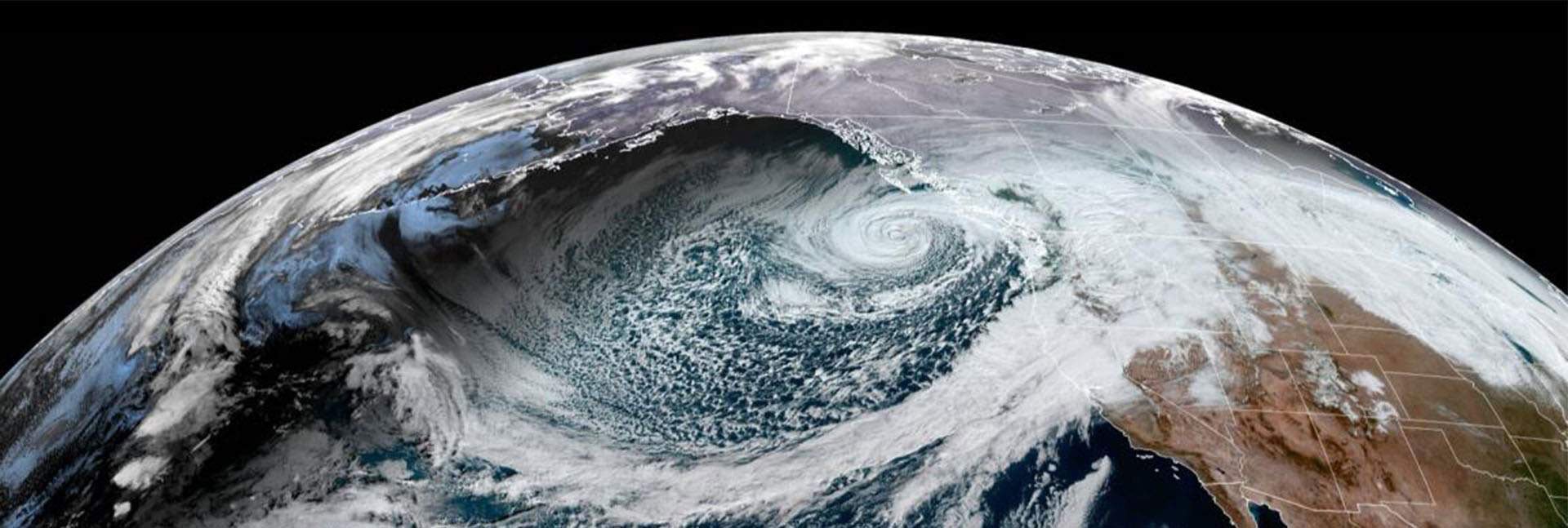 Satellite image of a winter storm in western North America. Credit: Cooperative Institute for Research in the Atmosphere (CIRA)
North Pacific winter storm paths are moving toward the North Pole faster than scientists expected.
In Alaska, glaciers are losing about 60 billion tons of ice each year. Farther south, across California and Nevada, heat and dryness records are falling, leaving landscapes more prone to wildfire. These changes may seem separate, but both are tied to a major shift over the North Pacific Ocean.
Winter storm tracks, the usual paths followed by powerful weather systems, are moving northward. These storms act like atmospheric conveyor belts, carrying heat and moisture from warmer parts of the planet toward the pole. As their paths shift closer to the Arctic, Alaska receives more of that heat and moisture, while the southwestern United States loses some of the natural atmospheric flushing that helps moderate temperatures.
Storm shift outpaces models
Research published in Nature by Dr. Rei Chemke of the Weizmann Institute of Science’s Earth and Planetary Sciences Department and Dr. Janni Yuval of Google Research finds that this northward movement is happening faster than climate models have projected.
 Dr. Rei Chemke. Credit: Weizmann Institute of Science
To test whether the shift was part of ordinary climate swings or a sign of human-driven warming, the researchers used a new metric based on sea-level pressure, a measurement that has been collected consistently for decades. That long record gave them a way to separate background variability from a lasting climate signal. Their analysis indicates that the storm track shift is not natural variability, but a clear result of climate change.
Models may understate risk
The result fits with several earlier studies by Chemke suggesting that storm tracks are changing quickly and that climate models may not fully capture those changes. That matters because storm tracks help shape where heat, moisture, drought, and storms concentrate, especially across western North America.
“Our preparedness for future climatic change relies on the ability of models to make accurate predictions,” Chemke says. “The fact that models fail to capture the effect of climate change on the recent northward shift of storm tracks – and its consequences for western North America – suggests that changes in this region may be even more dramatic than we currently expect.”
Reference: “Climate change shifts the North Pacific storm track polewards” by Rei Chemke and Janni Yuval, 7 January 2026, Nature.
DOI: 10.1038/s41586-025-09895-y
This work is supported by the Israeli Science Foundation Grant 407/25.
Never miss a breakthrough: Join the SciTechDaily newsletter.
Follow us on Google and Google News.


















 English (US) ·
  French (CA) ·
  French (FR) ·