

PROTECT YOURSELF with Orgo-Life® QUANTUM TECHNOLOGY
Orgo-Life the new way to the future Advertising by Adpathway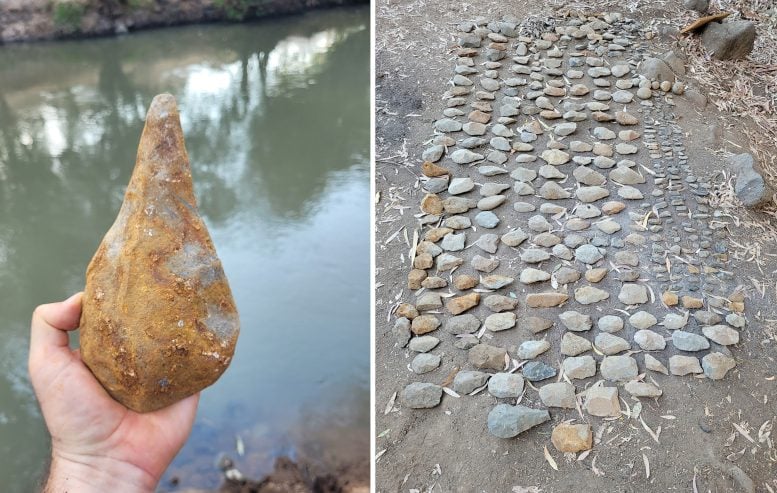 The elephant remains were discovered alongside basalt handaxes and cleavers, hallmark tools of the Acheulian tradition, one of the earliest and most widespread stone-tool technologies in human history. Credit: Tel-Hai University of Kiryat Shmona in the Galilee and Hannah Farrell, University of Haifa
A giant elephant’s tooth has preserved clues to the watery world that sustained early humans nearly 700,000 years ago.
Researchers studying elephant remains from Gesher Benot Ya’aqov (GBY-NBA) in northern Israel have reconstructed a Pleistocene environment rich in water, vegetation, and wildlife. Published in Quaternary Science Reviews, the study reveals the landscape shared by enormous mammals and some of the region’s earliest human toolmakers.
Led by Hannah Farrell (a PhD candidate at Haifa University), the research examined molar and tusk fragments excavated by Prof. Gonen Sharon of Tel-Hai University of Kiryat Shmona in the Galilee and his colleagues. The site, Gesher Benot Ya’aqov (Daughters of Jacob Bridge), sits in the Jordan Rift Valley, south of today’s Hula Valley.
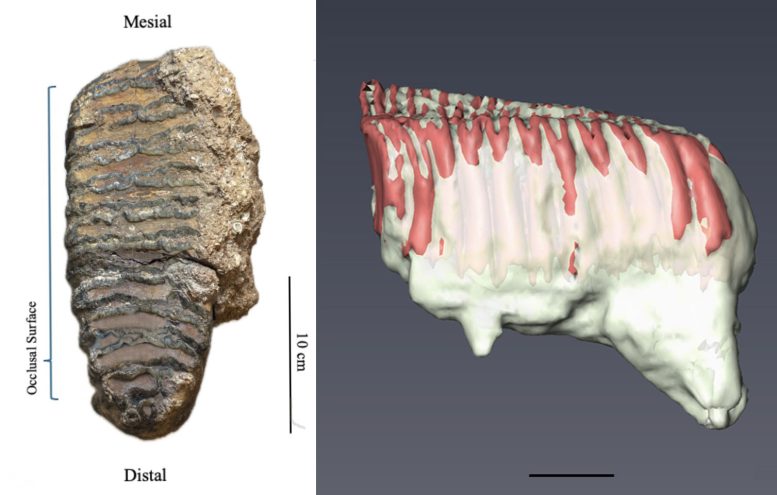 Rather than studying the elephant alone, researchers used the tooth as a biological archive to reconstruct the broader ecosystem shared by large mammals and early human toolmakers. Credit: Tel-Hai University of Kiryat Shmona in the Galilee and Hannah Farrell, University of Haifa
The fossils belonged to Palaeoloxodon antiquus, the straight-tusked elephant, one of the largest land mammals of the Pleistocene. Nearby basalt handaxes and cleavers place early humans in the same setting. These tools belong to the Acheulian tradition, among the earliest and most geographically widespread stone tool technologies in human history.
An Elephant Tooth Holds Environmental Clues
The tooth offered more than a way to identify the animal. Its structure, microscopic wear, and chemical composition provided different lines of evidence about its life and surroundings. The team combined CT scanning, 3D reconstruction, microscopic wear analysis, isotope geochemistry, and pollen studies to piece together the broader ecosystem.
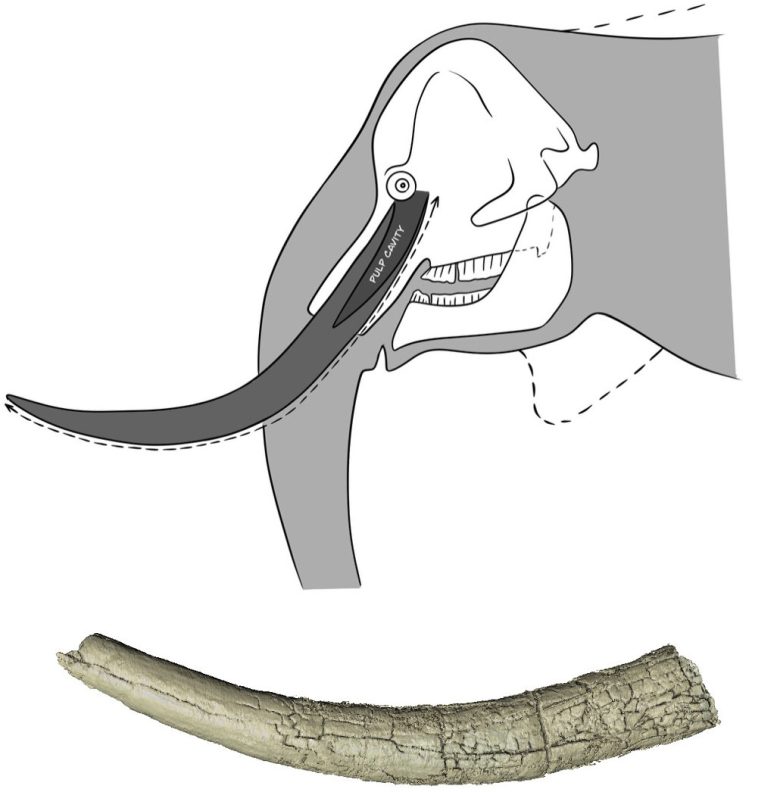 The remains belong to Palaeoloxodon antiquus, the straight-tusked elephant, one of the largest land mammals of the Pleistocene. Credit: Tel-Hai University of Kiryat Shmona in the Galilee and Hannah Farrell, University of Haifa
The results point to an enduring landscape of woodlands, grasslands, marshes, rivers, and shallow-water habitats. Carbon isotope values suggest that the elephant lived where water remained consistently available. Pollen recovered from sediments added detail to that picture, revealing reeds, sedges, willows, tamarisks, and aquatic plants.
Together, the findings suggest that the Hula Valley region was a stable ecological refuge within the Levantine Corridor, the land bridge connecting Africa and Eurasia. Reliable water and biological resources likely made this landscape a valuable stopping point or habitat for wildlife and human groups moving through the region.
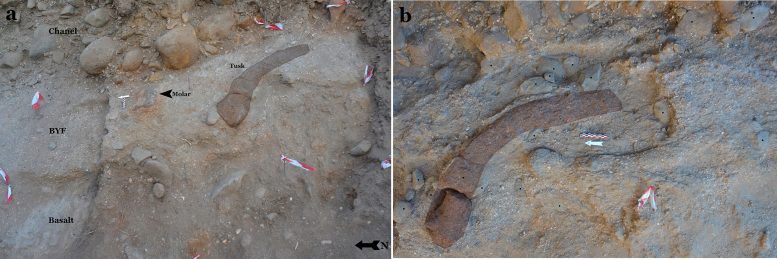 The research focuses on a giant elephant molar and tusk fragments discovered alongside Acheulian stone tools at Gesher Benot Ya’aqov in northern Israel. The remains belonged to Palaeoloxodon antiquus, the straight-tusked elephant, one of the largest land mammals of the Pleistocene. Credit: Tel-Hai University of Kiryat Shmona in the Galilee and Hannah Farrell, University of Haifa
According to Sharon, “understanding how humans and animals responded to environmental change hundreds of thousands of years ago helps us better understand the forces that shaped our species.”
“The availability of water, vegetation, and animal resources shaped where humans and wildlife could survive,” Sharon says. “The wetlands, rivers, and woodlands of the Hula Valley helped sustain life along one of the world’s earliest migration corridors, offering a rare opportunity to understand the ecological conditions that supported both animals and human populations nearly 700,000 years ago.”
Reference: “Elephant dental remains from the Acheulian site at North Bridge Acheulian–Gesher Benot Ya’aqov: hominin behavior and environmental implications” by Hannah Farrell, Gonen Sharon, Minji Jin, Dafna Langgut, Cheryl A. Makarewicz and Nimrod Marom, 14 September 2026, Quaternary Science Reviews.
DOI: 10.1016/j.quascirev.2026.110277
Never miss a breakthrough: Join the SciTechDaily newsletter.
Follow us on Google and Google News.






















 English (US) ·
 French (CA) ·
 French (FR) ·