

 4 hours ago
2
PROTECT YOURSELF with Orgo-Life® QUANTUM TECHNOLOGY
Orgo-Life the new way to the future Advertising by Adpathway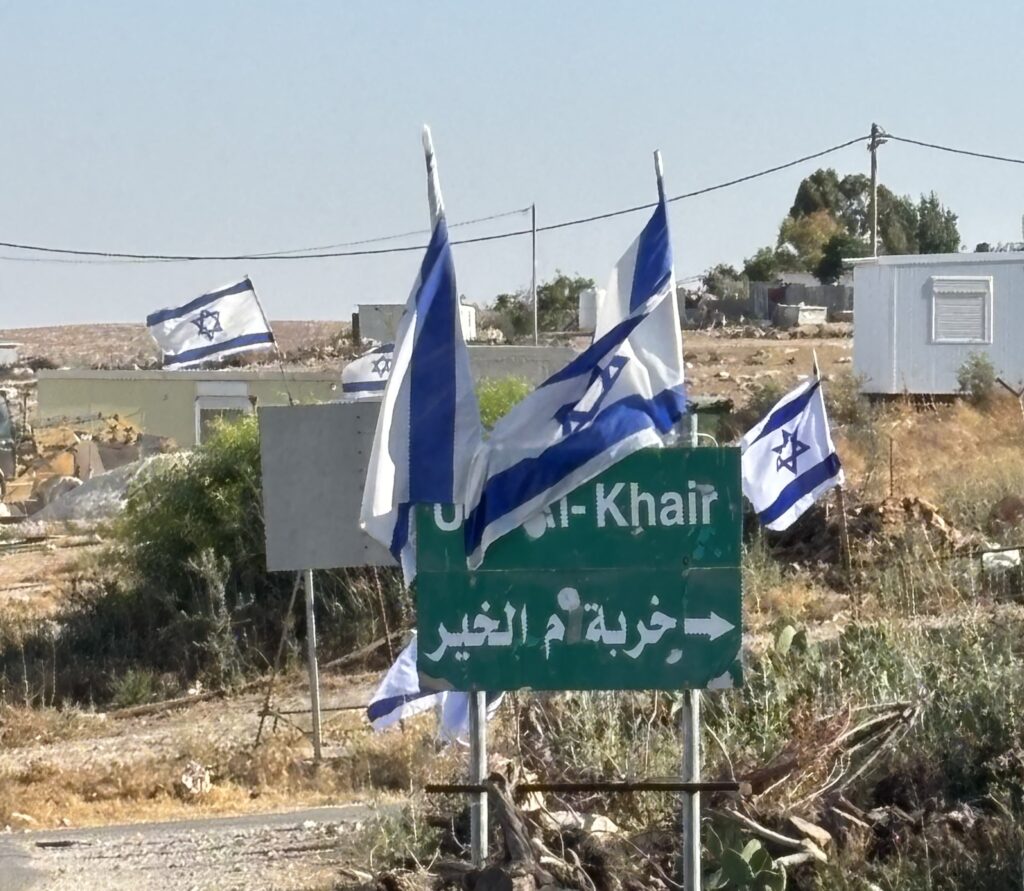
The entrance to Umm al-Khair in the occupied West Bank. Photograph by Jasper Nathaniel.
This February, the Israeli military installed a gate across a busy road in the South Hebron Hills. It was a simple contraption, maybe twenty feet of yellow steel that swung open like the door of a cattle pen—one of hundreds erected across the West Bank. But this one blocked the only drivable road into the tiny Palestinian village of Umm al-Khair as well as more than twenty other shepherding communities, home to thousands of people.
For the past nine months, soldiers have routinely locked the gate for days at a time, preventing residents from reaching work or school, blocking deliveries of food and supplies, and limiting access to hospitals and emergency medical care. Those who manage to drive through during a brief opening may return to find it locked, leaving them stranded on the wrong side, with no way home. Whenever soldiers close the gate, life in Umm al-Khair grinds to a halt. A closed gate also serves as a warning: a settler attack may be coming.
Umm al-Khair was founded by Palestinian Bedouins expelled from the Negev during the Nakba of 1948. It sits in the shadow of the Israeli settlement of Carmel, which was built on land confiscated from the village in 1980. For decades, settlers backed by the Israeli state have encroached on the land that remains. In the summer of 2025, a group of settlers established an outpost—an unauthorized settlement, illegal even under Israeli law—by installing several mobile homes directly adjacent to Umm al-Khair and moving into them. The construction set off a new wave of violence, one that drew international attention when a settler opened fire on a crowd of Palestinians, killing the community leader Awdah Hathaleen in front of his three-year-old son.
When I got dropped off at the gate on the evening of October 27, 2026, it had been locked for four days—the longest stretch since it went up in February. I was visiting Umm al-Khair as a journalist and activist, alongside my colleagues Andrey Khrzhanovskiy and Adele Shoko, both Russian nationals turned Israeli citizens now living in the West Bank. Andrey, who publishes under the name Andrey X, is one of the region’s most prolific non-Palestinian activists, as well as one of Israeli settlers and soldiers’ most frequent targets. A friend met us on the Umm al-Khair side and drove us into the village.
Residents and activists at the Umm al-Khair gate on October 26, 2026. Filmed by Mothers Against Violence, via Genocide.live.
At ten the next morning, we heard the familiar rumble of military jeeps and rushed to the gate, arriving just in time to see soldiers unlocking it. They gave no explanation of their actions—the IDF rarely does. As word spread, cheers erupted. Cars rushed in and out as residents hurried to work, visited nearby friends and family, and shopped for groceries in Yatta, the nearest city. It didn’t last. At 10:45 A.M., a local settler named Shimon Atiya arrived and locked the gate back up.
Shimon is the founder of an illegal farming outpost near Umm al-Khair. He’s an angry man, perpetually talking into an earpiece, known for overturning dumpsters and kneeing men in the groin. Though he carries a military-grade assault rifle, he is not in the IDF and has no formal authority in the sprawling military occupation that governs Palestinian life. But Israel’s de facto annexation of the West Bank relies on civilian enforcers like him. While the military has long maintained the facade of complying with international law, settler leaders like Shimon make no such pretense. They effectively command state-backed militias of men and adolescents who terrorize Palestinian residents to drive them from their land. Once the Palestinians are gone, the Israeli government may retroactively legalize the settlers’ outposts as “neighborhoods” of existing settlements or as new settlements altogether.
In Umm al-Khair, Israeli soldiers arrived at about 3 P.M. They had with them a photo of me and Andrey, likely taken by Shimon hours before. They told the residents to bring us to them. Once we got there, a soldier showed us a map of a newly declared Closed Military Zone (CMZ)—an arbitrary designation used to expel activists and journalists from Palestinian villages—and ordered us to leave.
Ostensibly, CMZs restrict all nonresidents from a designated area. But while we were speaking, a settler drove straight through the restricted zone. When I asked the soldier in charge whether he intended to expel the settler, he shook his head. The order, it seemed, applied only to us. Even so, the map left a small part of the village unrestricted. We pointed this out, and the soldiers reluctantly allowed us to stay. But if we entered the restricted area, they warned us, we would be placed under arrest.
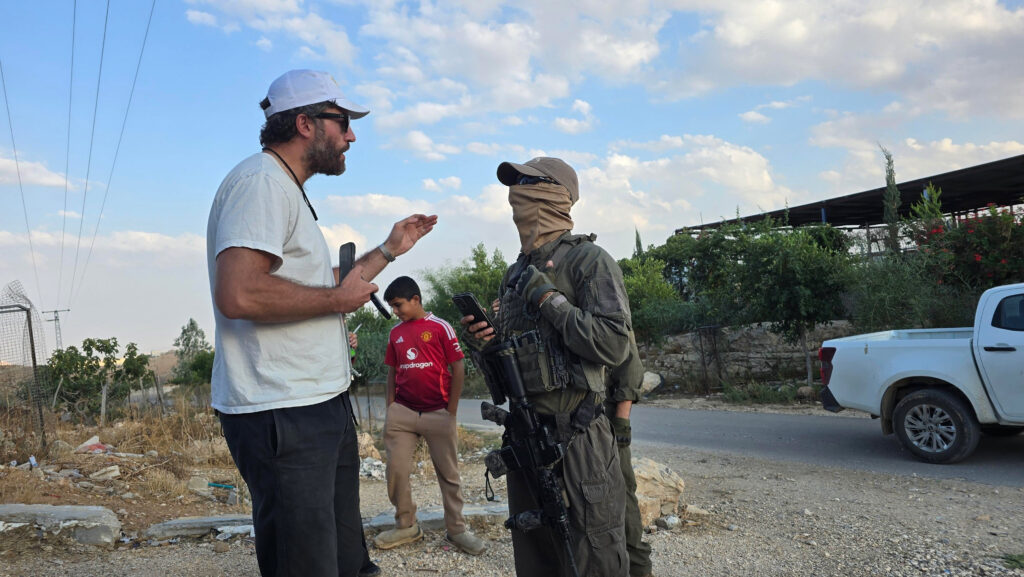
A soldier directing Nathaniel to leave the CMZ on October 28, 2026. Photograph by Adele Shoko.
*
Two hours later, a resident of Umm al-Khair found me outside the home of Hanady Hathaleen, Awdah’s widow, in the small part of the village not subject to the military order. He asked if I could head to the gate to wait with a Palestinian man from a neighboring village who was afraid to stand there alone. Earlier that day, at around two, the man had tried to drive around the gate—a maneuver that residents whose cars have four-wheel drive capability sometimes attempt, despite the risk of being shot by settlers. Nevo Nadalski, Carmel’s head of security, had raced to the gate, forced him out of his vehicle, and confiscated his keys. Nevo told the man to return in three hours to collect them.
Like Shimon Atiya, Nevo is a local settler with no formal authority in the military occupation. He often plays the proverbial “good cop” to Shimon’s “bad cop,” showing up at the scene of settler attacks and pretending to de-escalate while actually providing cover for the assailants. Many Umm al-Khair residents blame him for Awdah’s murder. They believe he instructed an Israeli construction worker to drive his excavator through the village, provoking the confrontation that led to Awdah’s death.
I joined the Palestinian driver at the gate at 5:20 P.M.—three and a half hours had passed with no sign of Nevo or the man’s keys. Andrey and Adele arrived from elsewhere in the village at around the same time. We watched as a Palestinian car pulled up on the other side and unloaded food supplies, passing them under the gate to a car on the village side. Later, a mother with four small children got out of a taxi, paid the fare, and ran with her family to their home.
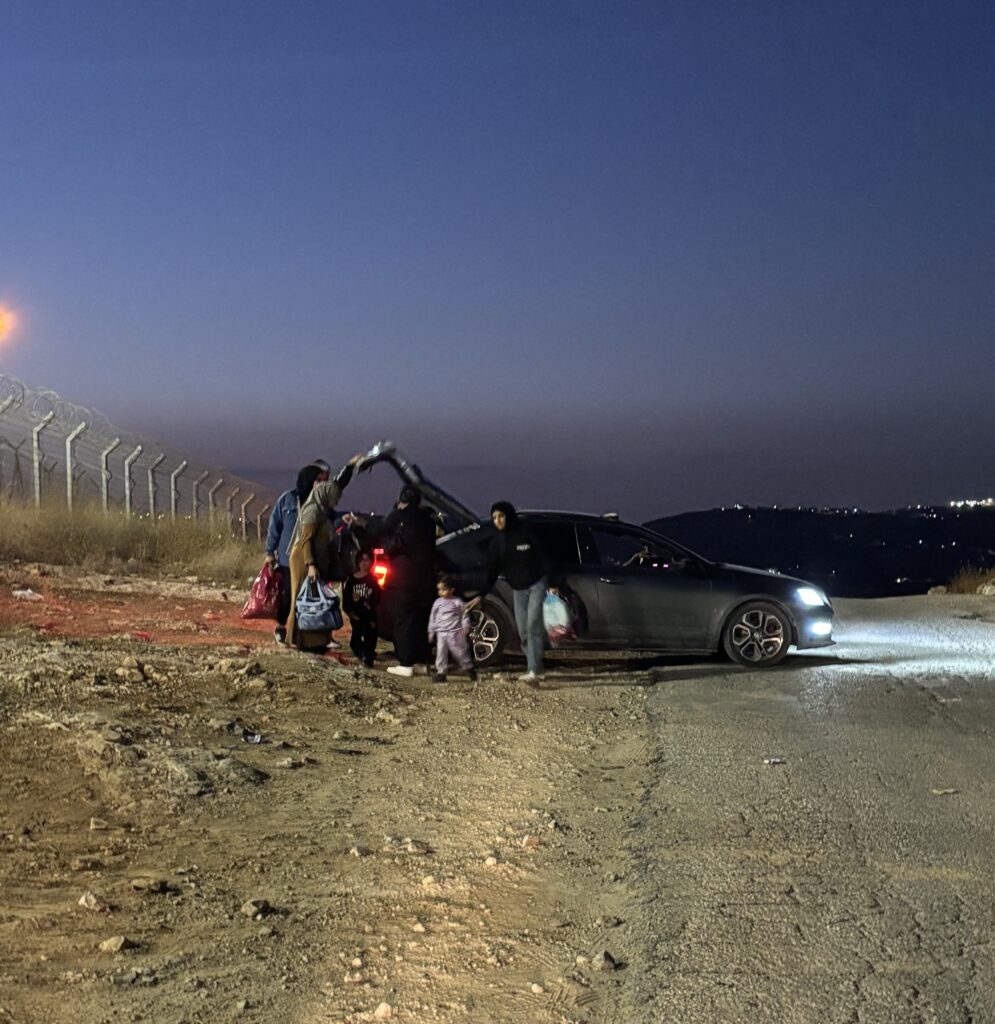
A family from Umm al-Khair getting dropped off on the other side of the gate. October 28, 2026. Photograph by Jasper Nathaniel.
None of this seemed out of the ordinary. Then, at 6:15 P.M., a white pickup truck driven by a settler approached from the Umm al-Khair side. (The settlers have alternative roads they can take to Carmel and other settlements, but often prefer to speed through the village when the gate is unlocked, scattering children who play in the street.) The truck stopped and a smirking, curly-haired settler who looked to be in his late teens or early twenties climbed out of the passenger seat. As the Palestinian man fled, the settler produced a key and unlocked the gate. He swung the gate open, waited for the truck to pass through, then closed and locked it behind him.
Andrey, Adele, and I have spent years reporting from the West Bank. Even so, we were shocked. We’d long known that the military could lock Palestinians in place at will. We had learned, months ago, that Shimon also had his own key. But we hadn’t expected to see some random settler, possibly a minor, casually let himself through, then lock the gate behind him. Thousands of Palestinians lived on the other side, and apparently he, too, had the power to decide when they could come and go.
The three of us began filming. Andrey approached the settler to ask how he had gotten a key, but he only smiled and walked back toward the truck. Still filming, Andrey followed, now turning his camera on the driver to ask the question again: “Who gave you this authority?” He stood several feet away from the window. The driver was a large man with brown teeth, a crusty beard, and, we soon discovered, no socks or shoes. We later learned his name, Tomer Liani. He lived in Havat Ma’on, a settlement on Palestinian land two miles away, and had served in the IDF during the genocide in Gaza. Tomer turned his own phone on Andrey and asked, outraged, what authority Andrey had to film him.
Tomer opened the driver’s-side door, revealing an M16 assault rifle slung across his chest. The curly-haired settler began to kick Andrey. Tomer then grabbed Andrey by the collar, snatched his phone away, and struck him in the face with it three times, breaking his glasses and his nose. When I tried to pull Andrey away, Tomer punched me in the eye.
Nathaniel, Andrey X, and Tomer Liani. Filmed by Jasper Nathaniel.
I finally freed Andrey from Tomer’s grip. The settlers climbed back into their truck, still holding his phone. He blocked their way, demanding that they return it. Tomer edged his truck forward, forcing Andrey aside. When Adele reached through his window for the phone, Tomer grabbed her glasses and hit the gas, dragging her several feet and spraining her wrist.
The settlers now had a clear path to drive away. Instead, Tomer flew into a rage. He got out of the truck, cocked his rifle, aimed it at Andrey, and started to shout: “I’ll shoot you! I’ll shoot you!” His nose was bleeding, apparently as a result of the scuffle, and he pointed at it, yelling, “See what you did!” He ordered Andrey onto the ground. When Andrey raised his hands and tried to back away, Tomer grabbed him and forced him onto the pavement.
Adele and I were still filming, but I knew that if we both stayed, there was a good chance we’d get our phones taken too. I whispered to her to run back to the village with hers so we’d have footage of how the attack had started. The settlers, focused as they were on Andrey, didn’t notice Adele slip away.
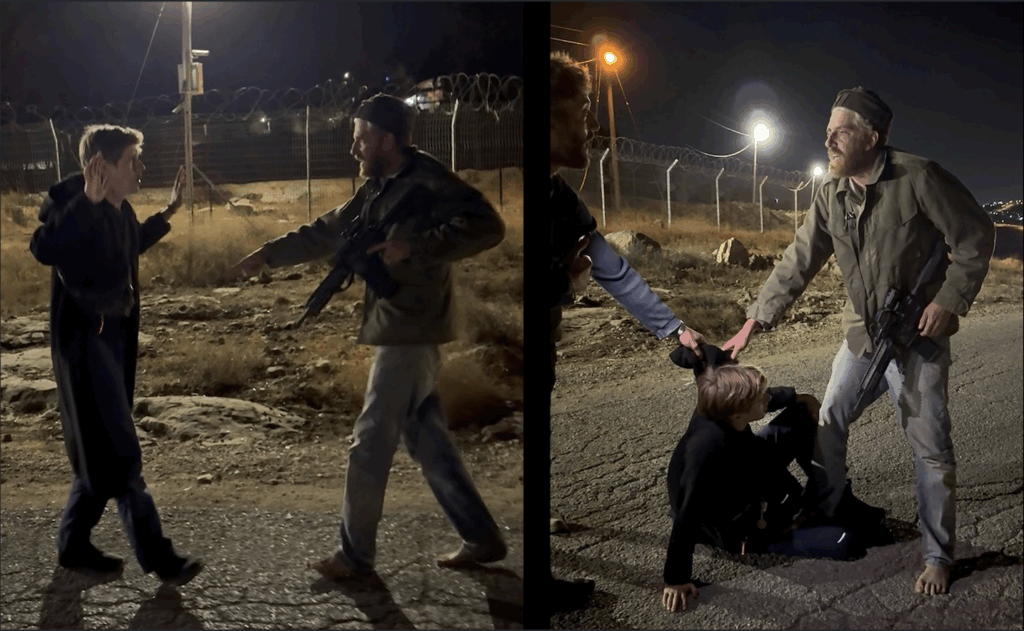
Photographs by Adele Shoko.
Tomer stood over Andrey now, holding him down by his jacket, kneeing him in the head, and stepping on his face with his bare feet—which, I noticed, were caked with filth. I tried to de-escalate. “We’re leaving,” I said—but Tomer pointed his rifle at me, shouting, “It’s not over!” When I grabbed Andrey’s jacket and tried to pull him away, Tomer trained his rifle on my chest. Leaning down, he whispered in Andrey’s ear, addressing him by name: “You made the worst mistake of your life, Andrey.”
Then the settlers tried to drag Andrey into the truck. I grabbed his jacket, a tug-of-war broke out, and, once again, Tomer pointed his rifle at me as his younger accomplice kicked and punched me. Andrey looked over at me and said, wide-eyed: “Don’t let them put me in the truck.”
Shimon Atiya and Nevo Nadalski arrived soon thereafter, armed with assault rifles too. Tomer seemed to have given up trying to get Andrey into his truck, but the leaders’ presence emboldened him. He dragged Andrey across the ground by his hair, slapped him, kneed him, stepped on him, pulled him up, and body-slammed him back down. At one point, Tomer spit in his hand and rubbed it across Andrey’s face.
When I shouted at Shimon and Nevo to put a stop to it, both men laughed. “He’s resisting,” Nevo said, grinning. “Resisting who?” I snapped, pointing to Tomer. “What authority does he have?” Then, Tomer lifted Andrey’s head and smashed it against the concrete.
Andrey screamed. I tried to reach him, but Nevo and Shimon blocked me. “Jasper, I’m nauseous,” Andrey called out. “I think I have a concussion.”
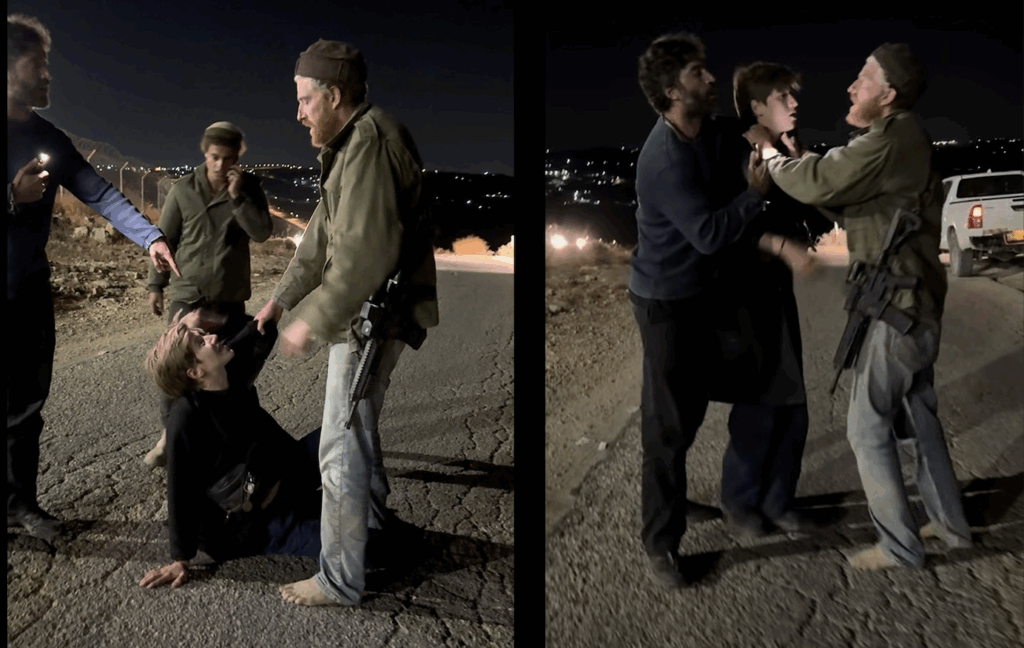
Photographs by Adele Shoko.
*
At about 6:40 P.M., the military and police arrived. I was sure the settlers had called them to arrest us. Tomer clicked the safety back on his gun. The soldiers wouldn’t let me approach Andrey either, and my pleas for an ambulance went unanswered. They left Andrey lying on the ground, drifting in and out of consciousness, without medical assistance for more than twenty minutes. One of the soldiers filmed him, laughing, then panned over to me.
Other settlers began trickling down from Carmel, many bearing assault rifles too. They high-fived our attackers and then mingled with soldiers and police, smiling, chatting, and filming us. Some took selfies with Andrey’s motionless body. Other activists arrived to document the scene, but soldiers held them back, threatening them with arrest.
By this point, I was shouting at the soldiers and police to call for an ambulance. Annoyed, one soldier told me that an ambulance had already arrived and pointed to the top of a nearby hill, where an Israeli emergency vehicle had parked. It did not drive any closer. Instead, a Palestinian ambulance pulled up. Two paramedics rushed out and began examining Andrey, checking his eyes, speaking to him, applying ice to his head. The soldiers ordered them away at gunpoint. Only then did the Israeli ambulance approach. A settler paramedic got out and stood by watching as the soldiers harassed his Palestinian counterparts.
I was still shouting, demanding that the police arrest Tomer and his young accomplice. I told them that Tomer had stolen Andrey’s phone and all they needed to do was search his truck to find it. Instead, three police officers swarmed me and snatched my own phone. I was under arrest, they announced. They dragged me away and shoved me into the back of a police jeep. Settlers lined up to wave at me and photograph me through the window.
Days later, Andrey described what had happened after my arrest. The cops offered him a choice between going to the hospital or the police station. Andrey chose the hospital, and the settler paramedic promised to take him there. (“Don’t worry,” the paramedic said, gesturing at the other settlers, “I’m not with them.”) Once Andrey was in the ambulance, the paramedic drove a few hundred yards, just out of view of the activists’ cameras. He took Andrey’s blood pressure and nothing else: no questions, no neurological exam. Then he helped the police lift Andrey out of the ambulance and shove him into a patrol car.
The arrest on October 28, 2026. Filmed by a witness who prefers to remain anonymous.
*
When I arrived at the police station in the Kiryat Arba settlement—where the national security minister, Itamar Ben-Gvir, lives—officers handcuffed me and shackled my legs. As they led me inside, I saw Andrey being taken from another police car and placed in shackles of his own. My eye was swollen, the side of my face cut and bruised. Andrey was nodding off, his nose bloodied. We were not offered medical treatment.
The officer sitting at the front desk was a bald, gray-bearded, portly man we’d come to refer to as the Burger King. As we entered, he stood up and pointed at me, his face red, shouting, “You son of a bitch!” If he recognized me—as Tomer had recognized Andrey—he didn’t say. The guards sat us in chairs facing each other. I tried to keep Andrey responsive by talking to him and snapping my fingers, but the officers kept ordering me to be quiet. Andrey had suffered a head injury, I explained. I was trying to keep him awake. “Since when is this what you do for a head injury?” an English-speaking officer asked. I told him to Google it. He didn’t. I kept calling out to Andrey until one cop turned my chair around to face the wall, as if putting me in a time-out.
I asked the English-speaking officer whether he’d heard about an attack from earlier that month, when Heidi Levine, a Washington Post photographer, was nearly beaten to death by settlers. Surely he’d heard about it, I said. The whole thing had been captured on video: masked settlers kicking her, beating her with clubs as she lay on the ground—leaving her with four fractured vertebrae, a broken rib, puncture wounds to her back and buttocks, and a finger cut down to the bone—before several Palestinians, Andrey, and I got her to safety. The incident had made international news. Even Netanyahu had weighed in, though he’d blamed “Arabs and far-left activists” for the “alleged” attack and claimed that a settler had come to Heidi’s rescue.
I told the officer to Google “Heidi Levine” along with our names. He pretended to ignore me. But out of the corner of my eye, I watched him pull up the video and press play, then scroll through headlines.
He turned to the other officers and spoke to them in a nervous whisper. A few moments later, they turned my chair around to face Andrey. They stopped yelling every time I spoke to him. We were given sandwiches, and the Burger King began speaking to me in his own limited English. It was the day after the election in Israel; he’d voted for Netanyahu—“Israel needs a strong leader,” he told me. “Only Netanyahu is strong.” Didn’t we agree?
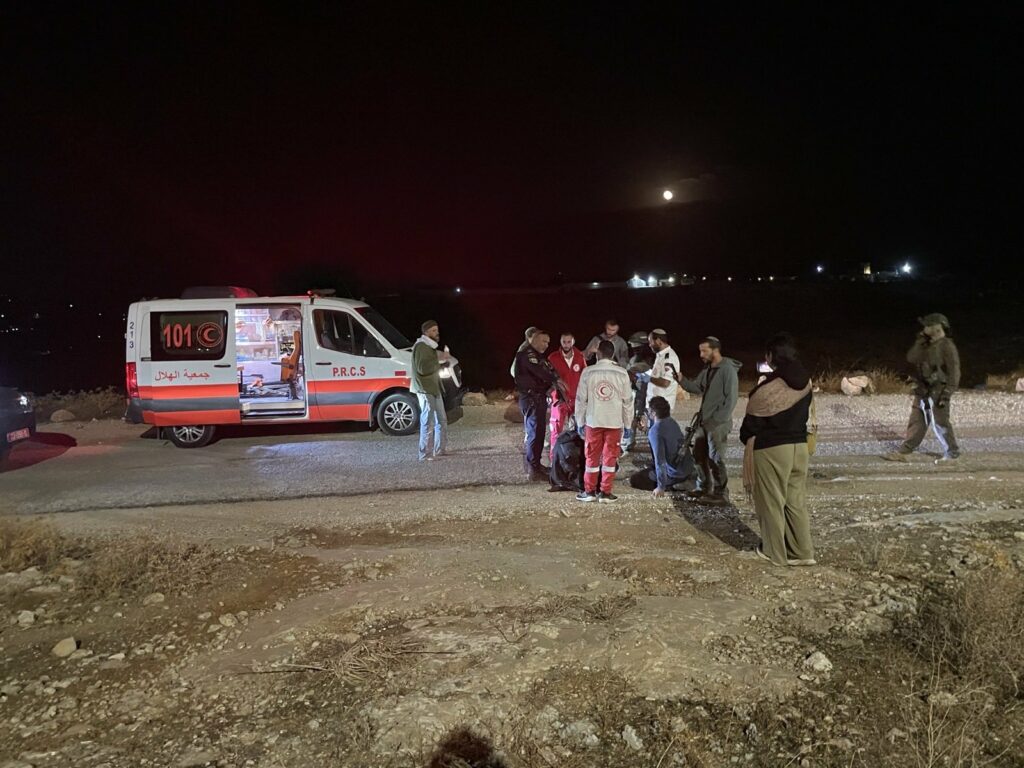
Israeli medics order Palestinian medics to stop treatment. Photograph by a witness who prefers to remain anonymous.
*
The warm treatment was short-lived. At about one in the morning, a plainclothes officer with an M16 and a pistol marched into the police station, looked our way, and grinned: “What are you doing here, Andrey?” The officer, Neriya—he wouldn’t share his last name—had interrogated Andrey a week earlier, after he’d been arrested during a peaceful olive harvest and charged with, among other things, “support for a terror organization.” Neriya’s arrival was our first clear indication that the police’s interest in us extended beyond the events of that evening.
Neriya’s English was halting, so before he read us our charges, he called a translator over speakerphone—by the sound of it, an elderly woman whose English wasn’t much better. The offenses she read out were incomprehensible. We later learned that we were being held on the same seven counts: entering a restricted area; violating a lawful order; assault causing actual bodily harm; insulting a public servant; making threats; obstructing a police officer in the performance of his duty; and using force to prevent arrest.
Neriya took Andrey to another building, where he was allowed to call our shared lawyer, Alon Sapir. He was then interrogated until four in the morning. Andrey would later tell me that the officers used the same translator, who struggled to understand basic statements, sometimes reducing lengthy explanations to a few words, forcing officers to resort to Google Translate for terms as simple as “violence.”
In an article about our arrest, police would tell the Times of Israel that they were investigating us for “an alleged attempt to steal weapons.” But during our interrogations, no one mentioned weapons or theft. The actual purpose of the “investigation” was clear: they wanted to prove that one of us had given Tomer Liani a bloody nose. Neriya showed Andrey a photograph of the injury and demanded to know why he’d done it. Andrey showed him his knuckles, which bore no swelling or marks. He reminded the officer that he had been beaten that night, and that the assault had been captured on video. All he had to do was recover his phone—or let us access mine.
Then the interrogator turned to the matter of Andrey’s reporting. “Is it normal for journalists to be arrested twice in one week?” And why, he asked, did Andrey keep turning up at the scene of violent incidents? Andrey explained that he went to places known for settler violence, like Abu Falah, where he and I had helped rescue Heidi Levine. Before Neriya could respond, the interpreter interjected. “I heard that the settlers helped her,” she said, parroting Netanyahu’s line. Finally, Neriya accused Andrey, who had fled political persecution in Russia years earlier, of disloyalty: “How could you turn against the country that took you in?”
The interrogation over, an officer handed Andrey a statement and asked him to sign it. Andrey refused—it was written in Hebrew, a language he understood somewhat but could not read. Neriya brought Andrey back to the waiting area, where we waited some more. He was still groggy but more alert than he’d been before.
The officers guarding us mostly slept. One fell backward out of his chair. Burger King had a loud argument with his wife (we heard both sides, since he was on speakerphone) about why he was out all night and would miss taking their child to school. She was worried about the kid’s grades. His job was dynamic, he insisted. He was currently responsible for guarding two criminals! Did she want him to just leave? After their fight, Burger King played a Hebrew song on repeat. By the third listen, Andrey had picked up enough words to understand what it was about: a woman falling in love with a police officer.
*
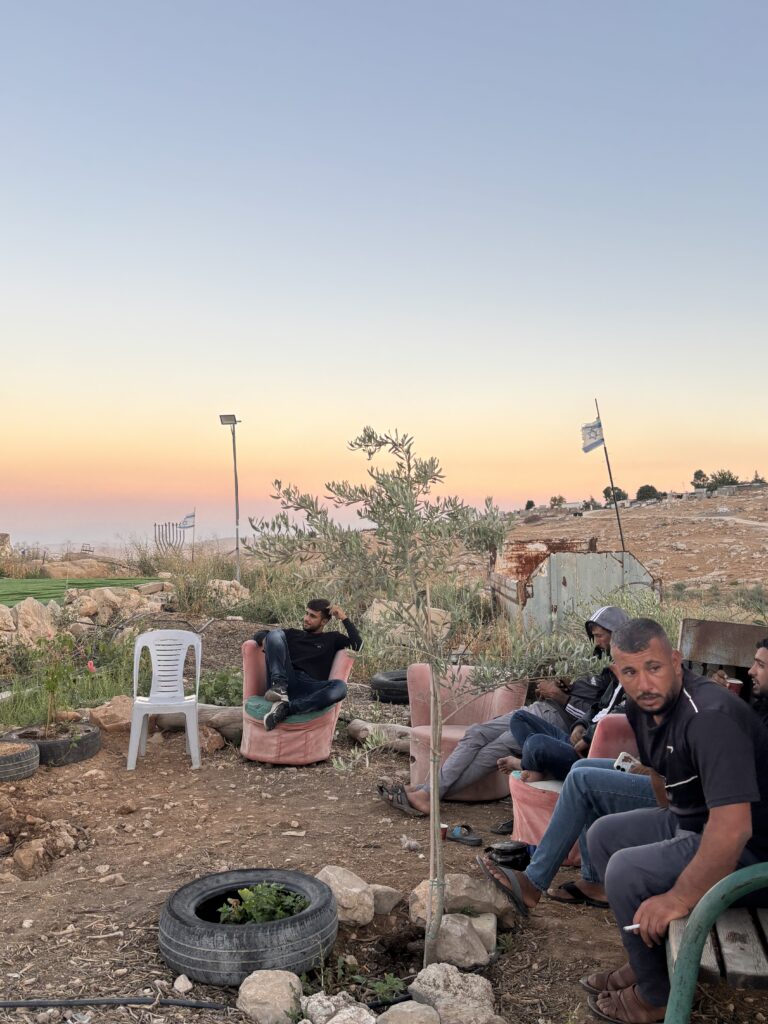
Photograph by Jasper Nathaniel.
At seven in the morning, the interrogator returned for me. I hadn’t slept in twenty-four hours. He refused my request for coffee. In the three hours since questioning Andrey, they’d managed to find a competent translator, who called in on speakerphone. My interrogation began much as Andrey’s had, with questions about who had bloodied Tomer’s nose. As with Andrey, the interrogator showed no interest in establishing what had actually happened—how the assault had started, how I’d gotten my black eye, or how Andrey had been beaten unconscious. Like Andrey, I was asked why I was always present when violence occurred. Like him, I found myself explaining the tenets of conflict reporting.
After two or so hours, a second investigator took over—an irritated, squirrelly man who, despite his petite size, had managed to find a shirt that was several sizes too small. He scoffed when I asked for coffee and then turned to Tomer’s nose, showing no more interest in my injuries than his predecessor. He then turned to the CMZ delineation, which he believed he could prove I had violated. He had obtained footage of my encounter with soldiers hours before the attack—but apparently hadn’t bothered to watch it, unaware that what it captured was the moment when I’d been permitted to stay. When we got to the part where the settler drove into the CMZ, he changed the subject—reeling off various nonexistent laws governing journalism that I had supposedly neglected to follow.
His actual interest became clear when he left the room briefly and returned with a thick folder. This was their file on me, he explained. He dropped the dossier in front of me with a dramatic flourish, then put it away and turned to his computer. Thus began the bulk of my interrogation, which concerned my social-media history. He started with my X bio, which says that I report from the occupied West Bank. He wanted to know what I meant by occupied. “This is violent language,” he said. Next, he opened a video I’d posted the week before, showing a police officer shoving me while Andrey was being arrested. Why, he demanded, had I called the officer a fascist? My violence, unlike the officer’s—which, he clarified, had been justified—put the state of Israel at risk. For the next several hours, he worked his way through my X feed, grilling me about phrases like crackdown, pogroms, and even my Palestinian friends. “Who exactly are these friends?” he asked.
Finally, he wanted to know who was funding me. Was I being paid by a foreign state? An enemy of Israel? I found myself in the unlikely position of teaching my jailer about the Substack business model. By now, it was after two in the afternoon. I’d been under interrogation for more than six hours and hadn’t slept for more than thirty. In the end, I, too, was handed a statement that I couldn’t read and declined to sign, despite the officer’s assurance that he’d recorded my answers faithfully.
He brought me back to Andrey, and we were loaded into a police car with three plainclothes officers. We were told that we were being taken to court in Jerusalem. As we pulled away, the driver turned to me and addressed me in English: “Are you Jewish?”
“Yes.”
“No, you’re not.”
Then he turned to Andrey and asked again: “Are you Jewish?”
“Yes.”
“No. No, you’re not.”
*
Our lawyer, Alon Sapir, met us outside the courtroom. Adele had made it to safety and had been able to share her footage online. The case was already attracting attention. Alon planned to show the judge the recording and request our unconditional release. He suspected the Israeli authorities were feeling some pressure. They wouldn’t want to do anything too drastic, he said, lest they draw more attention to the attack.
We were unshackled for the first time since our detention the day before, led into the courtroom, and seated on a bench before a small group of spectators, one of whom appeared to sneak a photo. The judge read the charges aloud. The prosecutor refused to look at either of us.
The investigation was ongoing, the prosecutor said, but he was not seeking to keep us in detention while it continued. Instead, he asked the judge to impose eight days of house arrest in Israel (where he seemed to assume we both lived), a no-contact order barring us from communicating with anyone involved in the incident, mandatory further questioning, thousands of dollars in collateral to ensure our compliance, and a six-month ban from the West Bank.
Alon spoke briefly, then showed the judge footage of the attack. The prosecutor presented footage of his own, though of what, I have no idea. The judge reached his ruling in a matter of minutes. It was clear, he said, that the settlers—the “other individuals” he called them—had initiated the violence, not the “respondents,” by which he meant us. Moreover, he went on, he “did not find that there was symmetry between the violence attributed to the respondents and the violence inflicted by the other individuals.” “Accordingly,” he concluded, “the reasonable suspicion of violent offenses is weak.”
As a result, he denied the prosecutor’s request that we be placed on house arrest but granted several of his others. He imposed a two-month no-contact order—meaning Andrey, Adele, and I could not communicate with each other—along with the mandatory further questioning and financial guarantees. The police would be allowed to keep my phone. And we were banned from the West Bank, though for two months rather than six. Just the previous afternoon, soldiers had tried and failed to expel us from Umm al-Khair. Now, the police and an Israeli judge had achieved something more concrete: the removal of two journalists from the West Bank for the remainder of a particularly brutal olive-harvest season. None of the settlers, whom the judge had just watched attack us, were charged.
*
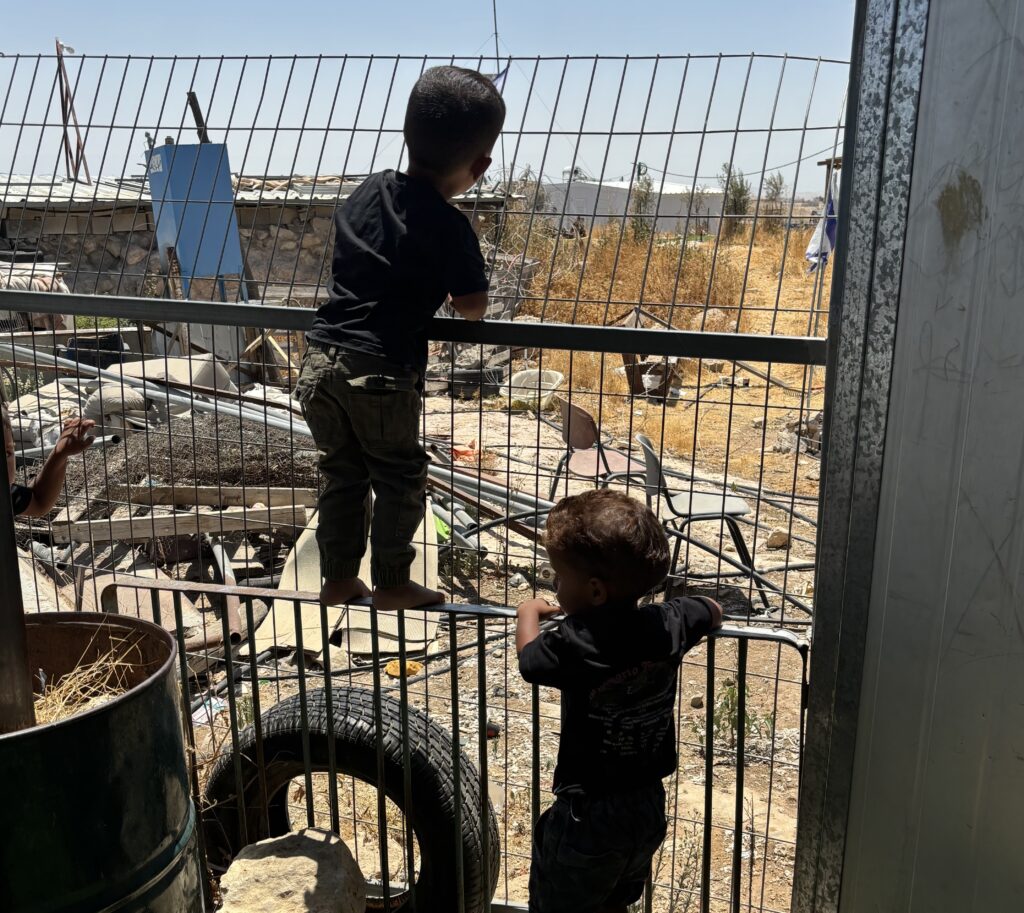
Palestinian children looking at destroyed property beside the settler outpost. Photograph by Jasper Nathaniel.
During my detention, the U.S. Embassy made no effort to contact my attorney. Days later, when I bought a new phone, I found a message from a consular officer asking if I was okay—sent to the phone the police had confiscated.
I was, in fact, okay, though not thanks to the U.S. government. I was okay because I was not Palestinian. Had three Palestinians approached Tomer’s truck the way we had, they might well have been shot dead. Had they survived to be arrested, they would have entered the military-justice system, where Palestinians can be held indefinitely without charge or trial, on the basis of evidence they aren’t allowed to see. They would have ended up in Ben-Gvir’s prisons, which the Israeli human-rights group B’Tselem has called a “network of torture camps.” Since October 2023, according to Reporters Without Borders, Israel has killed at least two hundred and ten Palestinian journalists in Gaza. As of this fall, per data from the human rights NGO Addameer, Israel is also holding more than nine thousand Palestinian prisoners and detainees on “security” grounds, nearly a third without charge or trial. At least thirty-eight are journalists.
The day before our detention, Ghassan Najjar, a thirty-six-year-old Palestinian activist, was arrested in a predawn military raid on his home in Burin. Andrey and I had both worked with Ghassan before. Like us, he had been documenting the olive harvest and protecting Palestinian farmers from settler violence. But unlike us, he was not released. Instead, he was placed under a four-month administrative detention order, which can be renewed indefinitely.
Andrey and I were extremely lucky. We had lawyers, a civilian court, and enough of an audience that the police knew they were dealing with a story that could draw international attention. Within a day, a judge had watched the footage and ordered our release. But the ban, though short, was strategic: earlier that October, while Andrey and I were in al-Mughayyir, a Palestinian village east of Ramallah where settlers torched our car, Israeli authorities revoked my Electronic Travel Authorization (ETA). Since January 2025, foreigners have needed an ETA in order to board flights to Israel or enter the West Bank from Jordan—but the Population and Immigration Authority has routinely revoked activists’ authorizations to keep them out. I don’t know of anyone who has gotten one back.
The court’s two-month ban covered almost all the time left on my visa, which meant that as long as I stayed, I couldn’t get back to the West Bank, and once I left Israel, I couldn’t board a plane to return. The stakes are higher for Andrey. This very morning, Israel’s Minister of Diaspora Affairs and Combating Antisemitism, citing the October 28 arrest, announced an unprecedented move: he had submitted a request to strip Andrey of his citizenship.
As news of our ban spread, prominent settlers and their allies celebrated online, portraying us as anarchists and provocateurs known for acts of violence against the “Jewish residents of Judea and Samaria.” Others were disappointed the judge hadn’t gone further. Elisha Yered, one of the settler movement’s most violent leaders, who stands accused of murdering a Palestinian teenager, slammed the court for not banning us sooner. “If only they had removed them from here at the start of the harvest season,” he wrote on X, “so much international damage and violent provocations would have been spared.”
Days after we were released, Israeli soldiers and intelligence agents, accompanied by Shimon Atiya, raided Umm al-Khair. They confiscated residents’ phones and warned them to stop inviting journalists and activists into the community. Otherwise, they threatened, they would return with trucks, load the residents into them, and expel them from the village. On their way out, they locked the gate.
Jasper Nathaniel is a Brooklyn-based writer and reporter. He covers Israel’s occupation of the West Bank and other political and cultural affairs on his Substack, Infinite Jaz.











 English (US) ·
 French (CA) ·
 French (FR) ·