

PROTECT YOURSELF with Orgo-Life® QUANTUM TECHNOLOGY
Orgo-Life the new way to the future Advertising by Adpathway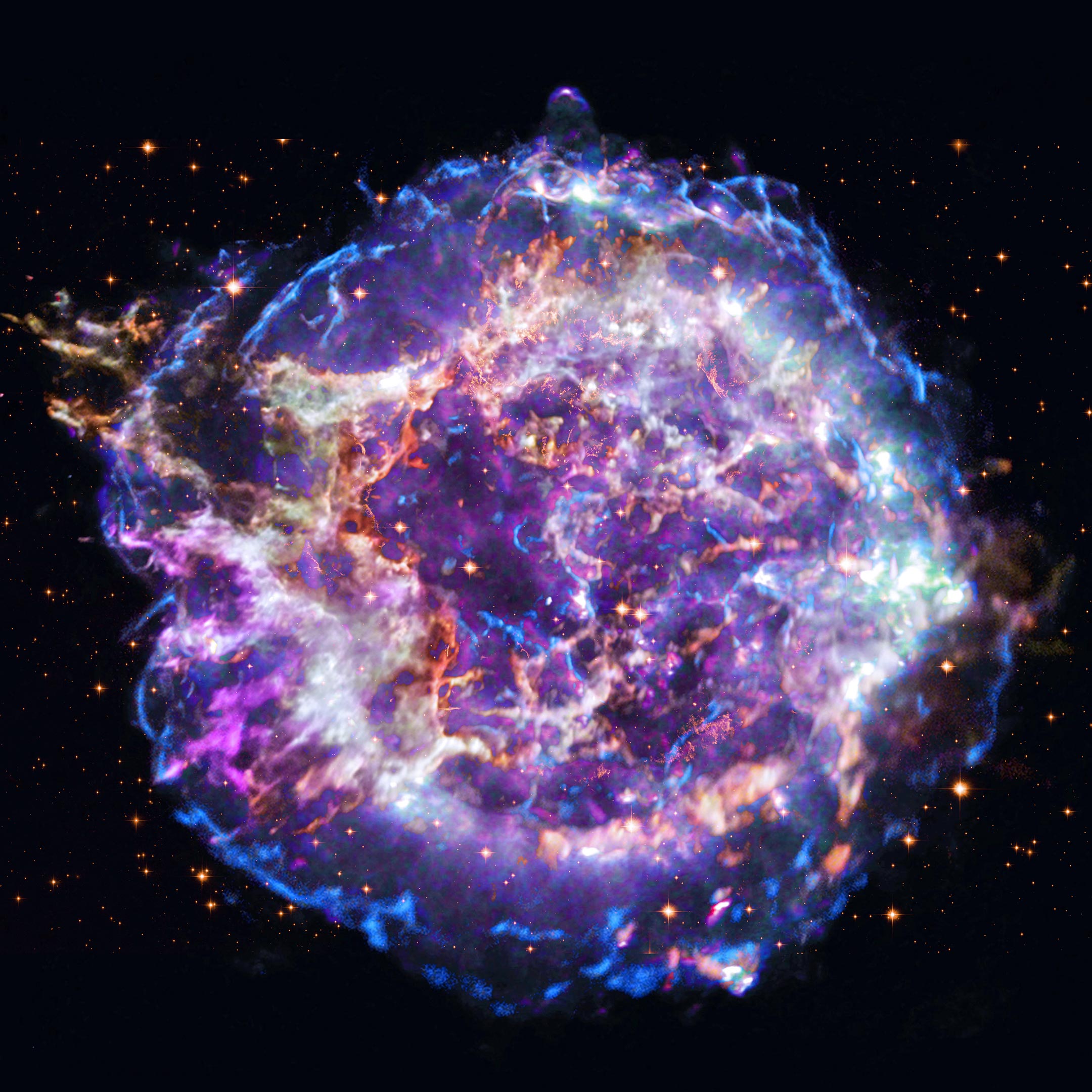 Chandra image of Cassiopeia A supernova remnant. Credit: NASA/CXC/SAO
A model of lunar soil mixing could help scientists reconstruct millions of years of supernova debris preserved on the Moon.
When massive stars die, some end in supernova explosions that scatter newly forged material through space. Traces of those ancient blasts can eventually settle on nearby worlds, and a new study led by a University of Hawai‘i at Mānoa researcher suggests that the Moon’s constantly disturbed soil may preserve a record of this cosmic debris.
Emily Costello, a research scientist at the Hawai‘i Institute of Geophysics and Planetology in the UH Mānoa School of Ocean and Earth Science and Technology, and her coauthors developed a mathematical framework for decoding that history from the lunar surface.
“Deep-sea deposits on Earth preserve interstellar debris, but only back about 10 million years,” Costello said. “The lunar regolith [soil], however, acts as a long-term cosmic archive that can preserve history spanning 80 to 100 million years or more. Understanding the physics of regolith mixing ensures that when future astronauts return deeper cores, we can properly read the scrambled layers to reconstruct the history of our Solar System’s journey through the galaxy.”
Impact gardening scrambles the lunar record
To make sense of that scrambled archive, Costello and her coauthors built a “unified stochastic model” for ‘impact gardening’, the ongoing process in which crater-forming impacts overturn, mix, and redistribute lunar soil. The process is highly random because it is driven by impactors ranging from microscopic dust grains to enormous asteroids.
Since each lunar core experiences its own history of impacts, separating a widespread interstellar signal from local variations requires sophisticated statistical modeling.
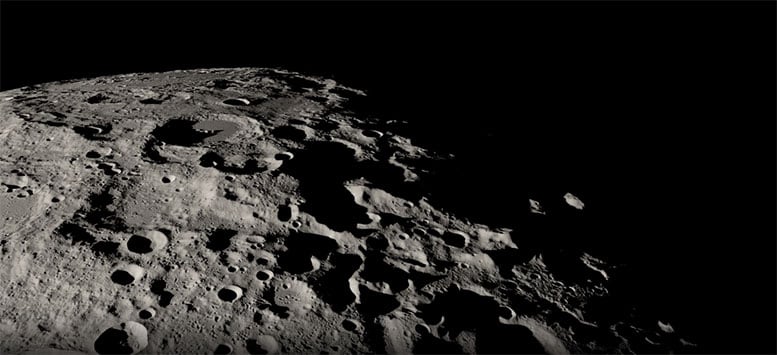 The lunar surface has been bombarded by impacts, creating craters across the surface. Credit: NASA
“To model impact gardening, we have to balance a complex web of physical mechanisms, including impact compaction, excavation, radioactive decay, and space weathering, all operating simultaneously within a single elegant continuum model,” Costello said. “Our mathematical model treats lunar impact gardening as a competition between forces burying the soil and impacts digging it back up. It also accounts for radioactive decay of the star remnants while mapping exactly when and where new stardust was delivered by episodic supernovae.”
Radioactive isotopes preserved in deep-sea sediments on Earth and in Apollo lunar samples already show that supernovae hundreds of light years away deposited radioisotopes on both Earth and the Moon. Evidence points to pulses about 2.3 million and 7.3 million years ago. After arriving on the Moon, however, those isotopes were gradually stirred through the surface by impact gardening.
Apollo cores preserved the buried signal
Costello tested the model against observations from Apollo core samples. It successfully reproduced the measured depth concentration patterns of radioisotopes whose ages had been independently constrained using cosmic ray tracks and radionuclide benchmarks. The researchers then combined the validated model with established timelines for supernova pulses recorded on Earth to simulate how those same interstellar events should appear at different depths in lunar soil.
The model accurately reproduced the depth concentration patterns of Iron-60 measured in Apollo regolith. The researchers then used it to predict how additional heavy elements, including Plutonium-244, Iodine-129, Hafnium-182, and Curium-247, would become buried over time.
“When I first shared my model results, my colleagues were surprised by how well-matched the model and the measurements were,” Costello said. “This level of fidelity between empirical observations and a physics model is exciting and remarkable.”
Artemis cores could extend supernova history
One major aim of the research is to help scientists interpret future lunar core samples. NASA’s Artemis Program is expected to return humans to the Moon, where astronauts could collect new samples of regolith containing a much deeper record of deposited stardust.
“These future samples taken from the Moon, when considered in conjunction with our gardening model, could reveal new insights into an untold chapter of supernova history!” Costello shared. “I think it’s beautiful that the remains of past stars can be used to navigate the vast history of our Earth-Moon neighborhood, if we have knowledge of how to read the stardust.”
Reference: “Gardening on the Moon: An Advection-Diffusion Model to Guide the Search for Supernova Debris in the Lunar Regolith” by Emily S. Costello, John Ellis, Brian D. Fields, Rebecca Surman and Xilu Wang, 14 August 2026, Physical Review Letters.
DOI: 10.1103/14kh-nkgl
Funding: NASA Headquarters, United Kingdom Science and Technology Facilities Council, U.S. National Science Foundation, National Natural Science Foundation of China, National Key Research and Development Program of China, China’s Space Origins Exploration Program, U.S. Department of Energy
Never miss a breakthrough: Join the SciTechDaily newsletter.
Follow us on Google and Google News.















![WTA 500 Guadalajara R1: [WC] T. Townsend def. T. Maria 6⁰-7, 6-3, 6-2](https://preview.redd.it/yenqk6xvlkph1.jpeg?width=640&crop=smart&auto=webp&s=259ebe14daea4631178447fa40cf26c8273c3cd8)

 English (US) ·
  French (CA) ·
  French (FR) ·