

 1 month ago
58
1 month ago
58
PROTECT YOURSELF with Orgo-Life® QUANTUM TECHNOLOGY
Orgo-Life the new way to the future Advertising by Adpathway
While bikepacking across the Balkans en route from England to India, Joshua Kian and Sarah Morgan had an unforgettable encounter and savored some of their journey’s most fulfilling riding in Albania’s Accursed Mountains. “The People in Empty Places” is a 20-minute video that unpacks the experience of feeling something shift inside. Watch it and find an accompanying feature story here…
Bora tssks and clicks, herding her flock with a stick in hand, smiling. Steering a stream of weathered sheep through sun-bleached thickets of grass, the animals push into the old paddock, kicking up dust and smells—manure, matted wool, grit. With the final swings of her stick, Bora stands tall in the sunlight and watches the last outliers usher through.
As the gate closes, her face lines with a deep smile. Upon the rusted latch, she rests her hands, hardened from years of farm work, a golden wedding ring tightly fitted amongst her tanned skin. Coarse wool presses between deeply furrowed wooden fencing—the harsh summers and cold winters have left their mark. Trotters trudge through the mud, past a trickling water butt, then stop, waiting. Bora flexes her hands, open and closed, wincing. Then her eldest daughter steps forward, bucket in hand, to meet the flock.
* * *It was the beginning of summer, and after a period cycling along a busy coastline, my partner Sarah and I were looking for something else—quiet mountains, empty spaces, hard riding. This is what I envisaged waiting for us at the end of the tarmac. We’d heard about the Trans Euro Trail (TET), an off-road motorbike route that meanders through remote corners of Europe. We hadn’t found many cycle reports, but hoped it could be our guide to traversing Albania’s Accursed Mountains.
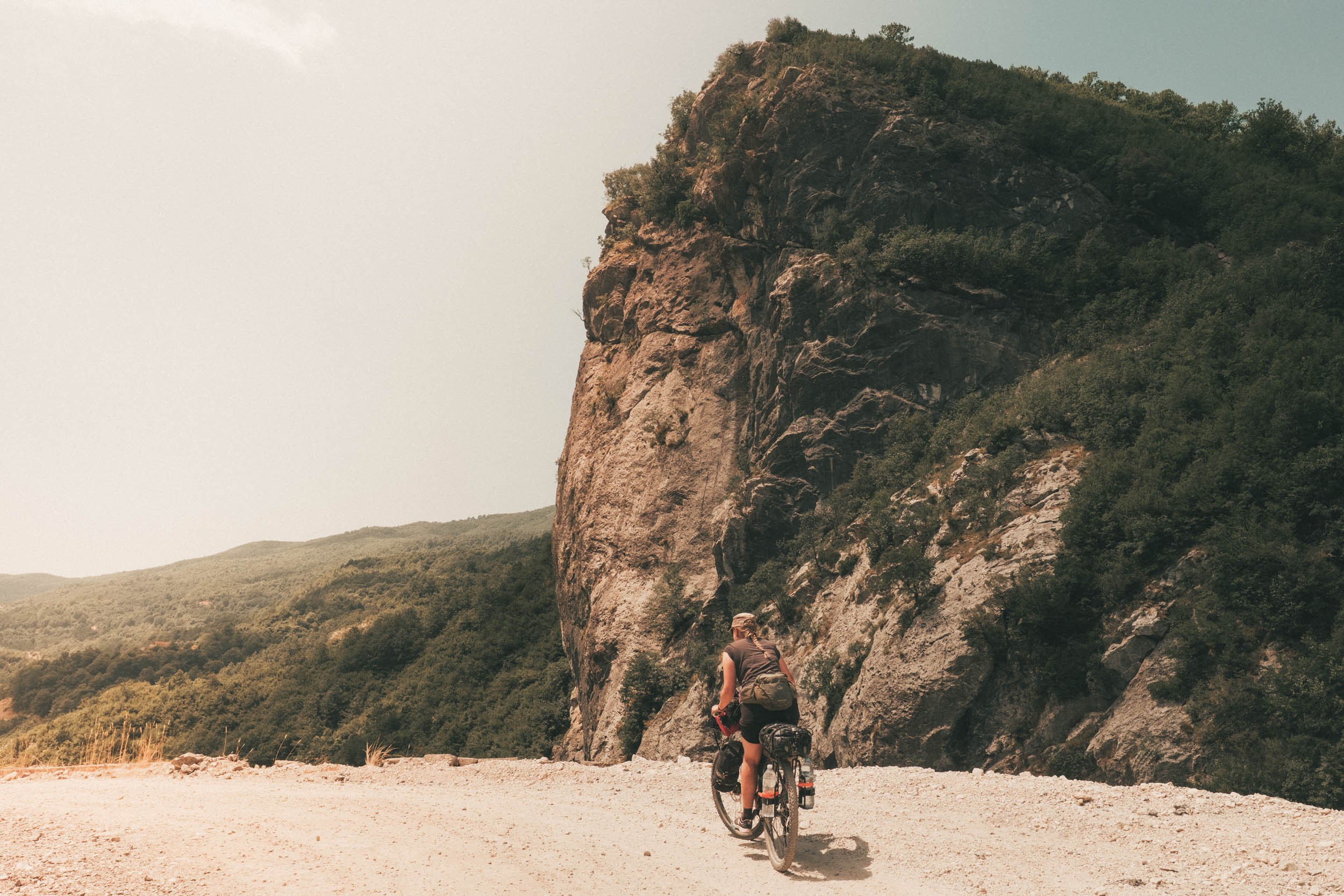
Together, we talked over plans, giddy but apprehensive. It was verging on 40°C. We didn’t know local customs and norms, nor did we have any experience following the TET. Would motorbike distances and the terrain be possible on a bicycle? Things would start with a hard 46-mile climb into the mountains. We’d then leave the tarmac behind, and the journey would really begin.
* * *Freshly crossed into Albania, we leave the sprawl of Shkodër—the biggest nearby city—and head north. A recently tarmacked road shimmers in the heat. One turning separates us from the Accursed Mountains, already piercing the horizon.
“You can see the road go the whole way up the valley,” Sarah says, between prolonged gulps of water.
As momentum gathers, suburbs thin into parched farmland. Slowly, the slick surface beneath us begins to coil and snake—the climb begins. An overbearing sun beats down, conversation dulls, and we’re pushed into a silent, introspective journey, creeping up the valley side. The world slides by, and I think of my friend who’d hiked in the Accursed Mountains 10 years ago. His stories had transfixed me for the best part of a decade. And they all started in Theth, the tiny mountain village on the other side of this climb. He’d described the collection of local houses like a hidden outpost on the edge of the frontier. And the thought of it spurs my legs on.
Lonely roadside kiosks advertising cold drinks slowly morph into accommodation blocks and newly built roadside restaurants. To the side, a stout farmer herds cows towards dilapidated buildings on the valley edge. Life seems to thrive along this petrol-laced vein, but withers with distance. We arrive at the summit, and a breeze lifts the thick, oppressive heat. A self-inflicted hunger carves at my stomach. Staving off my second bottle of water, we share a sticky embrace.
“You are completely soaked,” Sarah says in jovial disgust, and we laugh, looking out over the peak-studded horizon.
Hurtling down, dropping altitude and gaining speed, I see where the road has led. My thoughts are drowned out by cars and chatter, the smells of petrol and cement. I navigate between passing tour buses and people carriers, flashing signs in the periphery. Amongst dust and fumes, we squeeze between gridlocked vehicles, onto the hard shoulder and into a stream of hikers laden with heavy backpacks. I slam on my brakes as a car cuts ahead of us, turning towards chalet-style accommodation. Clambering blocks of concrete crowd the road, competing for space and custom. Sarah, caught amongst cars, calls behind, “Wait, I’m stuck!” Flickers of confusion and disappointment wash over me as we ride past wanderers like us.
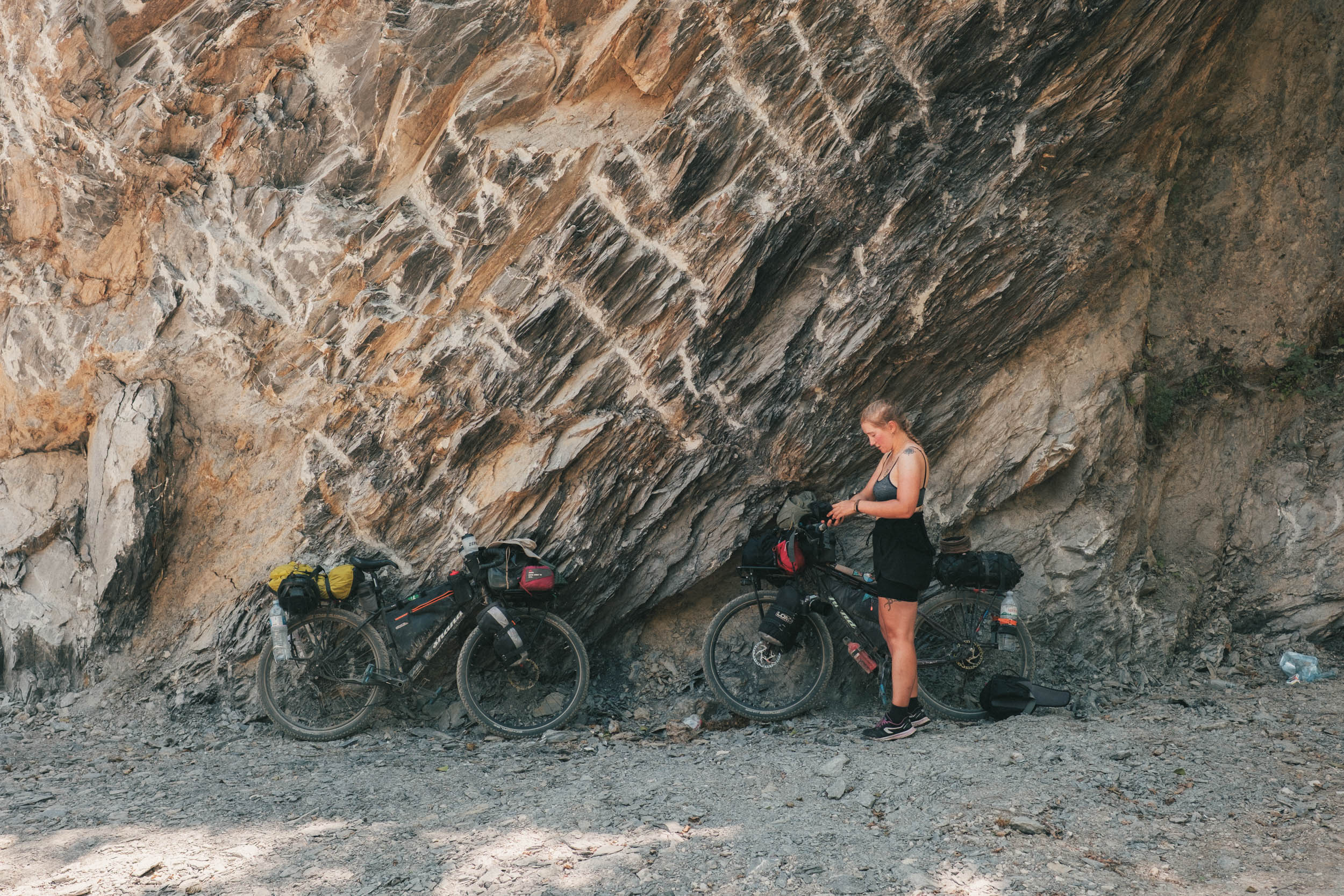
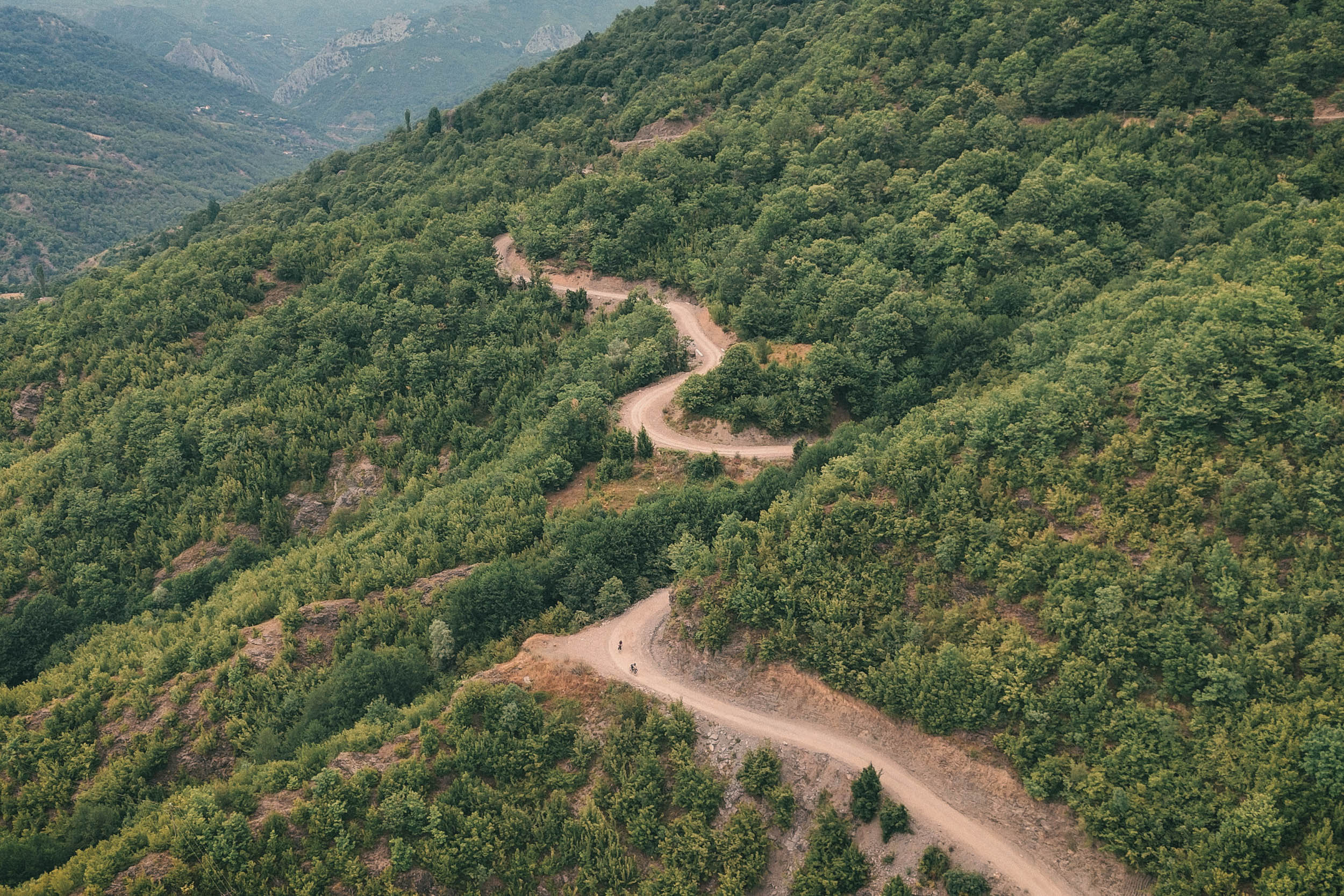
But we keep our heads down. Following the road down the valley, people and cars drift away, hotels disappear, the road gradually cracks, crumbles, and splits. Soon, everything slows. It feels like we’ve slipped somewhere older. A medley of dense greens and mountainous outcrops dominates the long valley running before us. Ahead, the grey tarmac sheen falls to a dusty track, dotted with large rocks. A hundred metres before the trailhead, we stop, both grinning, knowing the direction we’re heading.
“I don’t have enough water, Sarah says, shaking a steamy bottle. The world around is arid, and a bridge crosses a dried-out stream. “We can go and ask in one of those buildings, though?” Blending question and statement, Sarah heads towards a woman herding sheep further down the lane.
We wheel our bikes slowly, apprehensive of shepherd’s dogs. Ahead, the woman stands in a haze of sunlight and dust, surrounded by her flock. She fixes us with an unsure look as we approach. As we get closer, I call hello and hesitate. It’s our first time in the Albanian Mountains; we’re yet to learn the customs.
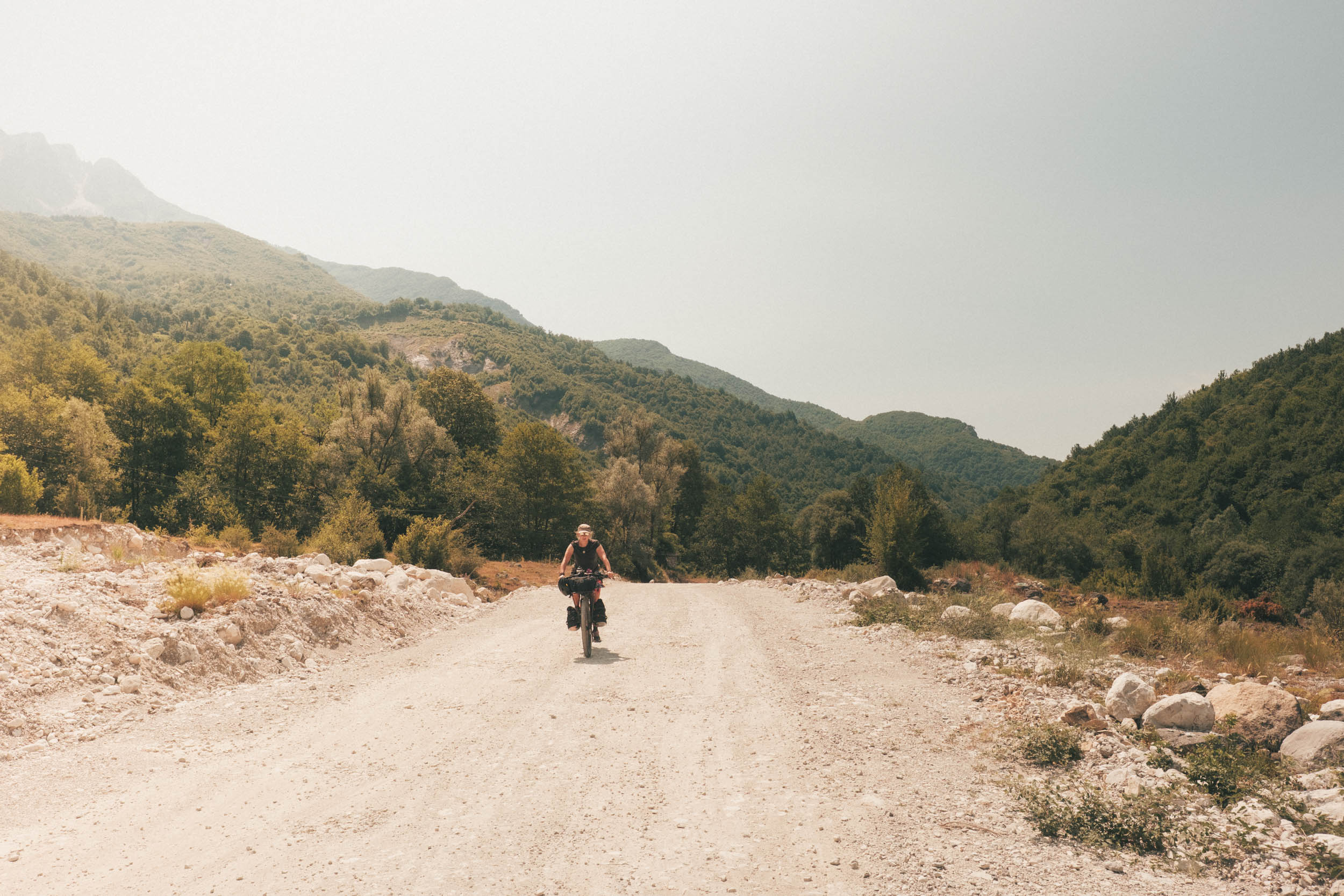
Now, close, I can see a golden cross hanging from her neck. There is a youthfulness to her, but deeply lined eyes give her away. These eyes track us closely. Sarah pulls an empty water bottle and, with a smile, mimes filling it… Slowly, the shepherdess nods and points towards a white farmhouse in the distance. We follow a rickety fence line, pass under the shade of leafy walnut trees, and find an outdoor tap on the imposing stone building. Emptying the remnants of now-hot water in my bottles, I notice two girls sitting under a veranda in the shade, watching us.
“Is this your family farm?” I ask.
“Yes.” The older girl responds.
“Do you know about the route to Shkoder?” I question.
“Yes. Go back to Theth and follow the road to the city.”
“Isn’t there a trail running past Breg-lumi and through the mountains?”
“That way is not easy,” the girl responds. “You should take the road. You can sit here in the shade, if you want.”
Introducing ourselves, I can’t tell whether we’re intruding. There’s a long, drawn-out silence broken only by the shepherdess coming to join us. Still expressionless, she hands us two large mugs of what seems to be yoghurt and says something quietly in the older girl’s ear. “My mother says you have a lot of tattoos.” At which point, the mother lets out a wicked, belly-aching laugh, which, in turn, spreads to us all. We sit together, all in hysterics, though not completely sure what about.
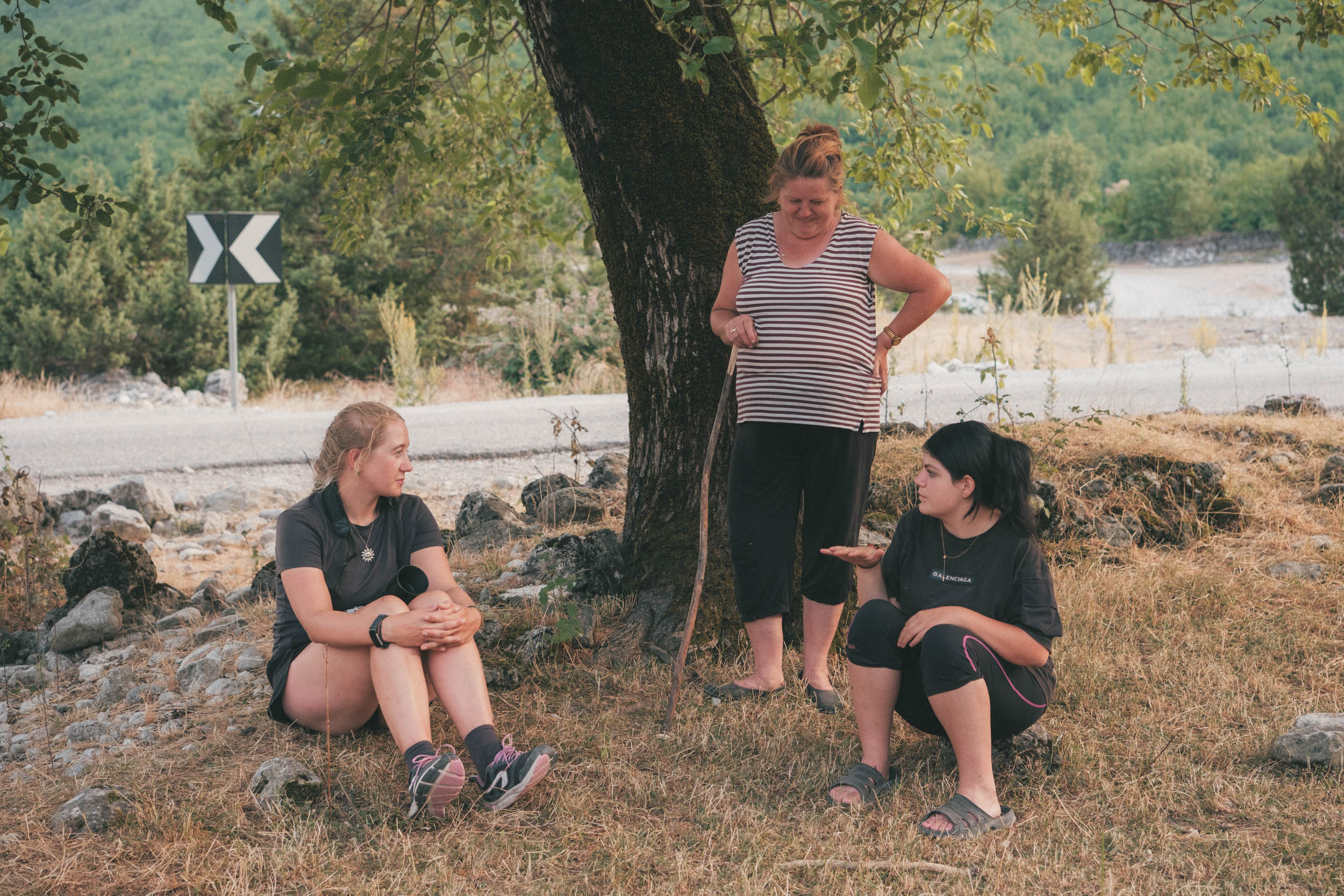
“You can milk the sheep with us.” Hana, the older daughter, says as she and her mother begin walking back along the gravel track. We follow promptly, leaving Elira, the younger sister, under the veranda, playing on her phone.
Bora, the shepherdess, pushes past swaying cornfields and, amongst a symphony of crickets and cicadas, the tssks and clicks begin. From nowhere, sheep start to gather. She stands tall amongst a blur of circling wool—weathered cream, grey, bleached black—as they push through the boundary fence. Hana is waiting for them in the milking pen, bucket in hand.
In the heat, sheep merge around Hana, who crouches down amongst them—her dark eyes and confident smile just visible. Hands pump and squeeze, the milk squirting hard against the bucket. She moves one out of the way and pulls in the next full udder. Bora observes with a smile, then looks at me, noticing my obvious wonder.
“When do you start milking the sheep?” Sarah asks.
Hana is now barely visible amongst the fur. “I milk the sheep now since it hurts my mother’s hands. She has arthritis.”
“Does your sister help too?”
“Normally not. She doesn’t like working with animals. I don’t even like yoghurt!” Hana proclaims. And with that, both mother and daughter tear into laughter. I don’t know quite how much Bora understands.
“When it gets cold, my father takes the sheep back to Shkodër. He used to herd them along the mountain route you are choosing to take. But it is hard and can be dangerous, particularly after rain. The land is not safe.”
“But he doesn’t anymore?”
“No. There is a road now.”
The comment sits with me as I watch the young girl continuing to milk. We’d come hundreds of miles to ride this remote shepherd’s route. The difficulty and isolation had all been part of the allure.
“You can milk the sheep now,” Hana says.
We take turns dribbling milk into a bucket. The sheep are clearly not enjoying our fumbling. But Hana remains unfazed, sharing calm guidance and assurance. Bora laughs deeply at our struggles, as Sarah squirts another modest stream onto her leg.
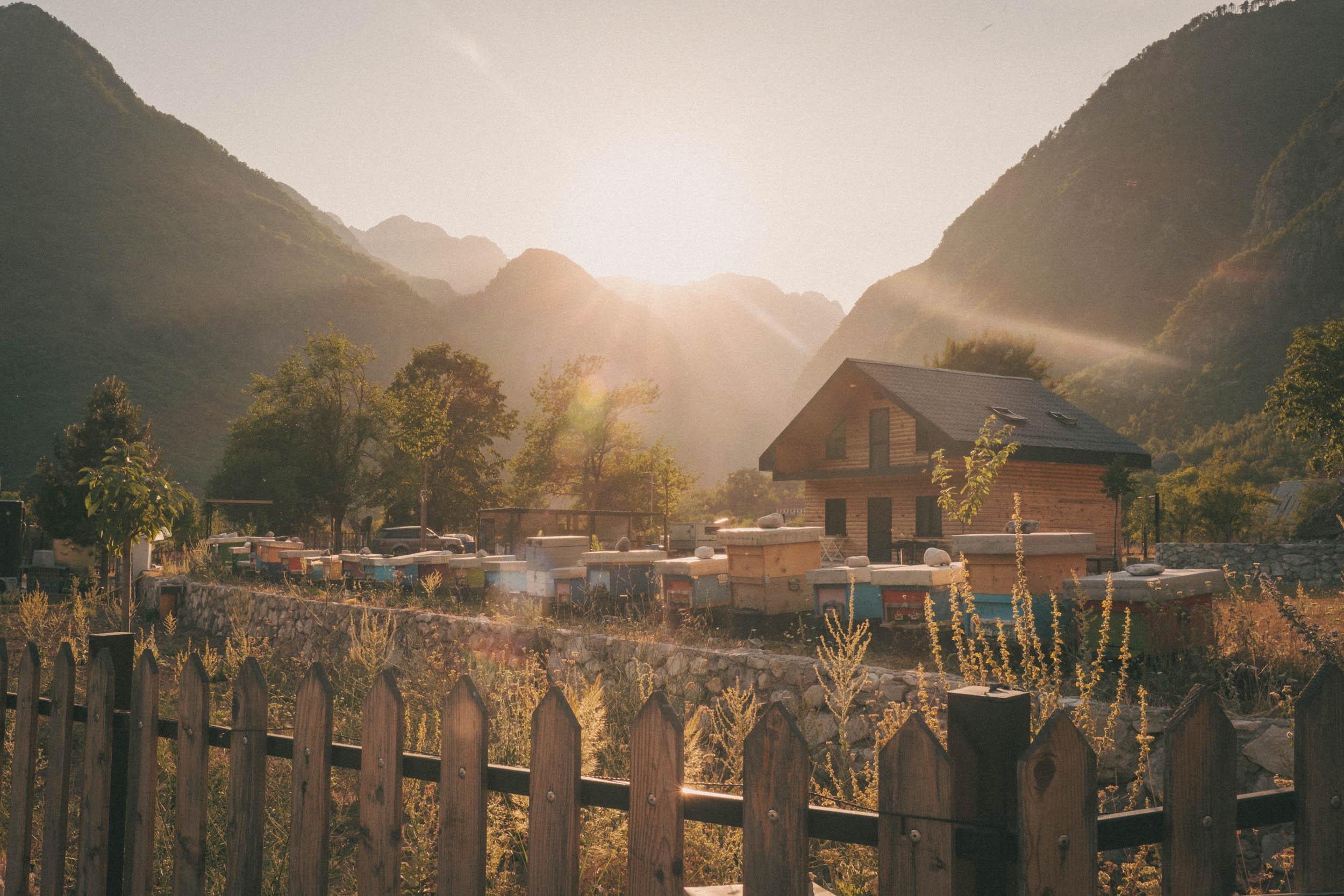
Dusk begins to fall in the valley, and bugs fill the air. Bora and her daughters bring crockery and pots of food to the terrace, talking and giggling as they go. They’ve invited us to eat with them. Wafts of home-cooking mix with the scent of hot walnut trees, making my mouth water.
Under the veranda, Besim, the brother, is waiting. He must be around my age and seems curious about us. And it begins. Arms reach, spoons scoop, generous plates are loaded with hot bean stew, hearty chunks of cheese, deep bowls of yoghurt, salad, butter, fried bread, rakija—a full table—all from these fields and hands around us. I bite into the crunchy bread and appreciate the gamey taste of the cheese. It’s unlike anything I’ve tried before.
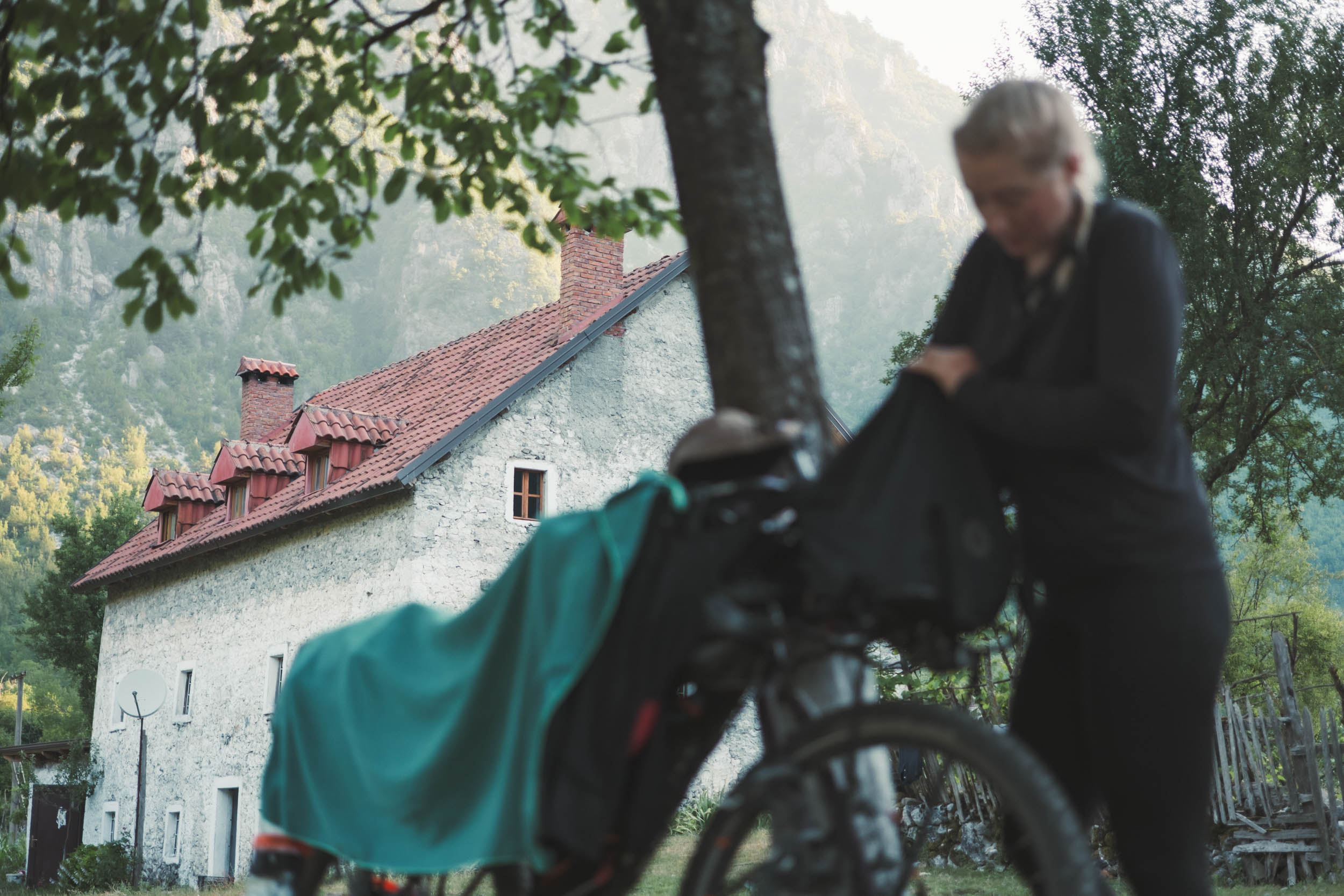
The siblings playfully bicker, but we feel their bond. I relish the togetherness, wishing more of our evenings could be spent like this. As the first plates are finished, conversation bubbles, battling over the roar of cicadas.
“Has Theth always been the main hub?” I ask, between mouthfuls.
Hana translates for Bora. “Well, yes. And no. Theth has always been popular for nature. But Breg-Lumi, further down the valley, was the main administrative hub. Thousands of people used to live in this valley. But when communism fell in 1991, most people went abroad or to cities. Very few farms survived.”
Light leaves the valley, and our faces are now barely visible. Elira’s eyes glow, lit up by her phone. With the rakija flowing, it seems to have inspired confidence in Besim.
“You have a drone?” He asks slowly. “Can you take videos of our farm?”
He hopes to build traditional accommodation buildings on the land and is launching a website to bring in guests. We chat about social media and advertising.
“Right now, very few people come from Theth. But soon, the road will continue the whole way through the valley to Shkodër,” he says with a confident smile.
His English is not as strong, but his enthusiasm comes across.
“Will you keep working with your mum and the animals?” Sarah asks Hana.
“No. I will go to Shkodër to be a teacher.” Her patience and instruction-giving now make a lot of sense. Bora seems to have understood our topic, but remains unfazed. I want to ask what will happen to the farm if she leaves, but there’s movement. Bora walks into the darkness towards the cattle as Besim goes inside to send an email.
Together, we help sisters load plates in the darkness. I ask them if they think the farm will change when the road comes through.
“My mother doesn’t think so. It’s always been a very traditional village,” says Hana, and both sisters nod.
We wander back to our tent, admiring the old farm buildings sitting peacefully in the moonlight, empty, unused. Not far away, newly built A-frame houses are lit up, lined with fairy lights, with groups sitting outside, laughing.
Falling into the tent, there’s a hum of distant chatter and bugs, a soothing breeze cooling us. Still, I struggle to sleep. Beneath closed eyes, I picture Bora, gripping hold of her farm with arthritic hands, change being pressed upon her, whilst her children walk towards it. A village on the edge, with a new world to one side and emptiness to the other. A valley in flux.
I wake at 6 a.m., eager to leave an already hot tent. Stepping out onto dewy grass, a thick valley fog hangs over the surrounding fields, pierced by points of sunlight scraping over the peaks. I can see Bora already leading two cows into a small enclosure. Hana is not far behind, carrying a milk bucket. With our tent packed down, we approach on our loaded bikes, and they welcome us with warm eyes.
“Are you ready?” Hana asks.
“Yes! A little nervous,” Sarah responds.
Bora says something to her daughter, and then bursts into her wicked laughter.
“My mother says you should take the road.”
We share a heartfelt goodbye and a tight hug, grateful for everything they’ve shared with us. Then, we push back down the road. Within a few hundred metres, we pass the threshold of the village, bouncing off the tarmac and onto rubble.
The following hours become a blur of movement. Skidding maniacally along loose gravel, we slingshot back and forth, chasing the Shala River to our side. Moving too fast for the details, the valley widens, and the open space fills me with euphoria, pumping my legs faster. Flying by crumbling buildings and under low-hanging branches, I share a flashed glance with Sarah, a fevered grin in silent appreciation of this forgotten world.
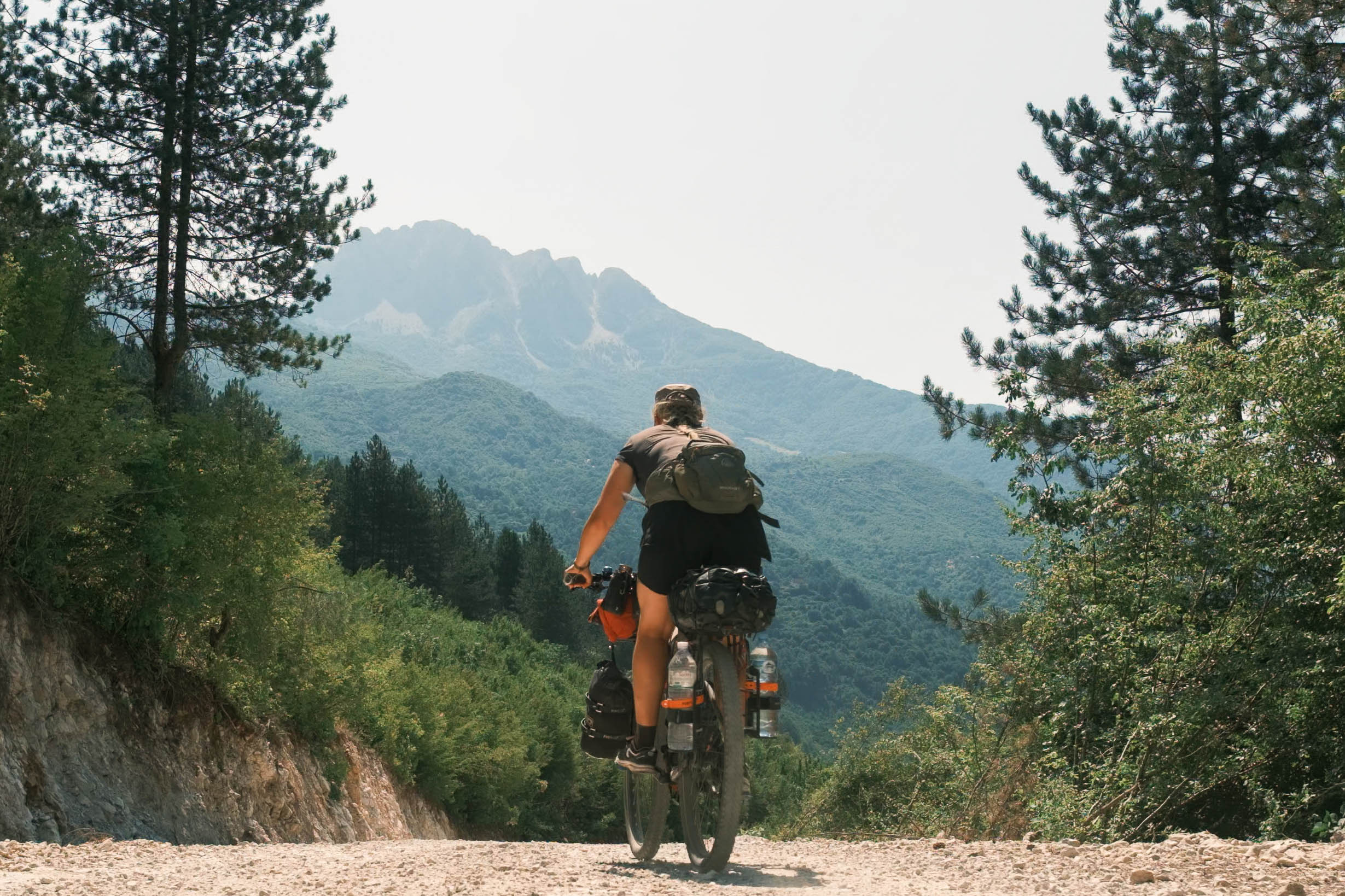
Gradually, the adrenaline subsides. We fall—dripping with sweat, covered in grit, breathing heavy—into an empty doorway. Slowly, my pulse lowers enough to take in the shelled-out building around us. It’s half lost in the overgrowth, yellow paint flaking from its walls, and it’s surprisingly big. Not a house but perhaps a school or medical facility. Foliage pushes through broken windows, inside a muddle of greenery, old books and rotten tables. The air is hot and heavy—mould, dust, urine.
Something ushers us into silence. I try to quiet the loud bites into my crusty roll but realise there is nobody to disturb. Across the gravel track, a half-built building is being reclaimed by nature, reminding me that time never stops.
Slowly, we pull into Breg-Lumi, the old administrative hub Hana had told us about. We lean our bikes against a disconnected water fountain. There’s a small collection of buildings—it’s hard to tell which are used and which aren’t—with a tiny shop and a bar, occupied by a few old locals surrounded by many empty bottles. Outside are rusted off-road vehicles and ragged dogs. I try to imagine this as a community hub, with excited kids hiking here from distant alcoves to pick up supplies and medicine. It’s almost impossible to believe now. There is a staid, forgotten feel that makes us want to push on.
Behind the broken fountain, I see a rusted wire bridge over the Shala River. I know beyond here, the trail climbs up into the mountains, along the old shepherd’s track. I feel a natural allure—empty valleys and hidden routes. This is what we came here for. But set amongst the remnants of this once-thriving community, I see the price it has come with.
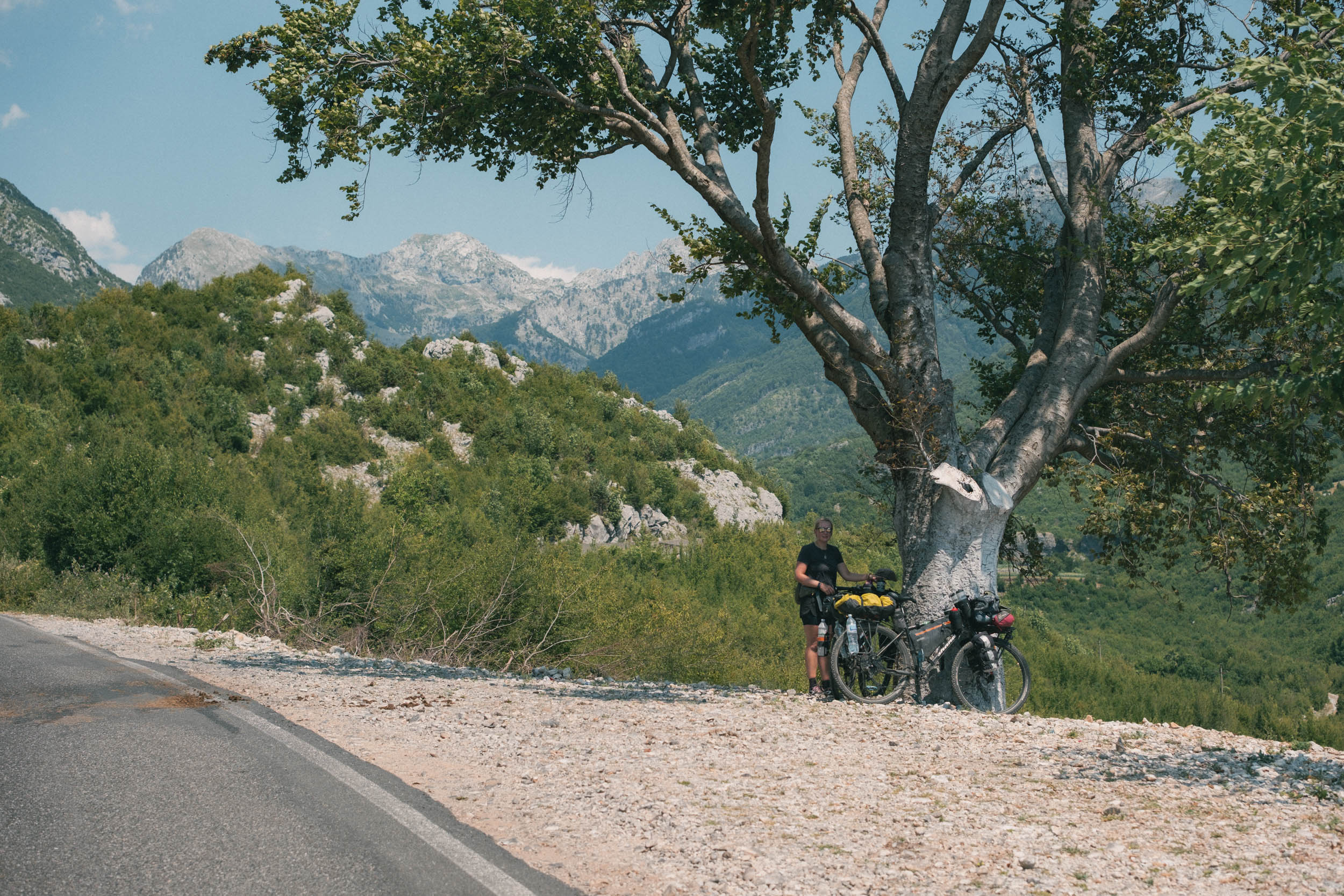
The day slips by, and we push higher up the valleyside, leaving behind lost communities. But now, there are no more buildings to remind us. I feel alone, pushed to the edge of my capacity in the heat, and still hooked. It is exactly what we’d hoped would be at the end of the tarmac. In the distance, I see a clearing and an isolated building that has stood the test of time. I picture a younger woman like Bora, milking sheep in the setting sun. Her husband, with his flock, passing high amongst the valley.
Reaching the summit, we let out air from our valves to fully embrace an isolated 30-mile dirt-track descent, letting the world slip away. And eventually, our tyres glide onto tarmac and roll effortlessly. A single serpentine road leads all the way back to Shkodër. There is laughter from children playing in a schoolyard. A distance conversation from an elderly couple tending their vineyard. An old farm truck pulls into a newly built restaurant advertising homemade soups and local cheese. And as the development builds and community returns, a young boy walks with his father along the road, herding a flock of sheep through the valley.
Further Reading
Make sure to dig into these related articles for more info...
Please keep the conversation civil, constructive, and inclusive, or your comment will be removed.






![Visiting Fukui can teach travelers how to make, and smash, Japanese kawara tiles [Photos]](https://soranews24.com/wp-content/uploads/sites/3/2026/09/x-gif-3-810024490-17.jpg?w=1000&h=525&crop=1)


 English (US) ·
  French (CA) ·
  French (FR) ·