

PROTECT YOURSELF with Orgo-Life® QUANTUM TECHNOLOGY
Orgo-Life the new way to the future Advertising by Adpathway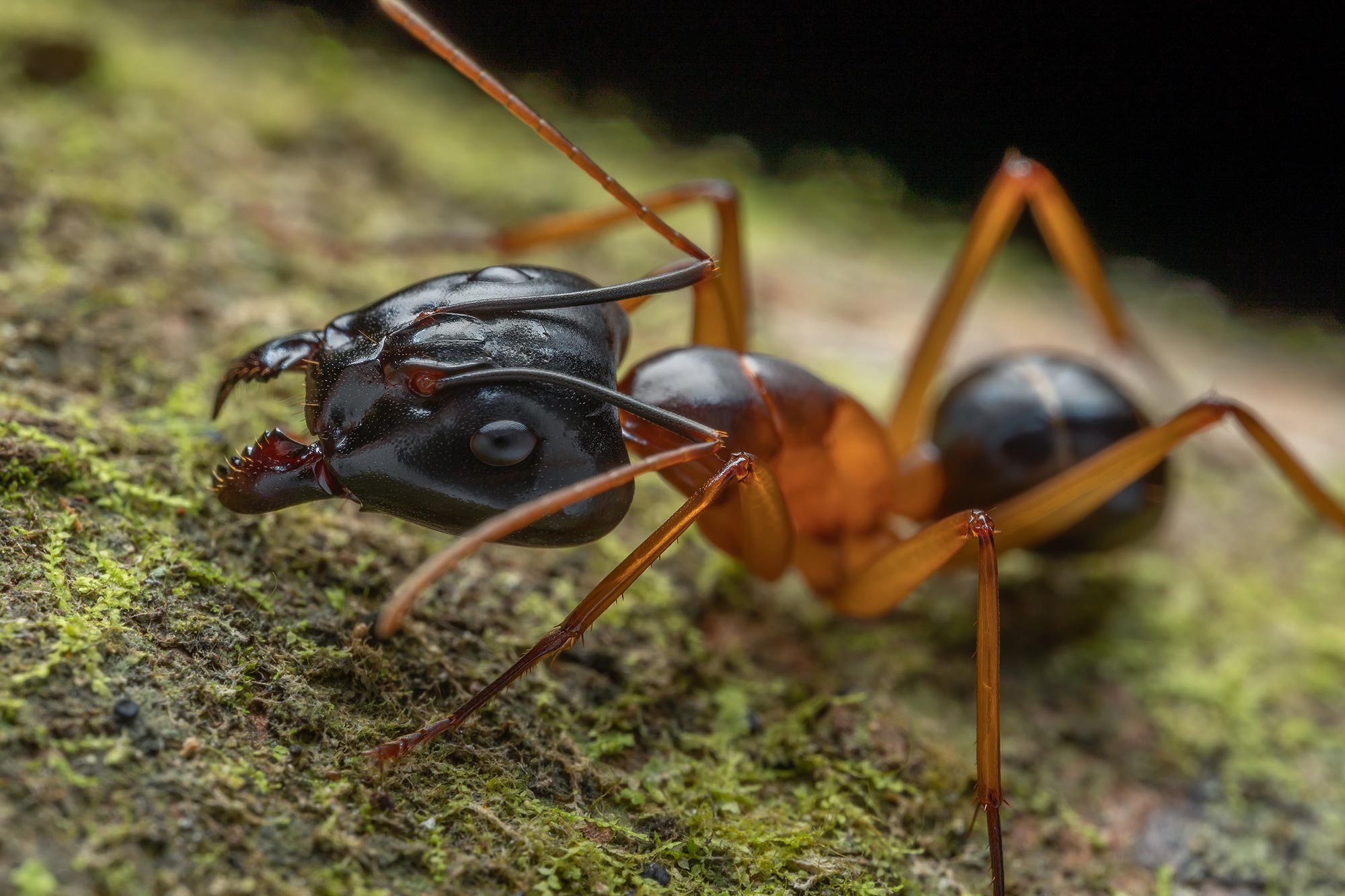 Pheidole is one of the most diverse genera of ants, with more than 1,000 described species found across much of the world, particularly in tropical regions. Commonly known as big-headed ants, their colonies typically contain two distinct worker castes: smaller workers that gather food and care for the colony, and larger soldiers with oversized heads and powerful jaws that help defend the nest and process food. Credit: Shutterstock
Bigger animals generally have bigger body parts, but new research reveals that certain ants defy this biological rule.
In the insect world, bigger bodies usually come with bigger body parts. But some ants break this rule in an unexpected way. A massive soldier ant, equipped with an oversized head and powerful jaws, can have smaller antennae than a worker that is only a fraction of its size.
Researchers at the University of Ottawa have discovered that this unusual pattern is widespread among Pheidole ants, a diverse group known for their distinct worker and soldier castes. Although antennae grow in proportion to body size within each caste, their sizes overlap between castes despite major differences in overall body size.
The findings suggest that evolution can alter how individual body parts grow, allowing ants to develop specialized features without following the usual rules of biological scaling.
A Surprising Discovery Across Hundreds of Ant Species
“It was total serendipity. We were sitting at the microscope and Erica (Erica Vong is a graduate researcher and student at uOttawa and lead author of this study) showed me the antennae of two individuals. One was clearly smaller, yet it turned out to be from the soldier!” says Rajendhran Rajakumar, Associate Professor of Biology at the University of Ottawa.
The smaller antennae belonged to a soldier, while the larger ones came from a worker. “Much like when you are getting your favorite latte, both castes have small, medium, and large sizes of overlapping antennae.”
Using laboratory experiments, field data, and museum collections, researchers examined 565 Pheidole species and found the pattern throughout the genus. Comparisons suggest it may have originated near the common ancestor shared with Cephalotes turtle ants.
“Biologists have long assumed that traits such as antennae generally scale predictably with body size,” Professor Rajakumar says. “Our findings show that evolution can decouple a trait from body size in one context while preserving that relationship in another.”
How Ant Colonies Control Body Growth
Antennae allow ants to detect chemical signals, navigate their surroundings, and communicate with nestmates. Their size and shape also influence the arrangement of sensory structures.
“The antenna is not simply getting bigger because the ant is bigger,” Professor Rajakumar explains. “In these colonies, development preserves a flexible range of antennal forms that may help individuals compatibly respond together to changing environmental demands.”
Experiments with Pheidole dentata showed that social signals, juvenile hormone, and an organ involved in regulating body proportions influence this flexibility. By manipulating these factors, particularly the soldier inhibitory pheromone, researchers produced unusual “nanoworkers” and “nanosoldiers.” The nanosoldiers had worker-sized bodies but the enlarged heads characteristic of soldiers.
“Social signals and hormones do more than determine whether an ant becomes a worker or a soldier,” clarifies Professor Rajakumar. “They can also reshape how different traits grow and scale together (or decouple), within castes, between castes, and more broadly across species.”
Breaking Biological Rules Through Evolution
The results demonstrate how colony conditions can influence individual development, supporting the concept of an ant colony as a superorganism. This flexibility may have contributed to the evolution of specialized castes and the remarkable diversity of ants.
“This work reminds us that evolution is not always a process of adding more or less of the same trait,” Professor Rajakumar concludes. “Sometimes new possibilities emerge when the expected connections between traits are broken and development is reorganized.”
Reference: “Breaking trait scaling via the evolution and regulation of dimorphic decoupling in ants” by Erica Vong, Shannon Parisien, Hélène Orfali and Rajendhran Rajakumar, 6 October 2026, Proceedings of the National Academy of Sciences.
DOI: 10.1073/pnas.2612172123
Never miss a breakthrough: Join the SciTechDaily newsletter.
Follow us on Google and Google News.















 English (US) ·
 French (CA) ·
 French (FR) ·