

PROTECT YOURSELF with Orgo-Life® QUANTUM TECHNOLOGY
Orgo-Life the new way to the future Advertising by AdpathwayWhat you pack for a winter road trip should help you stay warm, visible and supplied if traffic stops or your car breaks down. NHTSA, the National Weather Service and AAA Oregon/Idaho recommend basics such as blankets, traction material, a shovel, a flashlight, food, water and a phone charger. Here is what to pack, what to do if a winter storm strands you and what to check before you leave.
Quick overview: pack blankets and warm layers, sand or cat litter, a shovel, an ice scraper, a flashlight, jumper cables, water and non-perishable snacks, a phone charger, a first aid kit and reflective warning gear. Check the weather and road conditions before you leave, and keep the gas tank at least half full all winter.
Winter road trip packing checklist at a glance
| Warmth | Blankets, extra warm clothing, hats, gloves, winter boots, a sleeping bag |
| Traction and digging | Sand or cat litter, traction mats, snow shovel, tire chains |
| Visibility | Ice scraper, snow brush, winter washer fluid, flashlight and extra batteries |
| Breakdown tools | Jumper cables, tire gauge, portable air pump, multi-tool |
| Food and water | Drinking water, non-perishable snacks, soup or cocoa packets |
| Power and signals | Phone car charger, reflective triangles or flares, whistle, bright cloth |
| Safety | First aid kit, any necessary medicine, fire extinguisher |
The items below come from NHTSA, AAA, Ready Wisconsin, the National Weather Service and a North Dakota survival kit sheet, each linked where it is first used. Items we add ourselves are labeled as tips.
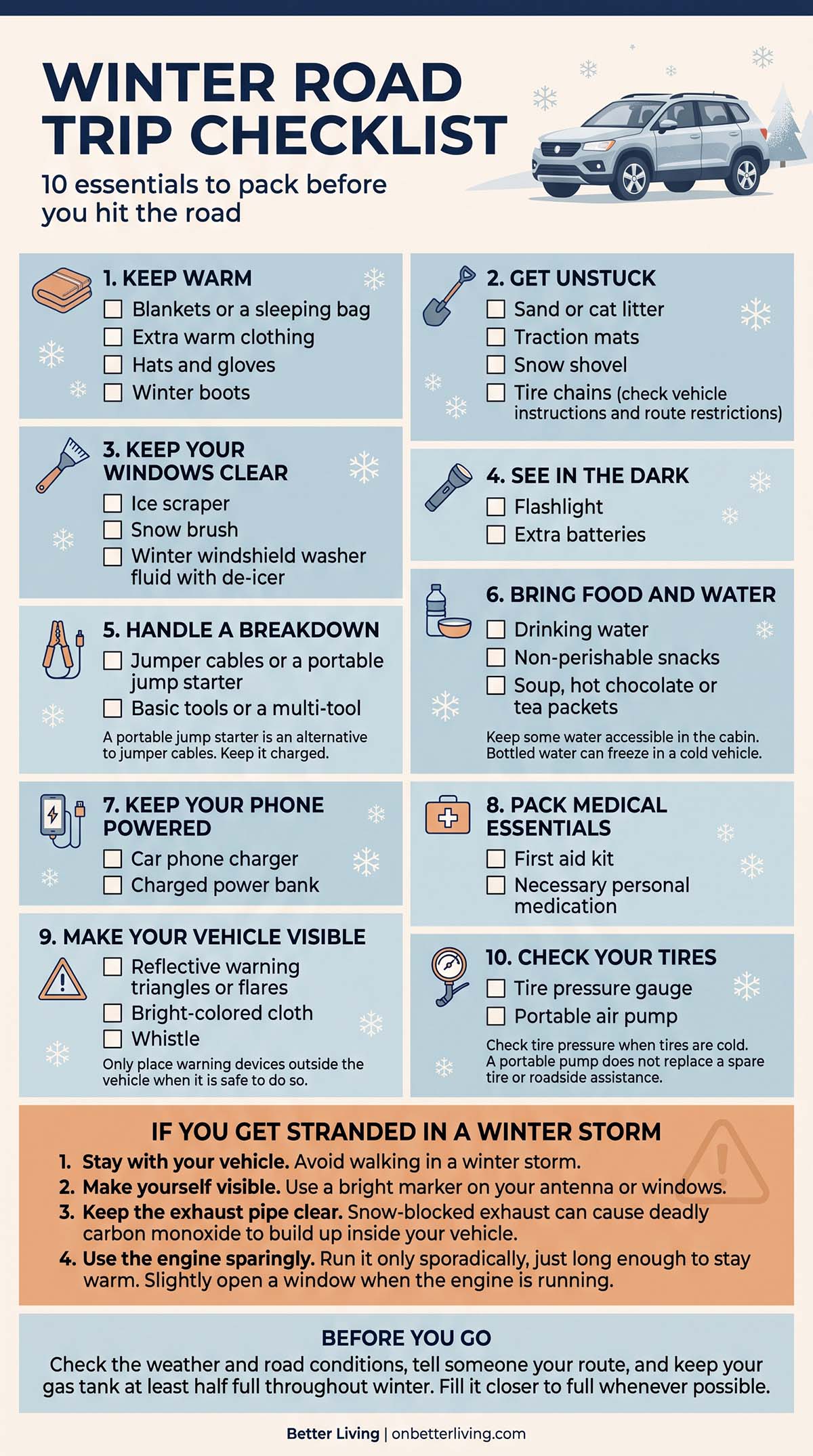
10 things to pack for a winter road trip
1Blankets and extra warm clothing
AAA Oregon/Idaho says to pack blankets and gloves, and Ready Wisconsin lists blankets, extra warm clothing, hats, gloves and winter boots for colder months. ND Response adds a sleeping bag and advises against cotton because it provides no insulation when wet. Our practical tip: keep a dry spare layer where you can reach it without opening the trunk.
2Sand or cat litter, traction mats and a shovel
NHTSA lists a snow shovel, broom and ice scraper plus abrasive material such as sand or kitty litter in case your vehicle gets stuck in snow, and AAA South Jersey lists traction mats as an alternative. AAA Oregon/Idaho also says to have tire chains on hand in case you encounter ice or snow. Check your vehicle manufacturer’s instructions and the chain requirements and restrictions along your route.
3An ice scraper, snow brush and washer fluid
AAA South Jersey lists an ice scraper, snow brush and window washer solvent. NHTSA says to fill the washer reservoir with winter fluid that contains de-icer, and AAA Oregon/Idaho says not to dilute it with water.
4A flashlight with extra batteries
Several emergency-kit lists, including NHTSA and Ready Wisconsin, include a flashlight. The ND sheet lists a flashlight and batteries, with a note to keep them separate.
5Jumper cables and basic tools
Jumper cables appear on the NHTSA, AAA, Ready Wisconsin and ND Response lists, and Ready Wisconsin also lists a multipurpose utility tool and a tow strap or rope. A tow strap is optional, and carrying one is not a recommendation to attempt a vehicle recovery yourself. Our practical tip: a portable jump starter is an alternative to cables, as long as you keep it charged.
6Water and non-perishable snacks
Ready Wisconsin lists drinking water and non-perishable snacks, and NHTSA lists water and food. ND Response suggests easy-to-eat, high-energy foods such as peanuts and candy, or canned ready-to-eat soups or fruit, plus packets of soup, hot chocolate or tea. For shelf-stable options such as trail mix and jerky, see our quick healthy snacks. Our practical tip: pack food that does not need heating or a can opener, and keep a small bottle of water inside the cabin, since bottled water left in a cold car can freeze.
7A phone charger
NHTSA lists a cell phone and charger, Ready Wisconsin lists a cell phone car charger, and ND Response lists a cell phone with a charger. Our practical tip: add a charged power bank so you can recharge without running the engine.
8A first aid kit and necessary medicine
Ready Wisconsin and ND Response both list a first aid kit, and NHTSA says to carry any necessary medicine. Check your kit before the trip, since supplies expire: see our post on whether a first aid kit goes bad.
9Reflective triangles, flares and signal gear
Ready Wisconsin lists reflective warning triangles or roadside flares. ND Response also lists a plastic whistle and bright cloth to tie to an antenna or door handle, and the National Weather Service suggests a red bandana or cloth for the antenna. Our practical tip: place triangles or flares outside only when it is safe to leave the vehicle.
10A tire gauge and portable air pump
Ready Wisconsin lists a tire pressure gauge, a portable electric tire air pump and foam tire sealant. NHTSA says tire pressure drops as the outside temperature drops and that it is best to check tires when they are cold, meaning they have not been driven for at least three hours. CBS Detroit notes the recommended pressure is on the placard on the driver’s side door, not on the tire. A pump does not replace a spare tire or roadside assistance.
What to do if a winter storm strands you
The National Weather Service says to stay in your vehicle and not attempt to walk in a winter storm. NHTSA says to make your car visible with bright markers on the antenna or windows, and to run the engine only sporadically, just long enough to stay warm, rather than for long periods with the windows up. Keep the exhaust pipe clear of snow and one window slightly open. The CDC warns that a snow-blocked tailpipe lets deadly carbon monoxide build up inside the vehicle.
Other useful items to pack
Beyond the emergency basics, these additions can make a winter trip more comfortable and organized:
- Sunglasses for glare off snow.
- Hand warmers and spare gloves in case a pair gets wet.
- An insulated bottle with a hot drink. See our hot chocolate recipes.
- Kids and pets: pack extra snacks, a favorite blanket, a spare leash and a bowl. For young children in car seats, NHTSA says heavy coats can interfere with the harness fit, so use thin layers under the harness and add a coat or blanket over it after buckling.
- Documents: your license, insurance card and roadside assistance number, kept where you can reach them.
Where to keep your winter road trip kit
ND Response suggests packing the kit in a plastic storage container and keeping it in the passenger compartment, in case you go into a ditch and cannot get to or open the trunk. It recommends doing this starting in mid-October, which is North Dakota’s timing; start whenever winter weather begins where you drive.
What to check before you leave
- Weather and route. NHTSA says to check the weather, road conditions and traffic before leaving, and to let others know your route and anticipated arrival time. PennDOT urges drivers to check conditions on 511PA, and you should check your own state’s transportation department for each state on your route. Our practical tip: if severe weather is forecast along your route, consider delaying the trip. A packed kit does not make an unsafe drive safe.
- Fuel. The National Weather Service says to keep the gas tank at least half full throughout the winter and to fill up before entering open country, even for a short distance. NHTSA says to keep it close to full whenever possible.
- Battery and engine. NHTSA says to have a mechanic check your battery, charging system and belts, and to make sure you have enough coolant that meets the manufacturer’s specifications.
- Tires, wipers and lights. NHTSA lists 2/32 of an inch as the minimum tread, which is a replacement threshold, not a winter target. AAA Mountain West advises replacing winter tires with less than 4/32 of an inch of tread. Make sure defrosters and wipers work, replace worn blades and check all lights. Shopping for new tires? See our Cooper tires review.
- Exhaust. Before you drive after a storm, check that the tailpipe is clear of snow.
- Your home. Our checklist for leaving the house for holiday travel covers the home side of the trip.
Driving an electric car in winter?
The AAA says range drops in cold weather and the battery accepts charge more slowly. It recommends pre-conditioning the cabin while the car is plugged in, and using seat and steering wheel heaters, which are more efficient than heating the cabin. Plan charging stops with extra margin, and pack the same warmth, food and signaling gear as any other driver.
See also

Winter road trip packing: your questions, answered
What should I keep in my car for a winter road trip?
Keep blankets, warm clothing, sand or cat litter, a shovel, an ice scraper, a flashlight, jumper cables, water, snacks, a phone charger, a first aid kit and reflective warning gear, based on NHTSA, AAA and Ready Wisconsin lists.
How full should my gas tank be in winter?
The National Weather Service says to keep it at least half full throughout the winter and to fill up before entering open country. NHTSA says to keep it close to full whenever possible.
What should I do if I get stuck in the snow?
The National Weather Service says to stay in your vehicle and not walk in a winter storm. NHTSA says to run the engine only sporadically, just long enough to stay warm, and to keep the exhaust pipe clear of snow. Keep one window slightly open, since a blocked tailpipe can cause deadly carbon monoxide to build up, per the CDC.
Is cat litter good for traction?
NHTSA lists sand or kitty litter as abrasive material to keep in your vehicle in case you get stuck in snow, and AAA South Jersey lists traction mats as an alternative.
Do I need tire chains for a winter road trip?
AAA Oregon/Idaho says to have tire chains on hand in case you encounter ice or snow. Check your vehicle manufacturer’s instructions and the chain rules along your route.
How much tire tread do I need for winter driving?
NHTSA lists 2/32 of an inch as the minimum, which is a replacement threshold rather than a winter target. AAA Mountain West advises replacing winter tires with less than 4/32 of an inch of tread. Have a tire professional check whether your tires suit your route.
What should I check on my car before a winter road trip?
NHTSA says to have a mechanic check the battery, charging system and belts, make sure coolant meets specifications, confirm that defrosters and wipers work, replace worn wiper blades and check all lights and tire tread.
The bottom line
Pack for waiting, not just driving: warmth, traction, light, food, power and signals, with a well-fueled tank and a clear tailpipe. Keep the kit in the passenger area, check the forecast and tell someone your route.
Related reading: road trip cooler mistakes and how to avoid them.

Better Living may earn commissions through affiliate links and may occasionally feature sponsored or partner content. If you make a purchase through our links, we may receive a small commission at no cost to you.


















 English (US) ·
 French (CA) ·
 French (FR) ·