

PROTECT YOURSELF with Orgo-Life® QUANTUM TECHNOLOGY
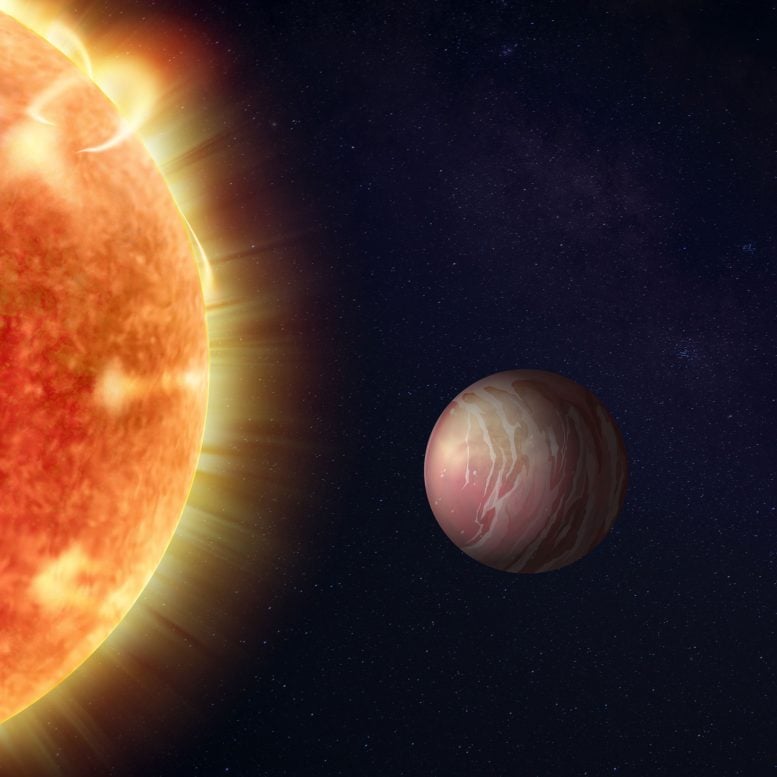
Orgo-Life the new way to the future Advertising by Adpathway After around 2033, planet TOI-1355 b will disappear from view as it must pass between the star and Earth to be seen. There would be no major changes for the planet itself. But astronomers will become unable to observe its transits to characterize the planetary nature for hundreds of years. © ESA/Hubble, N. Bartmann CC-BY Credit: ESA/Hubble, N. Bartmann CC-BY
Astronomers have discovered an unusual planet with an extremely hot host star and a highly eccentric orbit that challenges expectations for its class.
A giant planet racing around an unusually hot star has caught astronomers’ attention because of its highly elongated orbit. Known as TOI-1355 b, the planet completes one revolution in roughly two Earth days, following a path that differs sharply from the nearly circular orbits typical of many hot Jupiters.
Researchers from the University of Tokyo and their international collaborators believe the planet’s unusual trajectory could help explain how giant planets migrate toward their stars. However, its changing orbit is expected to limit observations after approximately 2033, leaving scientists a relatively short window to investigate its behavior.
An Unusual Orbit Around an Extremely Hot Star
TOI-1355 b belongs to a class of exoplanets called hot Jupiters, massive gas giants that orbit exceptionally close to their host stars. Its star, TOI-1355, has a surface temperature of approximately 8,400 degrees Celsius (15,152 degrees Fahrenheit), compared with about 5,500 degrees Celsius (9,932 degrees Fahrenheit) for the Sun.
Although astronomers have discovered thousands of planets around stars similar to or cooler than the Sun, planetary systems surrounding hotter stars remain less thoroughly explored. Project Researcher Noriharu Watanabe and Professor Norio Narita of the University of Tokyo’s Graduate School of Arts and Sciences are investigating these systems to better understand the diversity of planets beyond our solar system.
“Planet surveys around stars as hot or cooler than the sun are flourishing, and thousands of planets have been discovered around such stars. But planet surveys around hotter stars are still not advanced,” said Watanabe. “In this project, we hunted for planets around hot stars to examine the diversity of exoplanets more broadly. When we investigated the change in brightness of TOI-1355 from prior data, we found that the secondary eclipse, a phenomenon in which a planet passes behind a star, occurred faster than the timing assumed for a circular orbit. This was unusual for hot Jupiters around hot stars, and this is why we began to research this planet in detail.”
How Changes in Starlight Exposed the Planet’s Orbit
NASA’s Transiting Exoplanet Survey Satellite (TESS) first detected periodic decreases in TOI-1355’s brightness. Narita’s team identified these dips as planetary transits, which occur when a planet passes in front of its star from Earth’s perspective and temporarily blocks a small fraction of its light.
The researchers also examined the secondary eclipse, when the planet passes behind its star. Its unexpected timing indicated that TOI-1355 b was traveling along an elliptical rather than circular orbit. By analyzing brightness variations recorded by TESS, the team determined the planet’s mass and orbital eccentricity, a measurement of how far an orbit deviates from a perfect circle. Calculating the mass required more complex mathematical models to account for the planet’s elongated trajectory.
Clues to a Planet’s Turbulent History
One possible explanation for TOI-1355 b’s orbit involves gravitational encounters with other massive planets or celestial bodies. Such interactions can dramatically alter a planet’s trajectory, sending it into a highly eccentric orbit. Over time, tidal forces from the host star can shrink and gradually circularize that orbit, potentially producing the close, nearly circular paths observed in many hot Jupiters.
“It is considered that the planetary orbit had become highly elliptical, initially due to the gravitational interaction with other celestial bodies, such as other giant planets, and shrunk gradually later due to the tidal effect of its host star,” said Watanabe.
The discovery supports theoretical predictions that hot Jupiters around hotter stars may undergo dramatic orbital migration. Researchers have not established which interactions shaped TOI-1355 b’s particular orbit, but its pronounced eccentricity is consistent with a history of gravitational disturbances followed by tidal evolution.
The team is now investigating how the planet’s orbital plane is tilted relative to the star’s rotation, another measurement that could help reconstruct its past. The researchers are preparing a separate paper on this work and planning an observation proposal involving NASA’s James Webb Space Telescope. With the planet’s evolving orbit expected to prevent the same transit and eclipse observations after around 2033, the opportunity to collect these measurements is limited.
Reference: “Discovery of an eccentric hot super-jupiter leaving the transiting geometry of the early-A-type star TOI-1355” by Noriharu Watanabe, Norio Narita, Akihiko Fukui, Bun’ei Sato, Keisuke Isogai, John H Livingston, Jerome P de Leon, Daniel Huber, Yugo Kawai, Yuya Hayashi, Masashi Omiya, Hideyuki Izumiura, Akito Tajitsu, Keivan G Stassun, Eric Girardin, Giuseppe Marino, Antonio Frasca, Giovanni Catanzaro, Javier Alonso-Santiago, Manfred Raetz, Stephanie Striegel, Nobuhiko Kusakabe and Motohide Tamura, 18 September 2026, Publications of the Astronomical Society of Japan.
DOI: 10.1093/pasj/psag103
Funding: JSPS KAKENHI, JST SPRING, JSPS Bilateral Program, NASA, JST PRESTO
Never miss a breakthrough: Join the SciTechDaily newsletter.
Follow us on Google and Google News.
























 English (US) ·
 French (CA) ·
 French (FR) ·