

.png) 9 hours ago
4
PROTECT YOURSELF with Orgo-Life® QUANTUM TECHNOLOGY
Orgo-Life the new way to the future Advertising by AdpathwayFarmer Alastair Leake is standing in a field of sprouting winter wheat, pointing at his experiment. One side was ploughed before planting, with green shoots breaking through neat rows of upturned soil. On the other, the crop was drilled directly into the earth, emerging through a messy carpet of “trash” – stems, stubble and crop residue from previous harvests.
“When we’re watching to see where the birds are landing to feed, none of them are going on to the ploughed side,” says Leake, the director of the Allerton Project farm, standing on the trashy side. “They’re all coming and feeding down here.
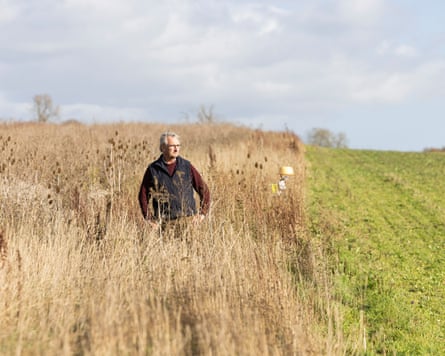
“That’s because that’s where the seeds, the earthworms and the insects are. On the ploughed side, they’re all buried.”
It is experiments such as these that have enabled the Allerton Project to buck the decline in farm bird populations across the UK. Farm bird abundance at Allerton has risen 145% since 1992 when monitoring began, compared with a 23% decline nationally over the same period.
“This is not some study that’s been done overnight,” Leake says. “We can be fairly confident that this is a robust recipe that we’ve got here.”
The Allerton Project is a working farm and research centre on the Leicestershire-Rutland border, where farmers and scientists have spent more than three decades testing how farming can produce food while supporting wildlife.
Frequently hosting farmers, policymakers and businesses, the 320-hectare “demonstration farm” uses a range of sustainable agriculture, habitat creation and landscape management methods to show how agriculture can be a part of environmental action.
“I don’t want people to come here and say: ‘Oh, that’s a nice nature reserve they’ve got going there’,” Leake says of his guests. “I want them to go back on to their farms and say: ‘Do you know what, I can do that.’”
Changes in farming practices across the UK have devastated farmland bird populations. An increase in pesticide use and a loss of suitable habitats have driven some species to extinction, according to the RSPB. But at Allerton, farm bird numbers are at their highest level since records began, with song thrush, blackbirds and linnets in particular on the rise.
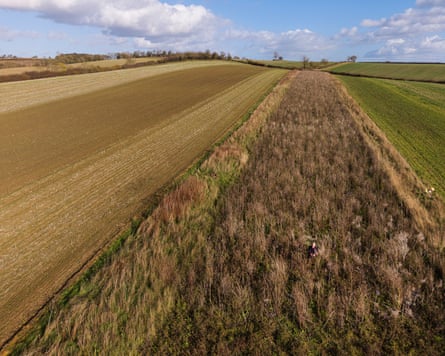
Leake points to a “bird table”, a channel of dedicated wildlife seed mix that splits the field. In these unkempt strips found all over the farm, kale, teasel, sorghum and millet are grown to supply seeds to birds through winter.
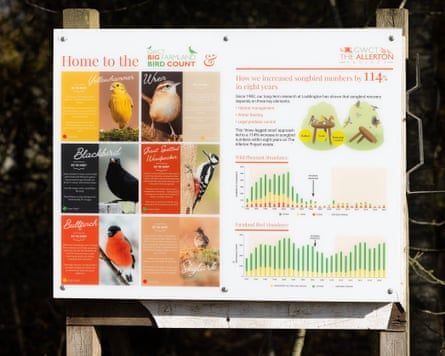
Photograph: Fabio De Paola/The Guardian
“That is probably the most important thing we’ve done, [making] sure that there is food in the landscape for those birds to go and feed on,” he says. “If they manage to survive what we call the ‘hungry gap’, which is January, February, March, that means they’re ready to breed again.” Goldfinches love the teasel, he adds.
after newsletter promotion
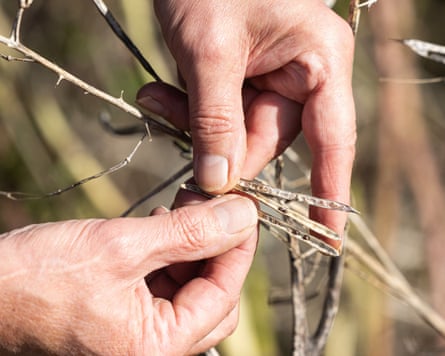
Adjoining the bird table is the “beetle bank”, a strip of uncultivated land planted with long, tussock-forming perennial grasses. As the grass dies down year after year, it falls over and builds a thick, fibrous blanket of dead plant material, where beetles move to hibernate.
“When it warms up in the spring, they go out into the crops and they eat the pests that attack the crops,” says Leake, adding that the beetles mean the crops do not need to be sprayed with pesticides. “But also they provide insect food for birds.”
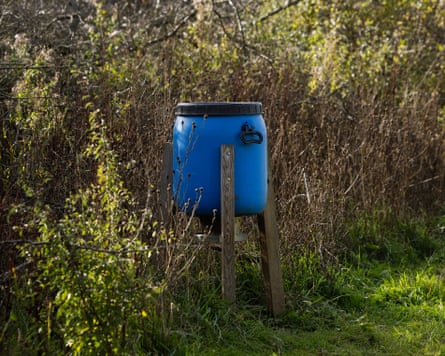
In a nearby field, Leake showcases an innovation found in gardens all over the country: bird feeders. “We fill the barrel up with wheat and the birds come and feed off it in the wintertime,” says Leake. “It’s just what people do in the gardens, feeding birds and things, but we’re doing it for farmland birds instead.”
The less-discussed aspect of wild bird protection is predator control. Foxes and crows, for example, can prey on eggs and chicks, sometimes holding back the recovery of vulnerable ground-nesting birds. Killing predators can be contentious.
Leake says Allerton’s approach is as humane as possible, targeting predators only during nesting season, the most vulnerable time for birds. “Our approach is a much more managed one,” he says. “So we are just reducing the pressure at the critical point.”
He says these measures prove it is possible to reverse the decline in wild bird populations. “We have reached the highest number [of birds] against the backdrop of the national figure continuing to go down,” he says. “This is because we’re learning how to manage the whole estate better for nature as time moves on. We come up with new ideas, we put them in place, and that is bringing nature recovery.
“There’s no reason why this couldn’t be done across the whole country. No reason at all, given the right incentives for people to do it.”


















 English (US) ·
 French (CA) ·
 French (FR) ·