

 5 hours ago
9
PROTECT YOURSELF with Orgo-Life® QUANTUM TECHNOLOGY
Orgo-Life the new way to the future Advertising by Adpathway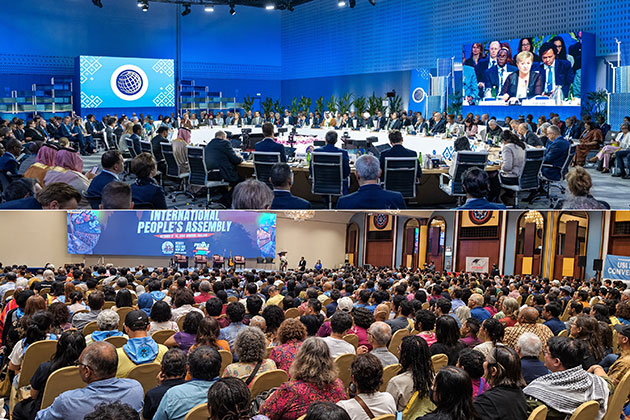 Top: Annual Meetings of the IMF and the World Bank inside the Queen Sirikit Convention Center in Bangkok Credit: (IMF photo/N.Karlin). Bottom: Opening of the People’s Assembly.
BANGKOK, Thailand, October 19 (IPS) - Bangkok hosted two summits last week. Inside the Queen Sirikit Convention Center, more than 15,000 finance ministers, central bank governors and CEOs of the world’s largest banks and corporations attended the Annual Meetings of the International Monetary Fund (IMF) and the World Bank. They flew in business class and slept in five-star hotels to talk about growth, inflation and public spending, and thus to decide the destiny of billions of people they will never meet. Outside, hundreds of social movements and civil society organizations held the People’s Assembly, for the 99% whose voice would not be heard. They flew economy and often shared modest rooms. The first was the summit of money and power. The second, the summit of the rest of us.
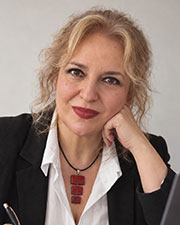 Isabel Ortiz
These are turbulent times, marked by crises that are not natural but man-made: war, energy shocks, cost of living crisis, debt crisis, climate crisis, inequality crisis, many aggravated by the Trump administration. Inside the convention center, instead of working to solve these crises, the IMF and the World Bank told countries to be “resilient” and to build “buffers”, that is, to cut public spending now to survive the next crises. Rich countries were told to “take some pain today for growth tomorrow” and low-income countries, in the IMF Managing Director’s own words, “may be forced to cut much-needed development spending”. In other words, accept the man-made disaster, and make the people pay for it with more austerity, cuts to wages, pensions and public services. Only military spending is spared, as a “competing spending priority” to be accommodated, and Europe’s rearmament is counted as growth.
The IMF report World Economic Outlook lifts global growth to 3.1% for 2026 on the back of investment in artificial intelligence (AI), a boom confined to only a handful of countries and a technology the IMF itself says will affect 40% of jobs worldwide, and that a third of jobs in high-income countries are at risk to be replaced by IA.
Both institutions presented private finance as the engine of development: the World Bank’s Development Committee agenda in Bangkok was centered on mobilizing private capital with public guarantees. In plain language, subsidizing large corporations with public money while prescribing cuts to the public services ordinary people depend on.
No communiqué was agreed in any ministerial committee. The corridor talk was how far both institutions have bent to the will of Washington: directors replaced (at the World Bank by private sector executives, most with no development experience); work on climate and gender shelved; and, above all, the chainsaw of Trump’s Department of Government Efficiency applied worldwide, with the myth that tax cuts for the wealthy and austerity cuts that impoverish the working and middle classes are necessary.
Outside the convention center, the story was completely different. The People’s Assembly worked through the alternatives in over 50 sessions to formulate a new system accountable to people and planet, not to the 1%. Behind them stand nearly 400 million people: 200 million small farmers of La Via Campesina, 191 million workers of global unions, and tens of thousands of civil society organizations. There were protests in Bangkok, and in more than 150 cities across 38 countries, including Argentina, Congo, Germany, India, Nigeria, Pakistan, Philippines, Uganda and the United Kingdom, with people marching peacefully under banners such as “We are the 99%” or “Tax elites and corporations” reflecting the aims:
- Tax the 1% not ordinary people: Progressive taxes on wealth, large corporations and big tech, and an end to tax havens, with an equitable UN tax convention, instead of consumption taxes and other taxes squeezing the working and middle classes.
- End austerity cuts: Public services and social protection for all; fund the right to health, education, social security, housing, water, instead of privatization and public private partnerships that shift costs to people.
- Debt justice: No country should cut health or education to pay creditors as happens in 51 countries today; audit and cancel illegitimate debts, end IMF surcharges and loan conditions, and a UN framework convention on sovereign debt instead of restructurings run by creditors.
- Climate justice: Make polluters pay, phase out fossil fuels, and a just transition.
- Democratize global economic governance: The IMF and World Bank are not the solution but part of the problem, as a few rich countries (and their corporations) hold most of the voting power (and only the US has a veto); move decisions on debt, tax and finance to the UN, where every country has one vote.
- Gender justice: Women are half of the world population but just an afterthought for policy makers, gender-responsive policies and budgets, public services, redistribution of care work.
- Decent jobs: Employment respecting international labor standards and living wages, union rights and protection for migrant workers.
- Food sovereignty, fair crop prices for farmers, agroecology instead of agrobusiness, land rights for indigenous peoples and small farmers, and rights guaranteed by the UN Declaration on the Rights of Peasants.
- Industrialization of developing countries, oriented to domestic and regional markets, instead of exporting raw materials and importing everything else.
- No more corporate impunity, promotion of private finance and privatization: public services can be funded by taxing the 1%, a binding UN treaty on business and human rights, and fair trade rules instead of investor-state arbitration that lets corporations sue governments.
- AI: Slow down and put AI under public control, binding public regulation of AI covering data harvesting, manipulation of public opinion, job destruction, civil liberties and environmental damage.
- Stop authoritarianism and the far-right: Defend civic space, Human Rights and democratic institutions against the authoritarian turn of governments.
- Peace and an end to the militarization that diverts budgets from social spending to rearmament, and an end to occupation and genocide in Palestine.
Another world is possible, and last week it was formulated a short distance from the IMF/World Bank convention center. Finance ministers must now choose whom they serve: the millions of citizens who elected them, or the 1%, by bending to pressure from the IMF and the World Bank that deepens inequality.
Isabel Ortiz, Director, Global Social Justice, was Director at the International Labor Organization (ILO) and UNICEF, and a senior official at the UN and the Asian Development Bank.
IPS UN Bureau



© Inter Press Service (20261019053745) — All Rights Reserved. Original source: Inter Press Service














 English (US) ·
 French (CA) ·
 French (FR) ·