

PROTECT YOURSELF with Orgo-Life® QUANTUM TECHNOLOGY
Orgo-Life the new way to the future Advertising by AdpathwayHigh schools across France have closed, thousands of teenagers have been arrested, and hundreds of people have suffered injuries as unrest over conditions in the lycée system has spread and erupted into violence in recent days.
Roughly 3,000 people have been arrested since the protests began nearly two weeks ago outside of Paris, with nearly 2,000 being detained on Thursday alone, the French interior ministry announced.
As demonstrations have at times escalated into violent clashes, 170 students and 65 school staff members have been injured, according to education minister Édouard Geffray. Nearly 400 police officers have also reportedly suffered injuries.
And the protests showed no signs of abating on Friday, when roughly 900 demonstrations took place around France, according to police. More than 500 French schools remained closed as students set fires, blockaded schools, and clashed with riot police around the country.
Geffray met with education unions, student organizations, and parent associations on Friday morning in an attempt to temper the protests through dialogue.
“High school students must be listened to. Their difficulties call for concrete responses, both in their schools and at the national level,” Geffray wrote on X. “This is the purpose of the dialogue initiated in high schools and academies, which I am continuing today with representatives of staff, parents, and high school students.”
He announced a platform students can use to submit proposals for education reform, which he said will be evaluated and used for a “national report.”
High school student organizations, however, have called for continued demonstrations following their meetings with Geffray, citing a lack of “concrete measures” from the French government to address their complaints.
Here’s what you should know about the ongoing protests.
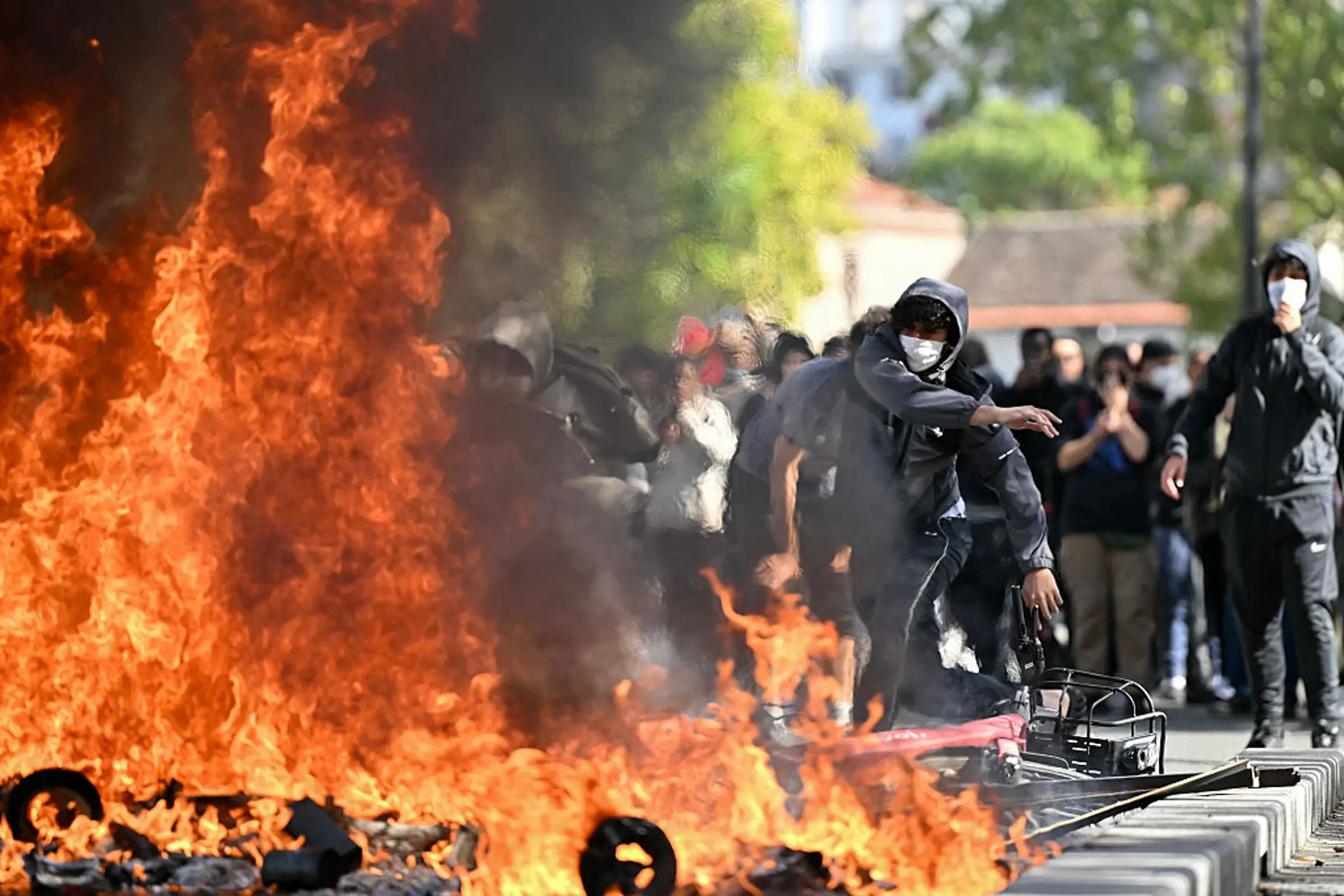
A protesting student feeds a burnt barrier during a blockading action outside the secondary school Le Corbusier, in Aubervilliers, northern Paris on October 1, 2026. Lou Benoist—AFP/Getty Images
Why are students protesting?
The protests have been driven by anger over a variety of issues impacting French high schools.
A main complaint among demonstrators is the shortage of teachers and support staff in the country’s schools.
The education ministry found that during the 2024-2025 school year, nearly 10% of teaching hours went untaught in public secondary schools. About 7.5% of those lost hours were due to a failure to find substitutes.
"Today our school is paralyzed due to a lack of resources, teachers, and not enough desks,” one student told the French outlet Agence France Presse (AFP). “We don't have nurses or supervisors, and all they do for us is take away our phones.”
Complaints about insufficient resources and funding and poor infrastructure in schools have also been raised in the student protests.
"We are 35 per class, we don’t have enough chairs in classrooms,” a 15-year-old student told Reuters in the Paris suburb of Pantin as demonstrators clashed with police deploying tear gas in an effort to quell the protest.
“There are 35 of us per classroom. With 35 degrees Celsius [95 degrees Fahrenheit] in summer, it’s unbearable. There aren’t enough toilets, and there are water leaks in some rooms,” a 17-year-old said while speaking to AFP at a protest in Strasbourg in the northeast of France. “The building is falling apart, the cafeteria is too small. There’s zero budget, zero resources, not enough supervisors.”
Another student also raised concerns about a lack of resources to address high supper temperatures when talking to The Guardian.
“We’re also protesting about the conditions in the heatwave,” the 19-year-old said. “Young people just want to study and learn in decent conditions. The French state seems surprised about worsening school results, but they’re doing nothing to remedy that.”
A series of deadly heatwaves hit Europe over the summer, with Western Europe experiencing its hottest summer ever. In France, nearly 8,000 people died over the course of the summer as a result of the high temperatures.
Student protesters have also expressed grievances with the country’s online university application system, Parcoursup, which they have described as a source of stress and mistrust in the education system.
The particular complaints being raised by demonstrators have varied somewhat across different parts of the country, however.
Geffray characterized this as a complicating factor in addressing the roots of the unrest. "One of the difficulties of this movement is that there are no national demands. It all started with local demands,” the Education Minister said Friday morning.
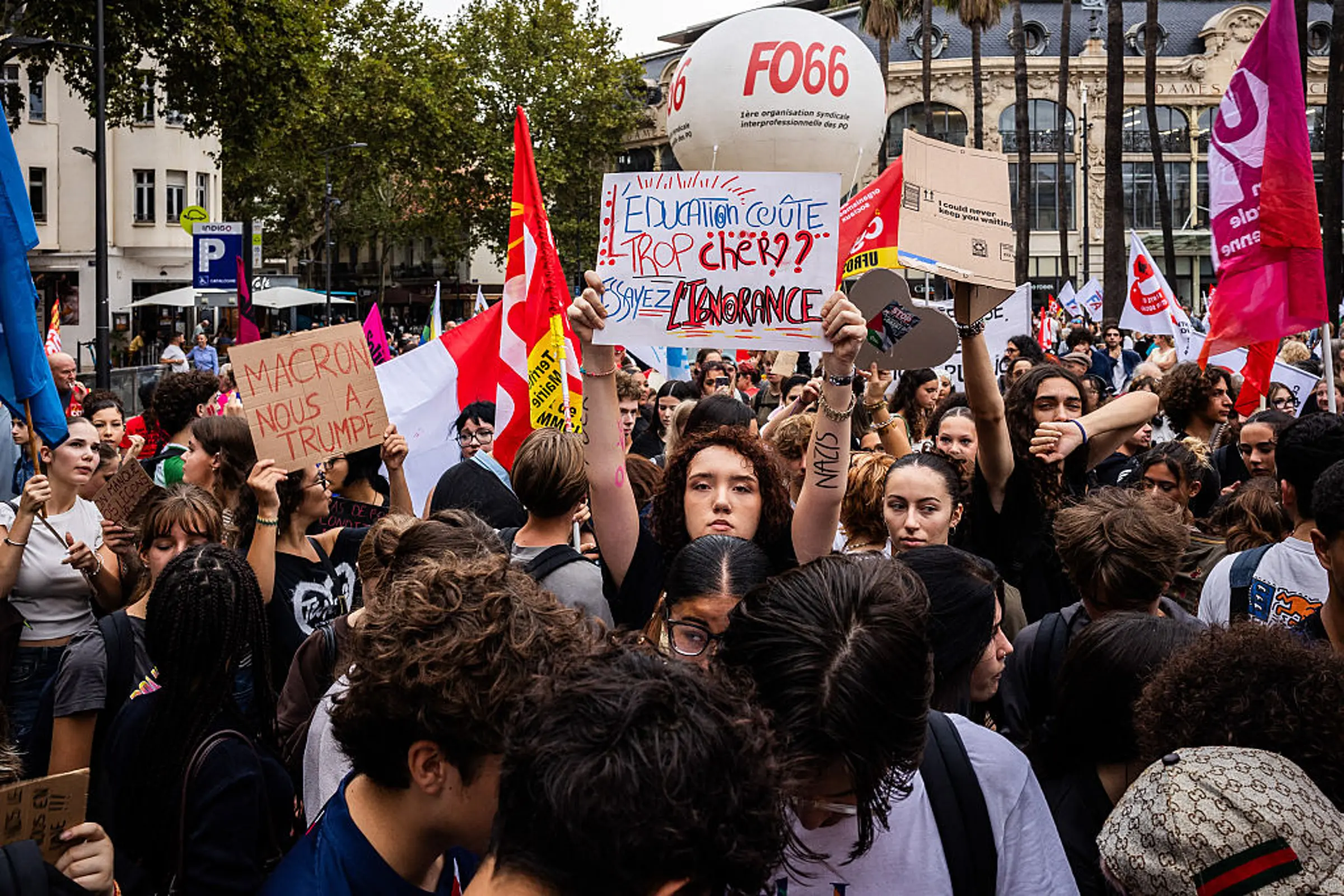
A group of high school students leading a march with signs reading "Education Is Too Expensive / Try Ignorance Instead" at Place de Catalogne in Perpignan, in the Pyrenees-Orientales department in southern France, on September 29, 2026. Jc Milhet—Hans Lucas/AFP/Getty Images
Where did the protests begin, and how have they expanded?
The protests began with r students at Lycée Saint-Exupéry in Créteil outside Paris mobilizing to protest teacher shortages and a lack of adequate resources in late September.
In the days that followed, protests spread throughout the Île-de-France region, which includes Paris and its surrounding metropolitan areas, as students attempted to set up blockades at dozens of schools.
The demonstrations have escalated still further this week, spreading outside of Paris’ surrounding area and into regions around the country. Tracking from Reuters also showed that protests have sprouted across western France in Rennes, Nantes, Quimper, and Brest; around the southern part of the country in Bordeaux, Toulouse, Toulon, Marseilles and Grenoble; as far east as Strasbourg; and as far north as Lille.
By Monday, 180 schools were disrupted by the expanded demonstrations, according to the interior ministry. That number had risen to over 500 at week’s end.
Thursday marked the largest escalation of protests.
Fires were started at at least two French schools that day. Several teachers were accidentally splashed with gasoline at Marseille's Victor Hugo high school. At Saint-Exupery high school, also in Marseilles, hundreds of students set ablaze a fire truck that had arrived to put out a previous fire from the morning. Firefighters were forced by students to exit their vehicle before it was burned. In protests around the country, confrontations broke out between students and police, who fired projectiles in attempts to control crowds of demonstrators.
As of Friday night, the protests show no signs of stopping. Two student unions, the Student Union and the High School Trade Union, have jointly called for continued protests next week.
“Students and high school students, while the authorities seek to drive us out of our places of study through budget cuts, the closure of places, dilapidated buildings, selection, or repression, let's not let them: let's block and retake the universities and high schools!” the unions wrote in a press release.
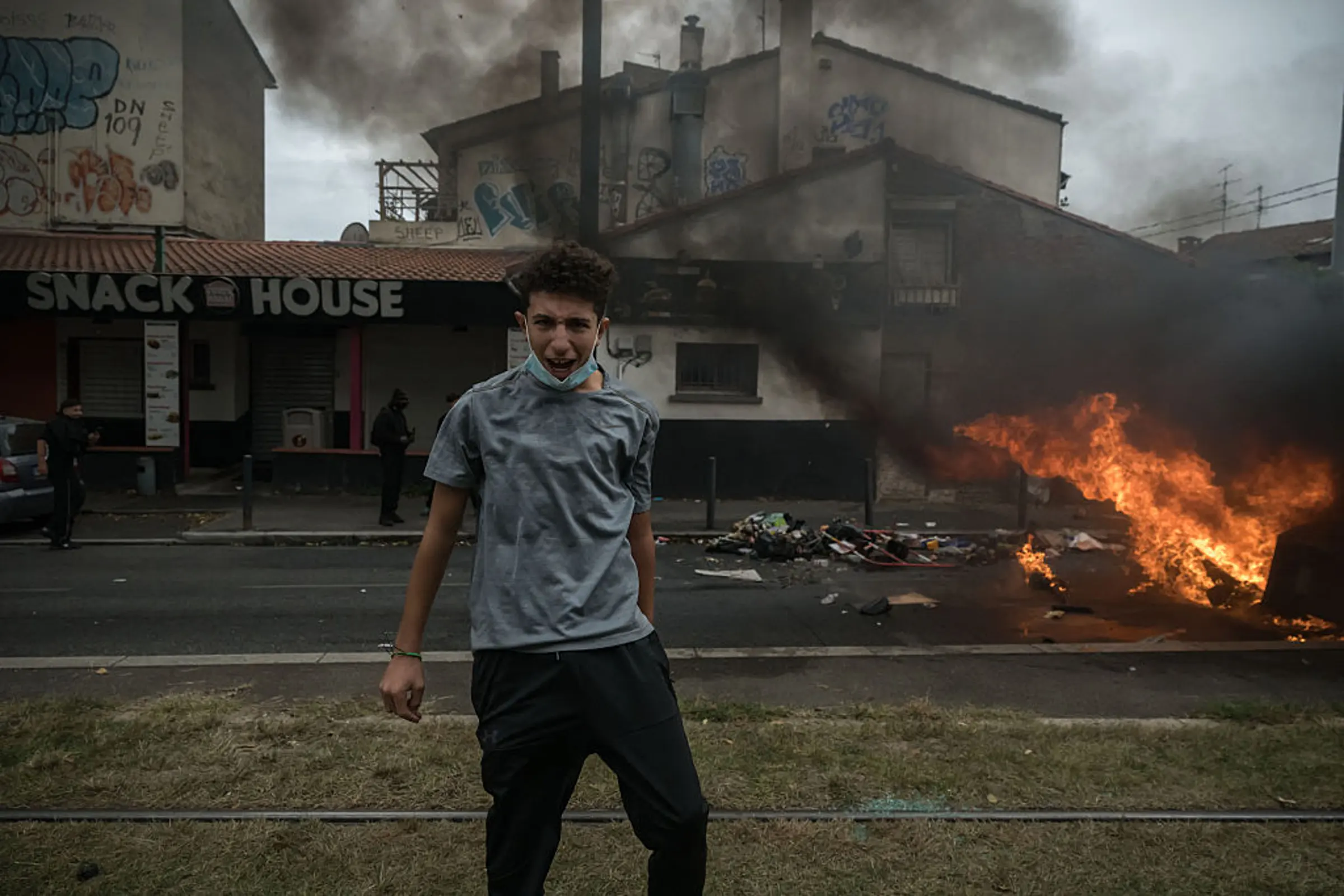
A student reacts by a burning barricade as highschool students demonstrate countrywide over what they denounce as poor learning conditions, near the Lycee Deodat high school in Toulouse, south-western France, on October 1, 2026. Ed Jones—AFP/Getty Images
What French officials are saying
Several French officials have weighed in the student demonstrations as they have continued to escalate and expand around the country. Some have specifically addressed remarks toward protesters’ parents.
Justice Minister Gerald Darmanin told RTL radio on Thursday that parents whose children have caused damage to property should pay reparations.
Meanwhile, Geffray cautioned against the dangers he said the increasingly violent protests pose to students.
"Parents clearly need to mobilize and tell their children not to go" to the blockades, Geffray said on Friday. "Now, what matters is ensuring that our children are no longer in the streets because they are in danger.”
As the protests intensified this week, French Prime Minister Sébastien Lecornu called a crisis meeting on Thursday and canceled ministers’ travel plans to work on quelling the demonstrations.
"I hear and understand the anxieties and anger that our youth may have,” French President Emmanuel Macron said on Wednesday while speaking in Madrid. “However, none of these debates, none of these fears legitimizes violence.”










 English (US) ·
  French (CA) ·
  French (FR) ·