

 2 months ago
32
2 months ago
32
PROTECT YOURSELF with Orgo-Life® QUANTUM TECHNOLOGY
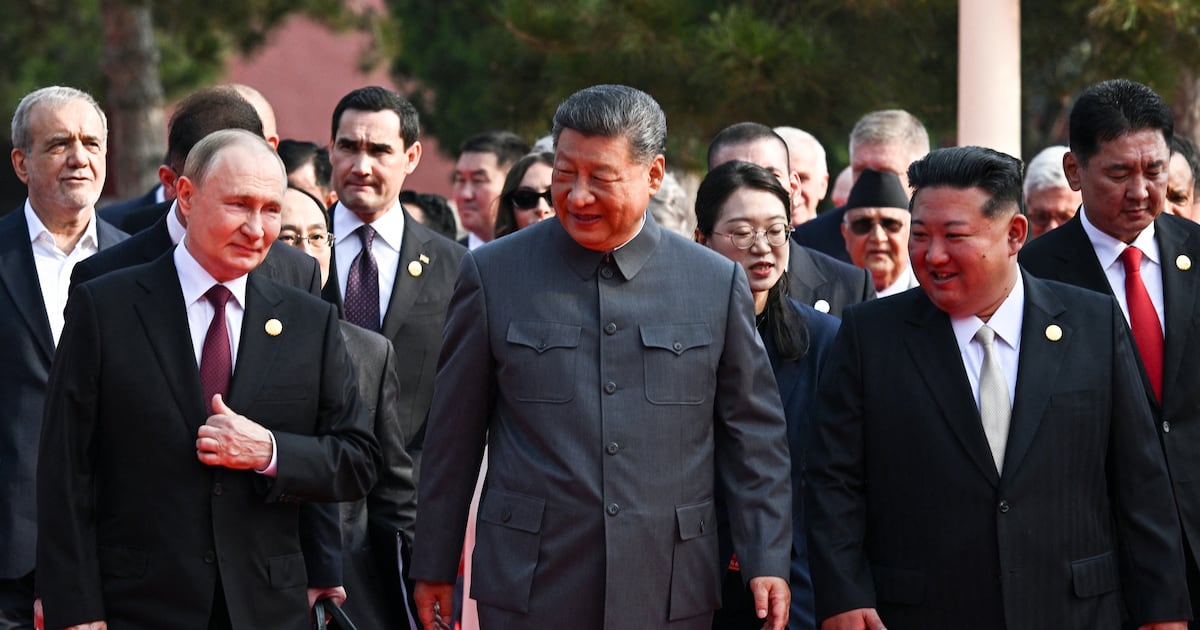
Orgo-Life the new way to the future Advertising by AdpathwayAccording to the state news agencies of China and North Korea, on June 8, Kim Jong Un, the leader of North Korea, and Chinese leader Xi Jinping, held a summit meeting around 6:30 p.m. local time at the Kumsusan State Guesthouse. It was the second summit between Xi and Kim since Kim visited Beijing to attend a military parade in September 2025 commemorating the 80th anniversary of China’s victory in World War II.
“Your current visit will mark an important occasion of showing once again that the DPRK and China have always stood together on the right side of history for independence and justice and their relations are definitely solid as they have stood the test of history under any international upheavals,” Kim was quoted as saying during the meeting by the North’s state-controlled Korean Central News Agency. (DPRK is an acronym of North Korea’s official name: Democratic People’s Republic of Korea.)
Affirming his regime’s firm support for Beijing, Kim also said that his top priority is strengthening bilateral relations with China into a “solid strategic relationship.”
“No matter the situation may change, our party and government will fully support the policy and stand of the Chinese party and government to defend the core interests on the ‘one-China’ principle,” Kim said.
Since U.S. President Donald Trump walked away from the negotiating table in Hanoi in February 2019, Pyongyang has explicitly beefed up its nuclear capabilities. In 2023, North Korea approved an amendment to its constitution legitimizing its nuclear-building policy.
With the enhancement of U.S.-South Korea-Japan trilateral cooperation, North Korea has also clearly taken steps to consolidate its coalition with China and Russia. Kim has extended its support to Russian President Vladimir Putin’s war efforts in Ukraine. The construction of the China-Russia-North Korea coalition is widely interpreted as an anti-U.S. coalition in the region.
Xi’s leverage is clear. Following his summit with Trump last month, he met in quick succession with Putin and Kim. Even if Trump still wants to approach Kim with a top-down diplomatic approach, Xi has grasped the lever in any future talks between Trump and Kim.
“The traditional friendship between the two countries is rooted in their shared ideals and beliefs as well as their common goals, and is backed by a profound historical foundation, a solid political basis and strong emotional bonds,” Xi was quoted as saying in China’s state-controlled Xinhua news agency on Monday, referring to the China-North Korea relationship.
“Both sides should enhance exchanges in diplomacy, law enforcement, military affairs and others, implement the important consensus reached between the two leaders, and pool wisdom and strength for the development of China-DPRK relations,” Xi said. “The two countries should strengthen strategic coordination, firmly safeguard their respective sovereignty, security and development interests, and jointly uphold regional peace and development.”
As of writing, the Chinese Foreign Ministry has not explained precisely what enhancing exchanges in military affairs means. However, one reading of Xi’s remarks implies that China de facto recognizes North Korea as a nuclear-armed state, meaning that China, a permanent member of the U.N. Security Council, will not agree to impose additional sanctions against any future North Korean ballistic missile or nuclear tests. Also, Xi made no remarks regarding the denuclearization of the Korean Peninsula and North Korea’s nuclear missile programs during his talks with Kim. Pyongyang’s growing nuclear capabilities and continuous development of nuclear weapons are no longer security concerns for Beijing. Rather, Beijing seems to have allowed Pyongyang to keep its nuclear weapons for the safety of the Kim regime — which could be a key to building North Korea as a stronger socialist country.
According to the South’s Yonhap News Agency, the U.S. State Department said its pledge for the complete denuclearization of North Korea remains, and it is open to engaging in dialogue with North Korea with no preconditions.
On Tuesday, South Korea’s Unification Ministry said that it will monitor developments between China and North Korea following Xi’s remarks. As South Korea’s Lee Jae-myung administration still supports the peaceful unification of the Korean Peninsula, Xi’s support for enhancing military cooperation with North Korea may be a huge obstacle for Seoul. The security dynamics on the Korean Peninsula could be transformed into a new Cold War, considering the deepening of both the U.S.-South Korea-Japan alliance and China-Russia-North Korea coalition.

![New Japanese convenience store rice balls taste like instant noodles [Taste test]](https://soranews24.com/wp-content/uploads/sites/3/2026/09/0_c8e809.jpg?w=1200&h=630&crop=1)
















 English (US) ·
  French (CA) ·
  French (FR) ·