

 2 months ago
27
2 months ago
27
PROTECT YOURSELF with Orgo-Life® QUANTUM TECHNOLOGY
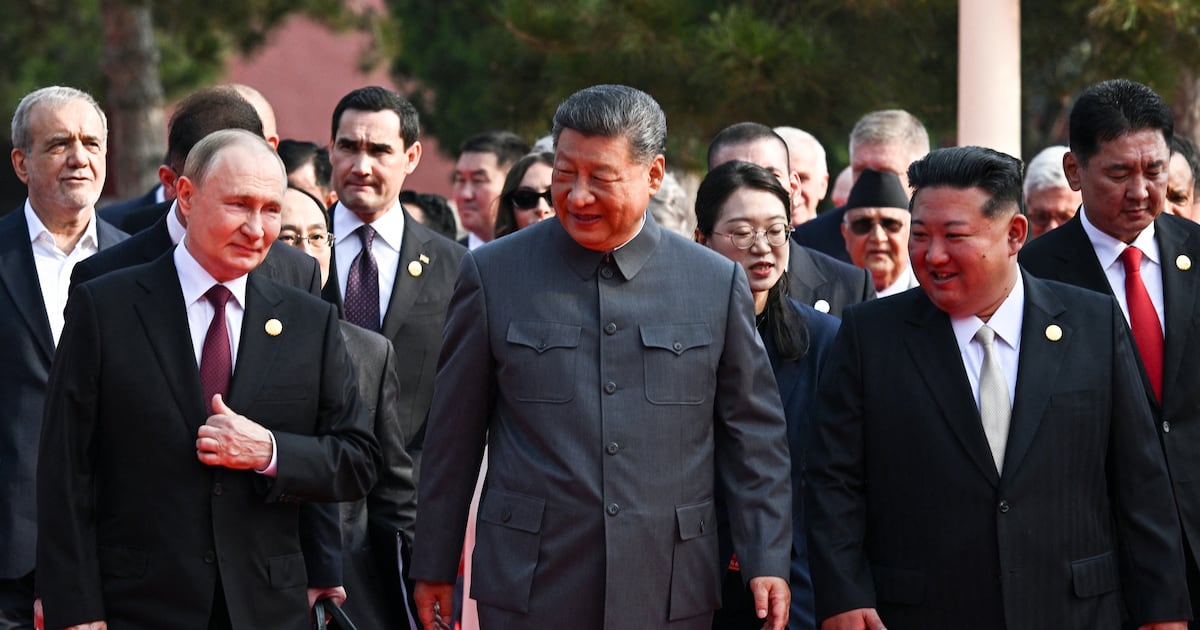
Orgo-Life the new way to the future Advertising by AdpathwayXi Jinping’s first visit to Pyongyang since 2019 – and his first overseas trip in 2026 – resulted in more speculation than results. North Korean leader Kim Jong Un hailed the relationship with China as “solid” and Xi spoke of taking China-North Korea ties to “new heights.” What this means concretely depends on the eye of the beholder. Media coverage across Pyongyang, Beijing, Moscow, and Seoul show the different concerns and hopes each of these countries has invested in the Xi-Kim summit.
No “No Nukes”
The two-day summit between Kim and Xi ended with both sides committing to future engagement in several sectors. Kim stated that Pyongyang will “maintain the [North Korea]-China friendship as the most important top-priority strategic work.” The North Korean State News Agency KCNA further reported that North Korea and China agreed to strengthen their bilateral relationship through high-level visits and cooperation and exchanges in the political, social, cultural, and economic spheres.
Surprisingly, according to South Korea’s daily newspaper of record, the Chosun Daily, Pyongyang’s news media omitted that North Korea and China also agreed to strengthen exchanges in diplomacy, law enforcement, and military affairs. Should military exchanges between North Korea and China take place, depending on their scope and purpose, they could have vast implications for the future of their relations and regional stability – and potentially impact Pyongyang’s deepening ties with Moscow.
For North Korea, denuclearization represented a clear red line for the Xi visit. A few days prior to the Kim-Xi summit, Pyongyang publicly dismissed calls by Washington, Seoul, and Beijing for denuclearization. To the contrary, Kim disclosed a newly launched nuclear material production facility, announcing that he would strengthen the country’s nuclear arsenal. Kim Yo Jong, Kim Jong Un’s sister and director of the General Affairs Department, also explicitly stated that North Korea’s status as a “nuclear weapons state” is a “stark reality.” She added that nuclear weapons are North Korea’s “core force” for its sovereignty and defense and they guarantee Pyongyang’s protection from outsiders. These statements were likely a strategic signal to the international community that North Korea would not engage in any discussions with Xi or anyone else about suspending its nuclear operations or denuclearization.
In advance of the summit with Xi, the North Korean Foreign Ministry also emphasized Russia’s value as a partner. According to TASS, the Russian state news agency, in the days leading up to the Xi-Kim summit North Korean Foreign Minister Choe Son-hui positively discussed the relationship between Pyongyang and Moscow. Choe, who was in Russia for a memorial event for Aleksandr Matsegora, the late Russian ambassador to North Korea, stated that the two countries “share a common position on all strategic issues, which corresponds to the level of an alliance.” Choe added that North Korea and Russia had developed their bilateral relations by “consistently defending key mutual interests.” However, it is notable that KCNA chose not to cover Choe’s visit, which took place just one week before the Kim-Xi summit.
What China Did Not Say… or Get
For international observers, the impact of the alliance between Russia and North Korea on China-North Korea ties has been a key concern. Why did Xi rush to visit Pyongyang a full month before the 65th anniversary of the PRC-DPRK Friendship Treaty? Was Xi seeking to reinforce China’s centrality as a partner at a time when North Korea appears to be drawing concrete benefits from military ties with Russia? Considering that most of North Korea’s trade is with China, it would be difficult for Kim to sidestep Chinese influence, though his alliance with Vladimir Putin’s Russia has provided long-sought military modernization.
Although Xi’s public remarks in Pyongyang did not reference Russia specifically, the Chinese leader alluded to unspecified international changes when he sought to emphasize the resilience and long-term nature of China-North Korea ties. In advance of his visit, Xi wrote in North Korea’s Rodong Sinmun, “No matter how the times change or how the international situation shifts, the traditional friendship between China and the North remains invincible.” Xi also made repeated appeals for greater strategic coordination and exchanges military affairs, perhaps suggesting a deficit in this area compared to Russia-North Korea relations.
One topic that decidedly did not come up was denuclearization of the Korean Peninsula, a phrase that also was lacking in Xi’s recent summits with Lee Jae-myung and Putin. After the White House readout of the Trump-Xi summit referenced a statement Xi allegedly made supporting the denuclearization of the Korean Peninsula, the PRC Foreign Ministry spokesman Guo Jiakun sidestepped the issue, stating that China pursued its own path to peaceful settlement of the issues. After the summit with Kim, China continued to duck the topic, asserting that the Chinese position remained consistent.
Another issue that apparently eluded resolution was China’s longstanding interest in obtaining navigation rights on the Tumen River, which would open up new development opportunities for northeastern China and provide a strategic vantage point for PLAN activities in the Sea of Japan. The Chinese border runs 15 km (9 miles) short of the mouth of this waterway as a result of the 1860 Treaty of Peking, an agreement signed with Russia that China considers “unequal.” This treaty awarded the territory to Russia, which now shares the river with North Korea. Although China, Russia, and North Korea have been discussing granting Chinese vessels navigation rights on the Tumen River since 2024, no agreement has been reached.
Perspectives from Moscow
Russian media commentary emphasized that the Chinese leader hoped to revive relations with North Korea which had lapsed since the COVID-19 pandemic, at a time when military cooperation between Moscow and Pyongyang was proceeding apace. This contrasts with China’s military cooperation with North Korea, which had not been very extensive since the Korean War, the Russian daily MKRU reported.
Some Russian observers focused on China’s security concerns with Japan driving Xi’s visit to Pyongyang. Aleksei Maslov, director of the Institute of Asia and Africa at Moscow State University noted that Xi’s visit coincided with a PLA naval patrol near Taiwan in response to a move by Japan and the Philippines to demarcate their maritime boundaries (which China claims violates its own maritime claims).
There was some speculation in the Russian media about what Trump and Xi may have discussed regarding North Korea. However, Russian commentary pointed out that prior to Xi’s visit, top North Korean officials discounted the possibility that China may have come to some agreement with the U.S. on the North Korean nuclear program. Vasily Kashin, a leading scholar at the Higher School of Economics, admitted that China was more concerned than Russia about the North Korean nuclear program but doubted that “any external influence” would succeed in reducing the priority Pyongyang places on nuclear weapons. Kashin observed that North Korea sought to reduce its dependence on China and that Xi would be unlikely to have the necessary leverage to convince Kim to change his policies or engage with the United States.
Russian media outlets also (gleefully) pointed out that foreign commentary saw China playing catch-up with Russia in North Korea. Some analysis saw China’s renewed interest in North Korea as a net positive for Russia, in that China might serve as a “soft restraint” on Pyongyang’s nuclear ambitions. According to this line of thinking, Russia and China shared an interest in avoiding the destabilization of Northeast Asia and dissuading North Korea from embarking on preventive wars.
A New Opportunity for Engagement?
From Seoul’s perspective, the Xi-Kim summit presented a new opportunity for future inter-Korean engagement. In his first year in office, South Korean President Lee Jae-myung tried to entice North Korea to engage by dismantling anti-North loudspeakers, cracking down on propaganda leaflets, and seeking mediation from the United States and China, but has had little success. It is unlikely that Pyongyang or Beijing discussed Korean Peninsula affairs considering the lead-up to and outcome of the summit. Instead, the South Korean Unification Ministry noted that China’s call for military cooperation, which was not reported in North Korean media, is “something worth watching closely.” The Korea Times mentions that the inclusion of the Chinese defense minister in the summit delegation may have signaled China’s intent for the summit.
Lee noted that intermediate steps – stopping the production of nuclear material and prohibiting its transfer abroad, and a moratorium or halt to ICBM development – are necessary for the North’s complete and verifiable denuclearization. However, Seoul’s Foreign Ministry spokesperson stated in a press briefing that North Korean denuclearization “remains a consistent goal of the international community.” South Korean media also reported the Trump administration’s allegation that Xi had affirmed a shared goal to denuclearize North Korea, a claim that Pyongyang rejected.
To Catch a Tiger Cub, You Must Enter the Tiger’s Den
Xi opted to pay a visit to Kim in hope of giving a boost to bilateral ties and improving “strategic coordination” with North Korea – a vivid reminder of the key role that China continues to play on the Korean Peninsula and perhaps also an effort to avoid a destabilizing arms race in Northeast Asia.
Russian observers downplayed any negative impact resulting from the deepening Russia-North Korea military partnership and instead some attributed Xi’s visit to his interest in using ties with North Korea to counter a perceived threat to China from Japan. It remains unclear whether the Chinese leader’s plea for greater coordination – especially in military affairs – resonated with Kim, and, if so, what this might entail.
South Korean commentary seemed the most optimistic that some steps toward denuclearization might be achieved despite firm denials by North Korean officials. By keeping the neighbors guessing about his intentions and avoiding any concessions, it is Kim who appears to have gained the most from Xi’s visit.

![New Japanese convenience store rice balls taste like instant noodles [Taste test]](https://soranews24.com/wp-content/uploads/sites/3/2026/09/0_c8e809.jpg?w=1200&h=630&crop=1)
















 English (US) ·
  French (CA) ·
  French (FR) ·