

 1 day ago
1
1 day ago
1
PROTECT YOURSELF with Orgo-Life® QUANTUM TECHNOLOGY
Orgo-Life the new way to the future Advertising by AdpathwayA stiff neck at 4 p.m. rarely comes from one bad sitting position. It usually comes from staying in the same few positions for too long. Desk work asks the body to repeat a narrow set of shapes: head angled toward a screen, shoulders slightly rounded, hips bent, wrists fixed near a keyboard, and feet doing very little.
You can open Table of Contents show
A better chair can help. A better monitor height can help. Keeping the mouse close can help. But no workstation setup fully replaces movement.
That is where mobility routines desk workers can actually use become valuable. The routine does not need to be long, sweaty, or complicated. For most people, the better approach is short, repeatable movement that fits between emails, meetings, calls, spreadsheets, writing blocks, editing sessions, and design work.
This list focuses on routines that make sense during real workdays. Some take two minutes beside the desk. Some fit better after lunch. A few are better saved for the end of the day when the body needs a clear break from work mode.
None of these routines should be treated as medical treatment. If pain is sharp, persistent, spreading down the arm or leg, linked with numbness or weakness, or caused by a recent injury, do not try to stretch through it. Get proper assessment first.
Before You Start: Mobility Cannot Outwork a Bad Setup
Movement helps, but it should not be used as a cover-up for an uncomfortable workstation. A laptop placed too low can keep pulling the head forward. A chair that does not support the body can make sitting harder than it needs to be. A desk that keeps the shoulders shrugged can cause neck and upper-back tension. A mouse placed too far away can turn every click into a small reach.
Mobility work may reduce stiffness, but it cannot fully solve a setup that keeps recreating the same strain every day.
A practical desk-worker plan needs two parts:
- A workstation that fits the person reasonably well
- Short movement breaks that change the position of the neck, shoulders, wrists, spine, hips, knees, ankles, and feet
There is no single perfect posture that works for everyone. The more useful goal is position variety. Sit, stand, walk, stretch, and reset often enough that one shape does not dominate the entire workday.
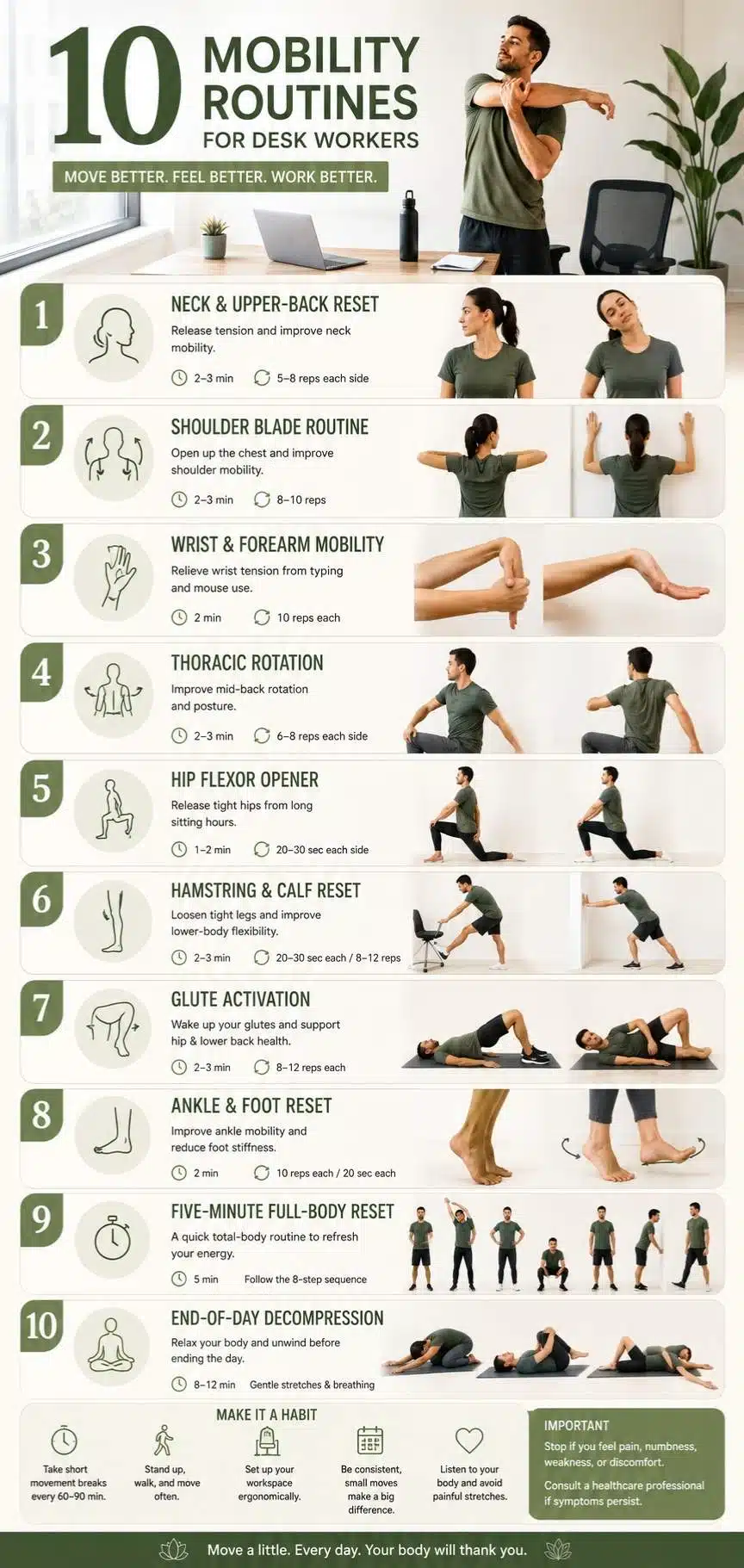
10 Mobility Routines Desk Workers Can Add to a Real Workday
These mobility routines that desk workers can use are organized by the body areas that usually complain first. Do not try to do all 10 every day. Pick the routines that match your work pattern and the stiffness you actually feel.
1. Neck and Upper-Back Reset for Screen Fatigue
Use this when your head starts drifting toward the screen and the upper back feels locked. It is useful because it does not need floor space, a yoga mat, or a full break. Two or three minutes beside the desk can be enough.
Start seated or standing. Keep the jaw relaxed and shoulders down. Slowly turn the head to the right, pause, then turn left. Next, tilt one ear toward the shoulder without pulling the head down. Return to the center and repeat on the other side.
Finish with a few gentle chin tucks. Think of sliding the head backward rather than looking down.
Add upper-back movement after that. Place both hands behind the head, keep the ribs from flaring too much, and gently open the elbows as you breathe in. Then soften the elbows forward as you breathe out. The motion should feel small and controlled.
Avoid aggressive neck circles if they make you dizzy or create sharp discomfort. Many desk workers do not need dramatic stretching here. They need calmer movement, a better screen position, and fewer hours spent with the head reaching forward.
2. Shoulder Blade Routine for Rounded Shoulders
Rounded shoulders are not only about “bad posture.” They often come from long hours of typing, mousing, driving, scrolling, and sitting with the arms forward. Over time, the shoulder blades stop moving through a comfortable range, and the chest starts to feel tight.
This routine focuses on the shoulder blades instead of forcing the shoulders backward all day.
Stand near a wall or sit tall. Start with slow shoulder rolls. Then move into scapular squeezes: gently draw the shoulder blades back and slightly down, hold for two seconds, then release. Do not jam the chest forward or arch the lower back.
Next, try wall slides. Place the forearms on a wall if comfortable, then slide the arms upward only as far as the ribs and lower back can stay relaxed. If the movement feels pinchy, reduce the range or skip it.
A useful version:
- 5 slow shoulder rolls backward
- 8 gentle shoulder blade squeezes
- 6 wall slides or wall angels
- 20 seconds of doorway chest opening
This routine fits mid-morning or mid-afternoon, especially for people who type for long blocks. It is not useful if done aggressively. The aim is to restore motion, not force the body into a rigid posture that becomes tiring in a different way.
3. Wrist and Forearm Mobility for Keyboard and Mouse Users
Wrist stiffness is easy to ignore until typing, scrolling, drawing, editing, gaming, or using a mouse starts feeling uncomfortable. This routine is especially useful for writers, designers, editors, coders, accountants, and anyone who spends hours with a keyboard and pointer device.
Start by opening and closing the hands 10 times. Then stretch the fingers wide, relax them, and repeat. After that, extend one arm forward with the palm facing down. Use the other hand to gently guide the fingers downward. Then turn the palm up and lightly guide the fingers back.
Keep the stretch mild. The wrist and forearm do not need harsh pulling.
A more active option is wrist circles. Make slow circles in both directions, then shake the hands out gently. If space allows, place the hands on the desk with fingers pointing forward and lightly shift weight from side to side. Keep the pressure low.
This is one of the most underrated mobility routines desk workers can do because it addresses a small area that works constantly. It is not a cure for carpal tunnel syndrome, tendon problems, or nerve irritation. Numbness, tingling, weakness, or persistent pain needs proper medical advice.
Also check the source of the strain. A mouse placed too far away, wrists resting at an awkward angle, or a keyboard that keeps the shoulders reaching forward can keep the problem alive even if the stretches feel good.
4. Thoracic Rotation Routine for a Stiff Mid-Back
The upper and mid-back often get ignored because the neck and lower back complain louder. But if the thoracic spine barely rotates, the neck and lower back may be forced to pick up extra work.
This routine is useful after long writing sessions, design work, video editing, spreadsheets, or any task that keeps the eyes fixed forward.
Sit upright with both feet on the floor. Cross the arms over the chest and rotate gently to one side. Pause for one breath. Return to center and rotate to the other side. Keep the movement controlled. Do not twist hard from the lower back.
If you have space, try a standing open-book variation. Stand with one hand against a wall, then rotate the chest away from that hand while keeping the movement smooth. You should feel the upper back and chest opening, not a sharp pull in the shoulder.
This routine is short, but it changes something desk work rarely changes: rotation. Many desk breaks focus only on standing up. Standing helps, but adding rotation makes the break more complete.
Skip strong twisting if you have acute back pain, recent injury, dizziness, or symptoms that worsen with rotation.
5. Hip Flexor Opener for Long Sitting Blocks
The hips stay bent for hours during desk work. Over time, many people feel tightness at the front of the hips or stiffness when they stand up. A hip flexor opener is one of the most useful routines for desk workers, but it is also one of the easiest to overdo.
The safer version starts with a half-kneeling position. Put one knee on a folded towel or mat and the other foot forward. Instead of lunging deeply, gently tuck the pelvis and shift forward a small amount. You should feel a stretch near the front of the back hip, not pressure in the lower back.
Keep the ribs stacked over the pelvis. Many people arch the back and think they are stretching the hip. Often, they are just compressing the lower back.
Hold for 20 to 30 seconds per side, then switch. Add a gentle arm reach overhead if it feels comfortable.
This routine works well after a long sitting block or before a walk. It is not ideal if you are rushing between meetings and cannot set up safely. In that case, choose a standing version: step one foot back, gently tuck the pelvis, and shift weight forward without forcing depth.
6. Hamstring and Calf Reset for Heavy Legs
Desk workers often think only about the neck and shoulders, but the legs also become stiff from long sitting. Hamstrings, calves, and ankles may feel tight, especially after a full day with little walking.
This routine works well before an afternoon walk, after lunch, or before leaving the desk at the end of the day.
Stand behind your chair and hold the backrest lightly. Place one heel forward with the toes lifted. Keep a soft bend in the standing knee and hinge slightly at the hips. You should feel the back of the thigh, but it should not feel sharp.
Then move into calf raises. Rise onto the balls of the feet, pause briefly, and lower slowly. After 8 to 12 repetitions, switch to a calf stretch by stepping one foot back and pressing the heel gently toward the floor.
A simple version:
- 20 seconds hamstring stretch per side
- 8 to 12 slow calf raises
- 20 seconds calf stretch per side
- 30 seconds walking around the room
The walking part matters. Static stretching can feel good, but the legs often respond better when stretching is paired with light movement.
7. Glute Activation Routine for Lower-Body Support
Sitting does not permanently “turn off” the glutes, but long desk days can make people less aware of how to use them. That matters because the glutes help support walking, standing, stair climbing, hip stability, and many basic movements.
This routine is better done away from the desk. It can fit before a workout, after work, or during a longer break at home.
Start with glute bridges. Lie on your back with knees bent and feet flat. Press through the feet and lift the hips without over-arching the lower back. Pause at the top, then lower slowly. After 8 to 12 repetitions, try side-lying clamshells or standing hip extensions while holding a chair for balance.
This routine is especially useful for people who feel stiff when standing after long sitting or who notice the lower back doing too much during basic movement.
Do not chase height during bridges. A smaller, cleaner lift is better than a big arch through the lower back. If bridges create back discomfort, reduce the range or stop.
This is not a full leg workout. It is a simple reminder to the hips that they have a job beyond sitting.
8. Ankle Mobility and Foot Reset for People Who Barely Walk During Work
Desk work can make the ankles and feet strangely inactive. That matters more than people think. Ankles help with walking, squatting, stair climbing, balance, and how the knees and hips move.
This routine is quiet enough for an office and practical enough for home.
Start seated. Lift the heels while keeping the toes on the floor, then lift the toes while keeping the heels down. Repeat slowly. Next, make ankle circles in both directions. Stand up and shift weight from one foot to the other. If balance is comfortable, rise into slow calf raises.
People who work from home can add a barefoot foot-spread drill on a clean surface: spread the toes, relax, and repeat. Do not force it. The goal is awareness and movement.
This routine is useful for workers who sit through back-to-back calls or notice stiff ankles when walking after work. It also pairs well with phone calls. If you can stand safely, walk around while listening.
Foot pain, swelling, numbness, or one-sided calf pain should not be treated as a simple mobility issue without proper medical advice.
9. Five-Minute Full-Body Meeting Reset
Some days do not allow a long routine. That is where a five-minute reset earns its place.
Use this between meetings, after a long writing block, or when the body feels mentally and physically stuck. It is not targeted like the neck, wrist, or hip routines. It is a general movement reset for the whole body.
Try this sequence:
- 30 seconds standing and breathing slowly
- 30 seconds of shoulder rolls and arm swings
- 30 seconds side bends
- 45 seconds of gentle squats to a chair or sit-to-stand repetitions
- 45 seconds standing hip flexor stretch, switching sides
- 45 seconds calf raises
- 45 seconds walking around the room
- 30 seconds relaxed standing before returning to work
The routine is intentionally simple. The value is not novelty. It is an interruption. Long static work blocks need a clear break, and a short full-body routine can be enough to reset posture, breathing, and attention.
This is also a good option for people who will not realistically do separate routines for every body part. If consistency is the issue, start here.
10. End-of-Day Decompression Routine
The end of the workday needs a different kind of routine. The goal is not to “fix” everything from eight hours of sitting. It is to help the body leave work mode.
This routine works best on a mat, rug, or comfortable floor space. Start with child’s pose or a relaxed kneeling position. Move into cat-cow, then thread-the-needle for upper-back rotation. Add a low lunge on each side, a gentle hamstring stretch, and a supine twist. Finish lying on your back with slow breathing.
Keep it easy. The end of the day is not always the right time to push deep stretches. If the nervous system is tired, forcing intensity may make the routine less useful.
A calm version could take 8 to 12 minutes:
- Cat-cow for one minute
- Thread the needle on each side
- Low lunge on each side
- Gentle hamstring stretch
- Supine twist
- Two minutes of quiet breathing
This routine is useful for remote workers who struggle to separate work time from personal time. It creates a small physical boundary. Close the laptop, move the body, breathe, and then leave the desk area if possible.
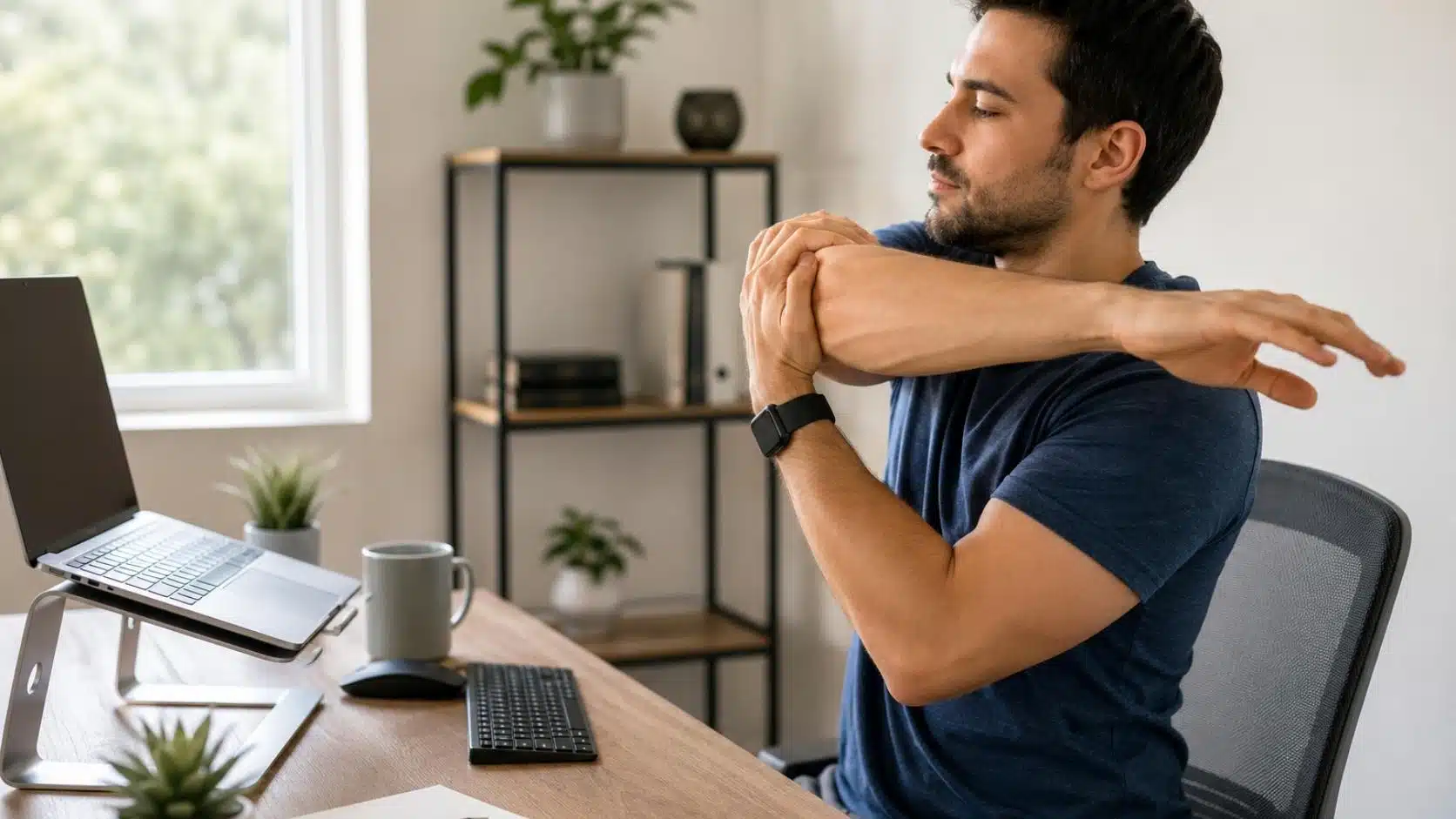
What Most Desk Mobility Advice Gets Wrong
Most desk-mobility advice gives people too many exercises and too little decision-making help. That is why many routines fail. A person with six meetings, two deadlines, and a crowded home office is not going to follow a complicated 30-minute plan every workday.
The better approach is smaller and more realistic.
Use targeted routines for the area that feels stuck most often. Use the five-minute reset when the day is packed. Use the end-of-day routine when work tension follows you into the evening. Pair movement with things already built into the day, such as finishing a call, making tea, sending a report, or returning from lunch.
Mobility routines desk workers can maintain are usually short, simple, and repeatable. That is not a weakness. That is why they are easier to keep.
A Practical Weekly Plan for Desk Workers
Do not try to do every routine every day. Start with the pattern that matches your work life.
If your neck and shoulders get stiff, use the neck reset and shoulder blade routine once in the morning and once in the afternoon.
If your hips and legs feel heavy, use the hip flexor opener after lunch and the hamstring-calf reset before leaving the desk.
If you work in long meetings, use the five-minute full-body reset between calls.
If you work from home and feel mentally stuck at the end of the day, use the decompression routine as a shutdown ritual.
A simple week might look like this:
- Daily: one short movement break every hour or two when possible
- Three to five times weekly: neck, shoulder, hip, or wrist routine based on your main stiffness
- Two to three times weekly: full-body meeting reset
- Once or twice weekly: longer end-of-day decompression
- Most days: a walk, even a short one, if your schedule allows
This does not replace regular exercise. Adults still benefit from aerobic activity and muscle-strengthening work across the week. Desk mobility is support work. It helps reduce stiffness and movement restriction, but it should sit beside a broader active lifestyle.
FAQs About Mobility Routines Desk Workers Can Use
1. How Often Should Desk Workers Do Mobility Routines?
Short routines are usually easier to maintain than long sessions. Many desk workers do better with two to five minutes at a time, repeated during the day, instead of one ambitious routine they rarely complete. Start with the body area that complains most often.
2. Can Mobility Routines Fix Desk-Related Pain?
They may help with stiffness and mild discomfort, but they should not be treated as a cure for pain. Persistent pain, numbness, tingling, weakness, swelling, or symptoms after an injury need proper assessment. Also check the workstation, because the same setup may keep recreating the problem.
3. Is Standing All Day Better Than Sitting?
Standing can help break up sitting, but standing still all day can also create discomfort. The better solution is changing positions: sit, stand, walk, stretch, and move regularly. A standing desk is useful only if it encourages more movement, not if it becomes another fixed position.
4. Do I Need Equipment for Desk Mobility?
Most routines here need no equipment. A chair, wall, desk edge, towel, or yoga mat can help. If a routine requires too much setup, it is less likely to survive a busy workday.
A Simple Way to Start
Do not build a complicated mobility plan on day one. Pick the one routine that solves the most obvious problem.
For a stiff neck, start with the neck and upper-back reset. For tight hips, use the hip flexor opener after long sitting blocks. For wrist tension, add the wrist and forearm routine before discomfort builds. If the whole body feels stuck, use the five-minute meeting reset.
The value of mobility routines desk workers can actually be found in doing everything perfectly. It is in interrupting stillness before stiffness becomes the normal background of the workday. Start small, repeat it often enough to matter, and adjust based on what your body keeps telling you.




















 English (US) ·
  French (CA) ·
  French (FR) ·