

 11 hours ago
13
11 hours ago
13
PROTECT YOURSELF with Orgo-Life® QUANTUM TECHNOLOGY
Orgo-Life the new way to the future Advertising by AdpathwayA bilateral anti-drone operation carried out last month along the Tijuana and San Diego border was small in scale, but analysts say it’s a notable development in the often-tumultuous relationship between Mexico and the United States.
The test and deployment of anti-drone technology, dubbed “Águila Alta,” or High Eagle, came as the two countries aim not only to reduce the smuggling of drugs and migrants across the border, but also rebuild diplomatic trust that had waned in recent years.
Although limited in scale, the border security operation demonstrates that “we see cartels as a shared threat for the countries,” said Gabriela De la Paz Meléndez, a political science and international relations professor at the Monterrey Institute of Technology and Higher Education in Monterrey, Mexico.
“The way the operation was done showed that they shared intelligence, which is something that’s key,” De la Paz Meléndez said.
The initial phase of the drone program began on Aug. 31 with militaries in both countries monitoring drones believed to be operated by criminal organizations.
From Sept. 7 through Sept. 21, the two countries utilized mobile and fixed anti-drone systems to jam and immobilize illegal drones. The operation covered five kilometers of the border near Tijuana, and at its conclusion Mexican authorities reported having disabled five unpermitted drones — including one that was detected in U.S. territory and brought down by Mexican personnel after entering Mexico.
“It’s not very much, but I think that’s possibly the least important piece of data here,” said Duncan Wood, CEO of Hurst International Consulting and a fellow at The Wilson Center, a think tank based in Washington, D.C.
For comparison, the U.S. military claimed that it had already taken down more than 300 cartel-linked drones by Sept. 4. But the new operation now signals that Mexico is willing to cooperate in those efforts, and it also sends an important message to cartels that “the two sides are talking,” Wood said.
United States President Donald Trump has pressured Mexico President Claudia Sheinbaum to act more aggressively to stop migrants from crossing the U.S. border and drug cartels from operating with near impunity. Meanwhile, Sheinbaum has won adulation at home for stressing the need for Mexico to maintain autonomy and sovereignty under pressure from the White House on everything from trade to immigration.
That Águila Alta was undertaken at all is significant because Sheinbaum’s predecessor, Andrés Manuel López Obrador, commonly referred to as “AMLO,” had spurned collaboration on security issues with the U.S. through both Republican and Democratic administrations. The disdain was mutual — on his way out, Democratic-appointed former U.S. Ambassador to Mexico called López Obrador’s famous “hugs, not bullets” security strategy a “failure.”
López Obrador and those within his party, Morena, have emphasized Mexico’s sovereignty and lamented American interference in Mexican issues; U.S. officials distrust Mexican officials who, in several high-profile cases, have been linked to cartels. That list includes Rubén Rocha Moya, the governor of the state of Sinaloa who the U.S. alleges had promised cartel leaders the freedom to operate with impunity in exchange for their assistance in winning election.
“During the AMLO years there was very much a reluctance on the part of the Mexican administration to share intelligence, to work closely,” Wood said. “There was a withholding of cooperation, in particular on the ground, and that was in large part because AMLO was a strong nationalist.”
The problem Sheinbaum inherited, De la Paz Meléndez said, is that “she’s between the pressure by the Trump administration on one side and the pressure from the former president and her party” on the other. “High Eagle” was born from a bilateral working group of security officials from Mexico and the United States launched last year. Each country’s military personnel remained on their side of the border, allowing Sheinbaum to strike that balance, De la Paz Meléndez said.
Trump has threatened to carry out direct military strikes against cartels in Mexico, which would be seen by Sheinbaum and her party as an infringement on Mexican sovereignty.
“The Mexicans are trying to do all that they can to keep the US happy, and it’s not just playing up to Trump, it’s really delivering results,” Wood said, pointing to its operations to shut down fentanyl labs and send alleged cartel members to the United States to face prosecution.
There are signs that it appears to be working. In August, the U.S. and Mexico signed an agreement that will allow Mexico to buy drones and anti-drone systems from U.S. manufacturers.
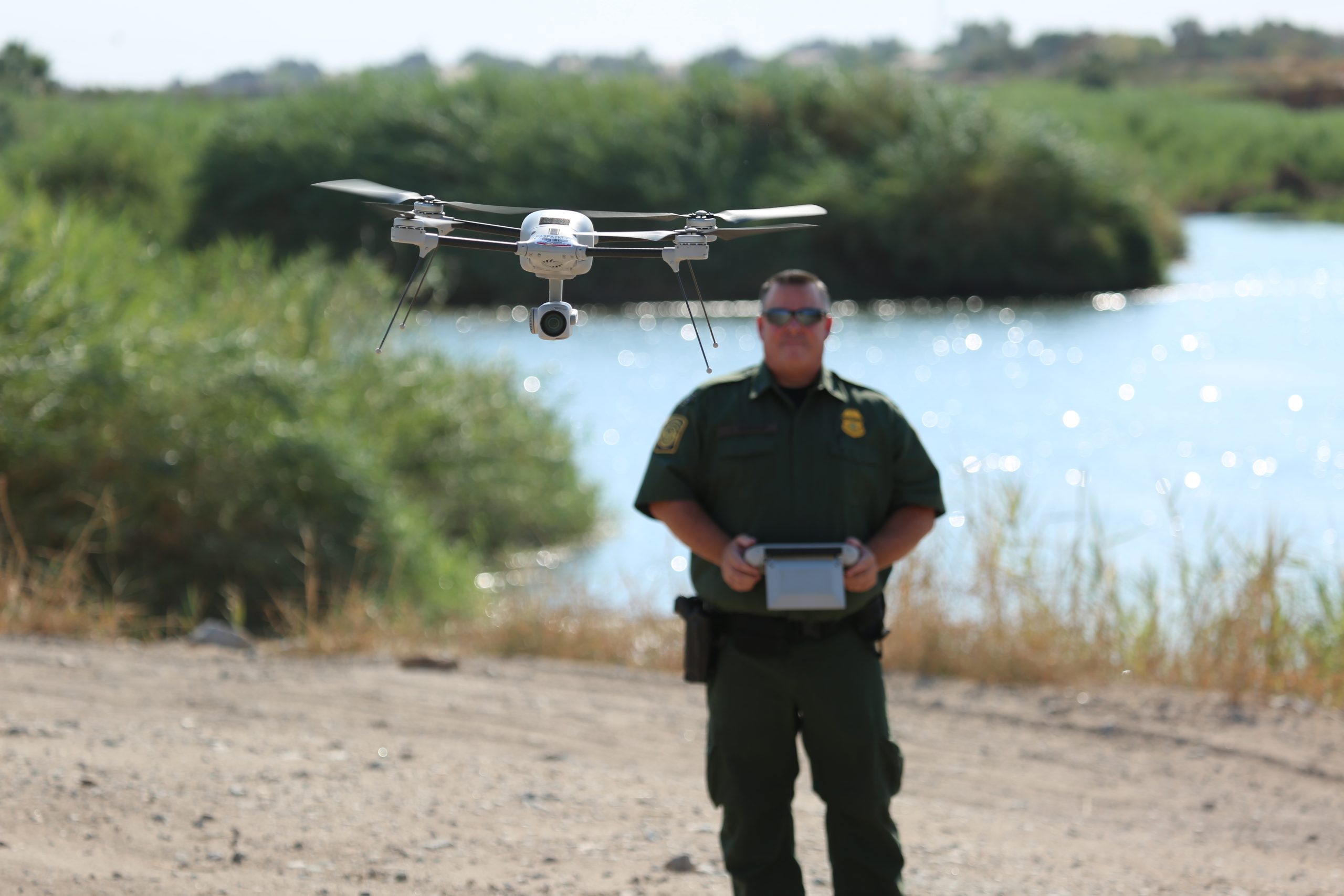
Featured image: U.S. Border Patrol agent piloting a drone.
Image credit: cbp.gov














 English (US) ·
  French (CA) ·
  French (FR) ·