

 2 months ago
92
2 months ago
92
PROTECT YOURSELF with Orgo-Life® QUANTUM TECHNOLOGY
Orgo-Life the new way to the future Advertising by AdpathwaySOUTH AMERICA · DEFENSE
Key Facts
—Argentina and the United States signed two letters of intent on June 4 to deepen defense cooperation.
—One covers reciprocal military fuel supply, letting each country buy fuel at military prices around the world.
—The other gives Argentina access to a US Army digital marketplace for drones and counter-drone systems.
—The US ambassador said Argentina is the first country in the Americas to join that drone platform.
—No prices, specific systems or timelines were disclosed; these are statements of intent, not final contracts.
—The deal deepens President Javier Milei’s broader pivot toward Washington.
A new Argentina US defense deal signed in Buenos Aires brings the two countries closer on the battlefield basics of fuel and drones, the latest sign of President Javier Milei’s drive to anchor Argentina firmly to Washington.
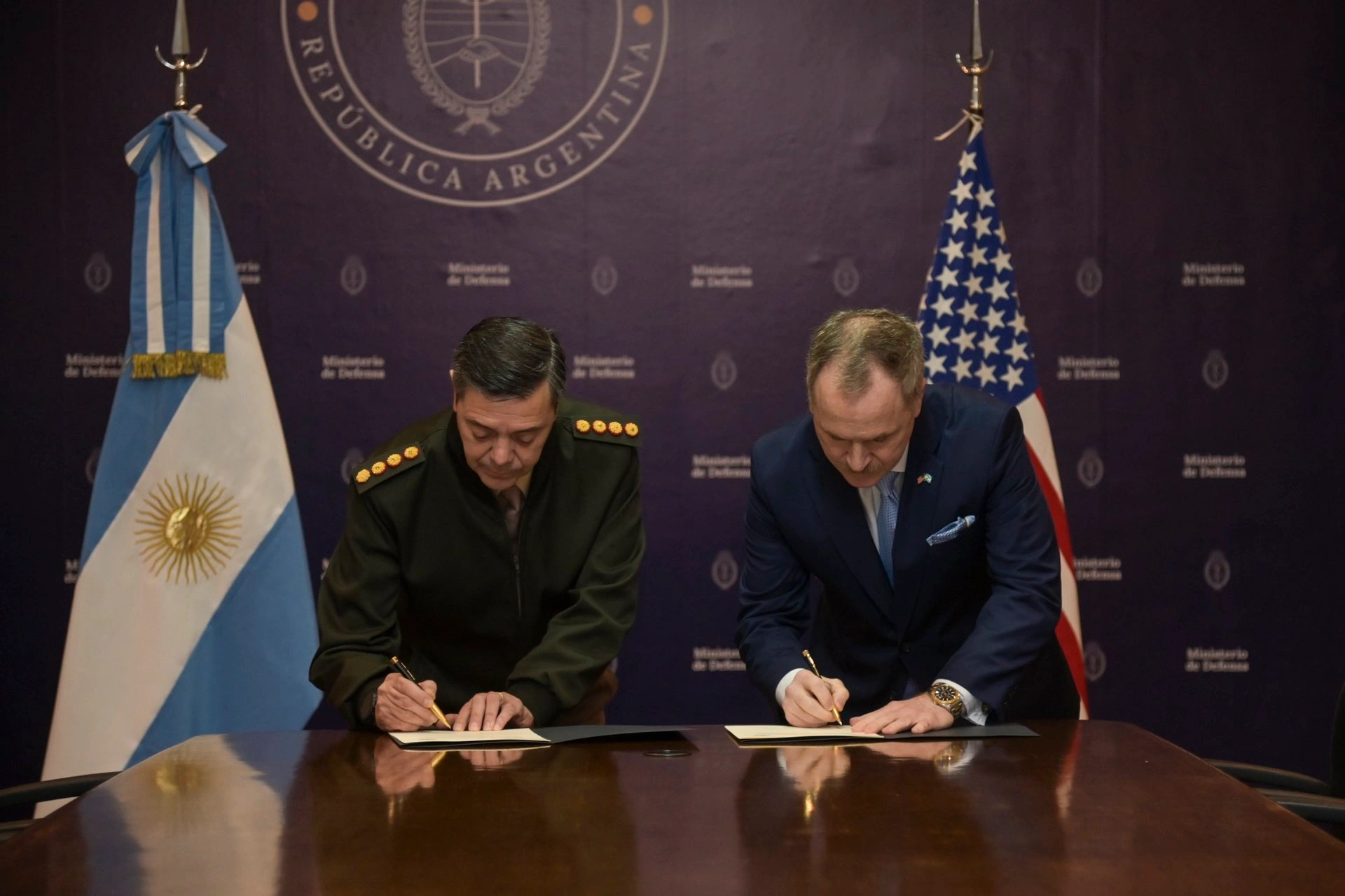
What the Argentina US defense deal actually covers
On June 4, Argentina’s defense minister, Carlos Presti, and the United States ambassador in Buenos Aires, Peter Lamelas, signed two documents known as letters of intent. These are not binding contracts but formal statements that both sides want to move ahead on specific projects, a common first step in defense cooperation.
The first letter is about fuel, setting up a system of reciprocal supply, meaning each country’s forces could buy fuel from the other at military prices in different parts of the world. For a country like Argentina, where the cost of keeping forces running far from home is a constant limit, cheaper and easier refuelling makes joint exercises and overseas deployments more affordable.
The second letter is about drones, and would let Argentina join a US Army digital marketplace where member countries can quickly buy unmanned aircraft and the systems used to detect and shoot them down, all pre-tested and approved by the US military. The American ambassador said Argentina would be the first country in the Americas to join that platform.
Why drones are the headline
The drone part matters because of how warfare has changed, with cheap unmanned aircraft reshaping recent conflicts and the tools to knock them out, known as counter-drone systems, becoming just as important. Access to a ready-made catalogue of both, vetted by the US Army, is a fast track to capabilities that would otherwise take years to develop.
For a foreign reader, the simplest way to see it is this: rather than designing or sourcing this technology alone, Argentina would plug into an American system and pick from an approved shelf. That speeds things up, but it also ties Argentina’s military more closely to US suppliers and standards.
Crucially, neither side put numbers on any of this. No prices, no specific drone models and no delivery dates were announced, which is why analysts are treating the signing as a direction of travel rather than a done deal.
Part of a bigger pivot to Washington
The agreement fits a clear pattern under President Javier Milei, whose government has steadily steered Argentina toward closer ties with the United States. The defense relationship has been warming through joint exercises, a hemispheric security declaration earlier this year, and a broader trade and economic alignment with Washington.
Seen from Washington, the move also fits a strategy of countering Chinese influence in Latin America and reasserting US leadership in the region. Pulling a major South American military into American logistics and technology networks is part of that wider contest.
There is history in the background too, because ever since the 1982 Falklands War the United Kingdom has restricted the sale of weapons containing British parts to Argentina, which has long complicated Buenos Aires’ efforts to modernise. Deeper cooperation with the United States offers one route around those constraints.
Not everyone is convinced
The announcement was not universally welcomed at home. Some voices within the Argentine Army described the deal as vague and criticised the way it was communicated, noting how little concrete detail accompanied the headline.
That caution is fair, given the gap between intent and delivery. Argentina’s defense budget has been squeezed hard under Milei‘s austerity drive, so whether these letters turn into real fuel deals and drone deliveries will depend on money and follow-through that are not yet guaranteed.
Frequently Asked Questions
What did Argentina and the US actually sign?
They signed two letters of intent on June 4, 2026. One covers reciprocal military fuel supply, and the other gives Argentina access to a US Army marketplace for drones and counter-drone systems.
Are these binding contracts?
No, they are not. Letters of intent are formal statements of shared interest rather than final deals, and no prices, specific systems or timelines were announced.
Why does the drone part matter?
Drones and counter-drone systems have become decisive in modern conflicts. Joining a US Army marketplace lets Argentina access pre-approved technology far faster than developing it alone.
How does this fit Argentina’s foreign policy?
It deepens President Javier Milei’s pivot toward the United States, building on joint exercises and a wider trade alignment. Washington sees it partly as a way to counter Chinese influence in the region.
Connected Coverage
Brazil Pitches Its Defense Industry to Argentina
Milei’s Security Shake-Up Puts a General in Charge of Defense
How the Trump-Milei Trade Pact Locks Argentina Into Washington’s Orbit









 English (US) ·
  French (CA) ·
  French (FR) ·