

 8 hours ago
1
8 hours ago
1
PROTECT YOURSELF with Orgo-Life® QUANTUM TECHNOLOGY
Orgo-Life the new way to the future Advertising by AdpathwayTorches still fixed on their heads but tools cast aside, the Sudanese goldminers of the North Valley had already mounted an impromptu rescue operation by the time Ammar* arrived at the site of a suspected Egyptian airstrike.
At least 114 were killed, according to the Sudanese rights group Emergency Lawyers, in the strike on Saturday 10 October on an artisanal goldmine brimming with young Sudanese trying to eke out a living in a country where the economy has been shattered by three years of war.
There has been anger in Sudan among those who accuse Egypt of being behind the strike, furious at what they see as aggression by their northern neighbour against workers who produce much of the gold consumed regionally and at the country’s inability to defend itself.
“These are people who have just come here to earn a living, through their own hard work,” says Ammar, a gold trader who worked at a different site and responded to calls to help the survivors.
“Their families are scattered by the war and they send them what they earn,” he says. “Sudan doesn’t have jobs, so they go to the mountains and dig with their hands to live.”
When Ammar arrived, he found chaos at the scene after the strike. The green bags used by the miners to carry excavated materials littered the ground as they abandoned their work to rescue the injured. They made stretchers from blankets, loaded the wounded into pickup trucks to be rushed to nearby towns, and began digging graves for the dead.
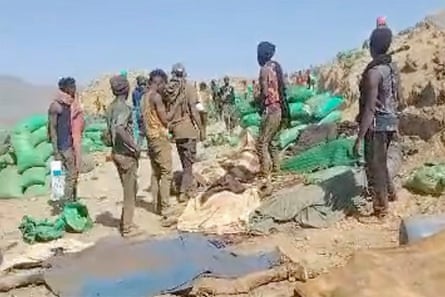
The strike was immediately attributed to Egypt by the miners, whose military later confirmed they had carried out operations as part of their push to end “illegal goldmining in the eastern desert”, though they did not address the airstrike.
Egypt reportedly struck the same site in June, killing at least 15 people, according to Sudanese media, and has carried out raids, arresting miners and confiscating equipment.
Egypt said it had distributed leaflets warning civilians to leave before launching the operation. Photos on social media appear to show a leaflet stating: “Surrender yourselves and your equipment. Your lives are more important than any equipment.”
Mohamed Salah, director of Emergency Lawyers, said there were scuffles before the bombing between miners and Egyptian security forces trying to force them out of the area.
“While Egyptian authorities have sought to curb illegal border trade for a long time, locals did not anticipate an escalation involving military aircraft,” says Salah.
He says most of the miners have dispersed since the attack but does not expect them to stay away.
“The miners say they will return – artisanal goldmining in these border areas is the only source of income for them,” he says.
Many come from conflict-hit parts of the country, such as the Darfur and Kordofan regions, he adds, and have slowly made their way through the country’s interior until finding themselves try to make a living prospecting for gold on the Egyptian border.
after newsletter promotion
While Egypt has framed its operations as an attempt to curtail illegal mining, it has been a beneficiary of the informal mining sector, receiving an estimated 60% of the gold produced and smuggled from parts of northern Sudan that border Egypt.
Despite a three-year war between the Sudanese military and rebel paramilitary Rapid Support Forces, gold production has continued in areas controlled by both sides, with artisanal mines proliferating because of rising poverty in the country.
The mines rely on manual labour and expose workers to health risks because of the chemicals used to process the gold, such as mercury and cyanide.
The human rights campaigner Hala al-Karib says the airstrike reveals the vulnerability of the prospectors.
“They are blocked from any other means of livelihood with the collapse of the education system [and] the high rates of unemployment. What other options do they have to survive?” says Karib, who leads the Strategic Initiative for Women in the Horn of Africa network.
“They are at the bottom of the chain because they are subject to the exploitation of big traders. So it is quite painful that on top of that they are exposed to this terror, being killed randomly. It’s a crime and there is nothing to justify it.”
* Name changed to protect his identity


















 English (US) ·
  French (CA) ·
  French (FR) ·