

PROTECT YOURSELF with Orgo-Life® QUANTUM TECHNOLOGY
Orgo-Life the new way to the future Advertising by Adpathway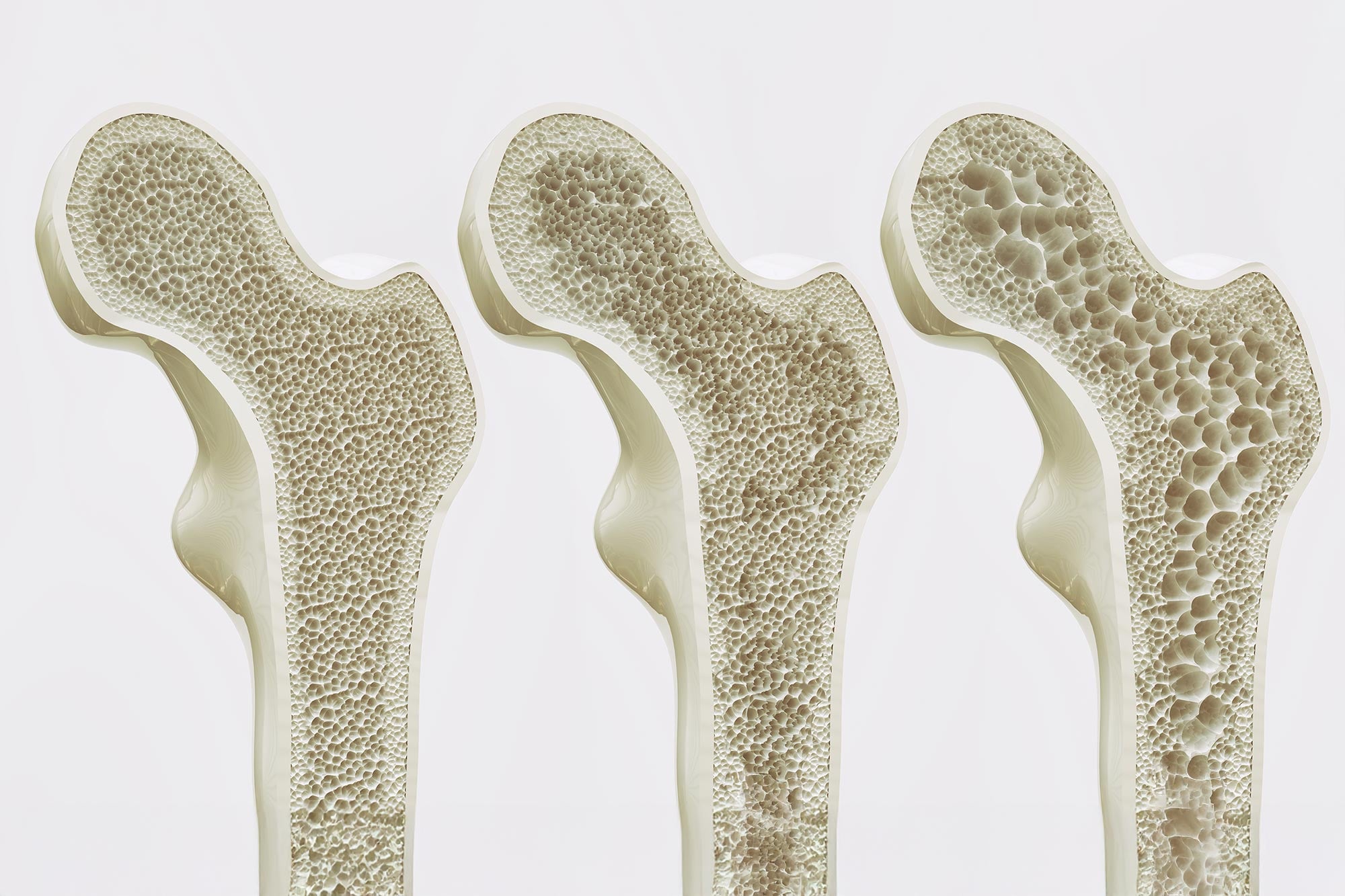 Researchers have identified a little-understood receptor that appears to play a central role in maintaining bone strength by balancing the activity of key bone cells. Credit: Shutterstock
A little-known receptor may reshape how scientists approach bone loss.
Scientists at Leipzig University have identified a little-studied receptor that could open the door to a new way of treating osteoporosis, a disease that weakens bones and raises the risk of fractures. The condition affects about six million people in Germany, most of them women, and the need for safer, longer-lasting treatments remains high.
The receptor, called GPR133, appears to help bones stay strong by supporting the cells that build bone and restraining the cells that break it down. Because osteoporosis develops when that balance shifts in the wrong direction, the finding gives researchers a promising new target for future drugs.
“If this receptor is impaired by genetic changes, mice show signs of loss of bone density at an early age – similar to osteoporosis in humans. Using the substance AP503, which was only recently identified via a computer-assisted screen as a stimulator of GPR133, we were able to significantly increase bone strength in both healthy and osteoporotic mice,” explains Professor Ines Liebscher, lead investigator of the study from the Rudolf Schönheimer Institute of Biochemistry at the Faculty of Medicine.
A Newly Identified Target in Bone Biology
GPR133 belongs to a relatively unexplored branch of receptors, even though many widely used medicines act on receptors in the same broader family. That makes it an intriguing candidate for drug development.
In bone, GPR133 is switched on by mechanical strain and by contact between neighboring bone cells. In other words, it responds to the kinds of physical signals bones naturally experience during movement and everyday loading. Once activated, it promotes osteoblasts, the cells responsible for building bone, while holding back osteoclasts, the cells that remove bone tissue. The overall effect is stronger, more resilient bone.
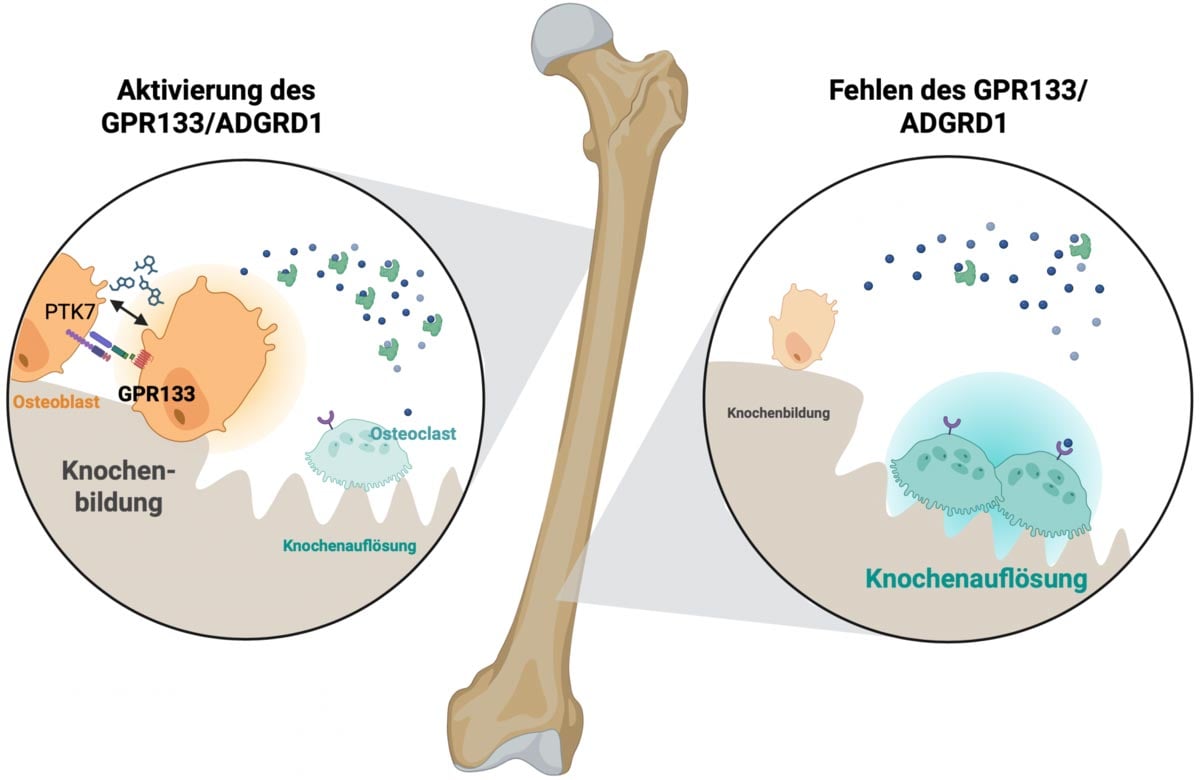 When GPR133 is activated in bone tissue, it triggers a signal that stimulates bone-forming cells (osteoblasts) and inhibits bone-resorbing cells (osteoclasts). Credit: Biorender, Ines Liebscher
Researchers found that AP503 can copy that natural activation. In mice, it improved bone strength not only in healthy animals but also in models of osteoporosis, including one designed to mimic postmenopausal bone loss. That matters because osteoporosis is often called a silent disease. Many people do not know they have it until a fracture occurs.
The study also helps explain why GPR133 may matter so much. Human genetic studies had already linked variants in the gene to differences in bone mineral density and body height, but its exact role in bone had remained unclear. The new research shows that the receptor is directly involved in the biology of bone formation and maintenance.
Great potential for an aging population
The receptor’s appeal may extend beyond bone. In earlier work, the Leipzig team found that AP503 also strengthened skeletal muscle. “The newly demonstrated parallel strengthening of bone once again highlights the great potential this receptor holds for medical applications in an ageing population,” says Dr Juliane Lehmann, lead author of the study and a researcher at the Rudolf Schönheimer Institute of Biochemistry.
That combination could be especially important in older adults, since bone loss and muscle loss often happen together and can jointly increase the risk of falls, frailty, and serious injury. A treatment that helps both tissues at once would stand out in a field where many current options come with trade-offs, including limited long-term use or significant side effects.
The researchers caution that the findings are still based on animal studies, so more work is needed before any treatment could reach people. Even so, the results position GPR133 as a compelling new target not just for osteoporosis, but potentially for other conditions marked by low bone mass. The Leipzig team is now pursuing follow-up studies to test AP503 in additional diseases and to better understand the receptor’s wider role in the body.
Reference: “The mechanosensitive adhesion G protein-coupled receptor 133 (GPR133/ADGRD1) enhances bone formation” by Juliane Lehmann, Hui Lin, Zihao Zhang, Maren Wiermann, Albert M. Ricken, Franziska Brinkmann, Jana Brendler, Christian Ullmann, Luisa Bayer, Sandra Berndt, Anja Penk, Nadine Winkler, Franz Wolfgang Hirsch, Thomas Fuhs, Josef Käs, Peng Xiao, Torsten Schöneberg, Martina Rauner, Jin-Peng Sun and Ines Liebscher, 30 June 2025, Signal Transduction and Targeted Therapy.
DOI: 10.1038/s41392-025-02291-y
Never miss a breakthrough: Join the SciTechDaily newsletter.
Follow us on Google and Google News.



















 English (US) ·
  French (CA) ·
  French (FR) ·