

 12 hours ago
8
12 hours ago
8
PROTECT YOURSELF with Orgo-Life® QUANTUM TECHNOLOGY
Orgo-Life the new way to the future Advertising by AdpathwayThe LatAm Brief
One email, every weekday morning. What moved in Latin American markets, politics and expat life.
Yesterday’s subject line: “Banxico has missed its target for 75 months in a row”
Free. We send a confirmation link first — nothing arrives until you click it. Unsubscribe with one click in any edition. If you stop opening us for 30 days we stop sending by ourselves, as we assume the interest is no longer there. See our privacy policy. We never share your email.
ECONOMY · COSTA RICA
Key Facts
- —The country Costa Rica, a Central American economy of about five million people that has built its export model on foreign-owned factories in tax-incentive free zones.
- —What happened Foreign direct investment reached US$2.74 billion in January–June 2026, up 23.4% from US$2.22 billion a year earlier, according to Procomer figures released on 1 October.
- —The numbers Free zones drew US$1.74 billion (+35%). Companies under the ordinary tax regime drew US$569.7 million (+46.9%). The United States supplied 68.9% of the total.
- —What it means for you More factory and service projects mean more formal jobs, mainly in medical devices and manufacturing. Tourism investment, by contrast, fell 27% in the half.
- —Still open The figures are preliminary Central Bank data and may be revised. They exclude the Fifco sale to Heineken, which Procomer values at about US$3.2 billion.
Costa Rica FDI, the foreign direct investment that flows into companies in the country, rose 23.4% in the first half of 2026. It reached US$2.74 billion, against US$2.22 billion in January–June 2025.
Free daily brief — no card needed
Get every Costa Rica story in one morning email
We build you a personalized brief around the topics you follow — free for 7 days. Love it? Your first month after that is US$1.
Yes, email me my free daily brief — I can unsubscribe any time.
The figures come from Procomer, the state export and investment agency, using preliminary Central Bank of Costa Rica (BCCR) data. Procomer, La Nación and Revista SUMMA published them on 1 October.
One-stop reference
Company Intelligence
Every listed company in Latin America — financials, ownership and structure for 1,450+ companies across 26 exchanges, in one place.
Free zones carry the growth
Most of the increase came from free zones (zonas francas), a regime that offers tax breaks to mainly export-oriented companies. Investment there rose 35% to US$1.74 billion, an increase of US$452.6 million, La Nación reported.
Companies under the ordinary, or “definitive”, tax regime attracted US$569.7 million, up 46.9%. Free-zone investment outside the Greater Metropolitan Area around San José rose 37% to US$149.6 million, Procomer said.
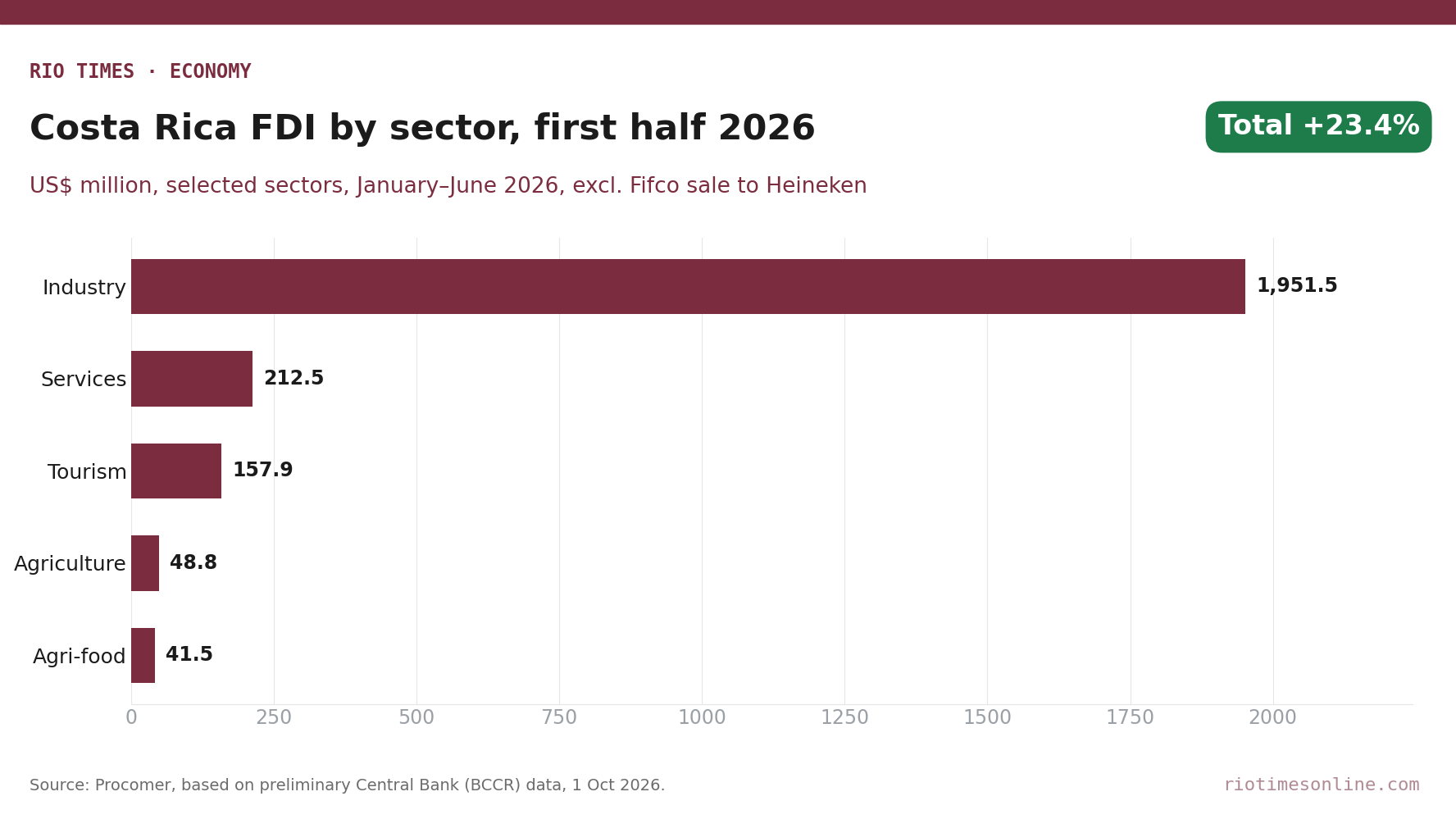
By sector, manufacturing dominated with US$1.95 billion, up 9.8%, Procomer reported. Services drew US$212.5 million, up from just US$9.4 million a year earlier.
Where the money comes from
The United States supplied 68.9% of the half-year total, Procomer reported. Switzerland followed with 5.7% and Spain with 5.1%.
That concentration is the model’s strength and its exposure. Medical-device and electronics makers from the United States have anchored Costa Rica’s free zones for two decades.
Trade Minister Indiana Trejos said the results show Costa Rica remains an attractive investment destination. Procomer general manager Laura López pointed to the double-digit growth outside the capital region.
The beer deal sits outside the count
The 23.4% figure excludes one extraordinary deal: the sale of the beverage businesses of Fifco, a Costa Rican brewer, to Heineken. Procomer estimates the deal at US$3.2 billion.
Including it, first-half FDI totals US$5.94 billion, La Nación reported. The deal had already lifted the first-quarter figure, as covered in One Beer Deal Made Costa Rica an Investment Magnet Overnight.
Procomer treats the acquisition as extraordinary and reports it separately. As a change of ownership rather than new capacity, the underlying number better shows the trend.
The weak spots
Not every sector grew. Investment in tourism fell 27% to US$157.9 million from US$215 million, Procomer reported, a soft patch for one of the country’s largest employers.
The capital inflow also arrives as the external accounts loosen. The second-quarter current-account gap widened, as reported in Costa Rica Current Account Deficit Widens to US$239.8 Million as Imports Outpace Exports.
Steady Costa Rica FDI helps finance that gap. For now, the free-zone pipeline gives the economy a stable source of dollars.
What Is Not Yet Known
The Central Bank data are preliminary, and may be revised. Procomer gave growth rates for new capital (+15%) and reinvested earnings (+5%), but not the full BCCR breakdown in dollars.
It is also unclear whether the fall in tourism investment is a one-off or a trend. Third-quarter figures, due later in the year, will show whether free-zone growth holds.
Sources: Procomer, analysis of preliminary Central Bank of Costa Rica (BCCR) data, 1 October 2026; La Nación, 1 October 2026; Revista SUMMA, 1 October 2026.
LatAm Markets: Live Signals → — real-time movers, turnover leaders and FX across Latin America.
The Rio Times · Power Map
See who really holds power in Latin America
Click to open the Power Map →

















 English (US) ·
  French (CA) ·
  French (FR) ·