

 2 months ago
16
2 months ago
16
PROTECT YOURSELF with Orgo-Life® QUANTUM TECHNOLOGY
Orgo-Life the new way to the future Advertising by AdpathwayA friendly, fact-based guide to separating fear from reality in False Bay
Shark cage diving has long been one of the most talked-about ocean experiences in the world—equal parts thrilling, mysterious, and, for some, misunderstood. If you’ve ever considered getting into a cage and coming face-to-face with one of the ocean’s most iconic predators, chances are you’ve also encountered a fair share of myths, half-truths, and sensational headlines along the way.
This blog is here to clear the water and hopefully debunk some of the most common shark cage diving myths.
We’re going to unpack the most common shark cage diving myths, explain where they come from, and replace them with science-backed, experience-driven clarity. Whether you’re planning your first dive or simply curious about how it all works, this guide will help you see shark cage diving for what it really is: a carefully managed, educational, and deeply moving wildlife encounter.
And yes—we’ll bring it all home to what makes African Shark Eco-Charters and shark cage diving in False Bay such a uniquely responsible and unforgettable experience.
Why So Many Myths Exist
Before we dive into specific misconceptions, it’s worth asking: why does shark cage diving attract so many myths in the first place?
The answer lies in a combination of factors:
- Decades of sensational media portrayals
- Fear-based storytelling (especially around sharks)
- A lack of public understanding about marine ecosystems
- The adrenaline factor—people assume “extreme” equals “dangerous”
Films like Jaws shaped public perception in a way that science has spent years trying to correct. Sharks became villains instead of vital apex predators. Naturally, anything involving close interaction with them inherited that fear.
But modern shark cage diving—especially in regulated, conservation-focused regions like False Bay—is a very different reality.
Myth 1: “Shark Cage Diving Is Extremely Dangerous”
Let’s start with the biggest one.
The idea that shark cage diving is inherently dangerous is perhaps the most widespread misconception—and also one of the easiest to debunk.
The Reality
Shark cage diving is designed with multiple layers of safety:
- Reinforced, professionally engineered cages
- Strict operational protocols
- Experienced skippers and crew
- Controlled conditions for entering and exiting the cage
The cages themselves are not improvised structures. They are built from high-grade galvanized steel, tested under marine conditions, and regularly inspected. Entry points, flotation systems, and anchoring mechanisms are all designed with redundancy in mind.
In addition, guests are never simply “thrown into the ocean.” Every step—from briefing to dive—is guided.
Why the Myth Persists
People often equate:
Shark + open ocean = danger
But in reality:
Shark + controlled environment + professional crew = managed, low-risk experience
It’s also worth noting that statistically, shark cage diving has an excellent safety record globally.
Myth 2: “The Sharks Are Aggressive Toward the Cage”
Another common assumption is that sharks are actively trying to attack the cage or the people inside it.
The Reality
Sharks are curious animals, not mindless attackers.
When they approach the cage, they are typically investigating:
- Movement
- Contrast in the water
- Natural stimuli in their environment
Their behaviour is exploratory, not aggressive.
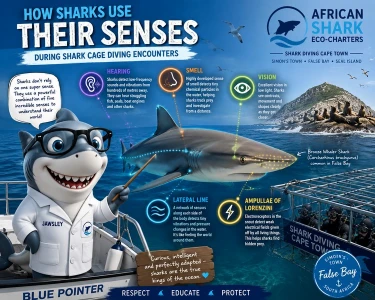
In False Bay, species like the Bronze Whaler (copper shark) are known for their inquisitive nature. They move gracefully, often circling and passing by rather than charging. Broadnose Sevengill Sharks are highly inquisitive and will stop following the bait to come up close to see what is causing the beating “sound / movement” in the water. (Remember, sharks are highly sensitive and they can “feel” your heart beat or the electric pulses from an underwater camera or mobile phone.)
What Guests Actually Experience
Most divers are surprised by:
- How calm the sharks appear
- How fluid and controlled their movements are
- How close yet non-threatening the encounters feel
The cage acts as a passive barrier—it doesn’t provoke sharks, and sharks do not perceive it as prey.
Myth 3: “Operators Use Bait to Make Sharks Dangerous”
This is one of the more controversial myths and deserves a clear, nuanced explanation.
The Reality
Yes, operators may use attractants—but not in the way many people imagine.
There is a difference between:
- Attracting sharks (bringing them into view)
- Feeding sharks (reward-based conditioning)
Responsible operators—like African Shark Eco-Charters—focus on attraction, not feeding.
This typically involves:
- A scent trail (often fish-based)
- Visual cues to encourage closer passes
Why This Matters
The goal is not to:
- Change shark behaviour
- Create dependency
- Encourage aggression
Instead, it’s to:
- Provide consistent viewing opportunities
- Educate guests about natural shark behaviour
- Minimize environmental disruption
Extensive research has shown that properly managed attraction does not fundamentally alter shark behaviour patterns, as the sharks are there already, all the attraction does is bring them closer for a better view.
Myth 4: “Shark Cage Diving Harms Sharks”
This myth is rooted in concern—which is valid—but often misinformed.
The Reality
When conducted responsibly, shark cage diving can actually support conservation.
Here’s how:
- It creates economic value for live sharks (discouraging fishing)
- It raises public awareness and appreciation
- It funds research and monitoring efforts
In regions like False Bay, shark tourism has become a powerful conservation tool.
The Bigger Picture
Sharks face real threats:
- Overfishing
- Habitat loss
- Misconceptions leading to fear-driven policies
Ethical shark tourism helps counter these threats by shifting public perception. Responsible shark cage operators will always have an educational portion to their dives, so as to educate and encourage positive understanding of sharks and their plight and their importance to the entire eco-system, both marine and terraform.
Myth 5: “You Need to Be a Strong Swimmer”
This one stops a lot of people from even considering the experience.
The Reality
You don’t need to be a strong swimmer—or even a swimmer at all, as long as you are comfortable to get your head wet, you can jump into the cage, and if not, well the view from the deck is incredible as well.
Shark cage diving is designed to be accessible:
- The cage is attached to the boat
- You hold onto fixed bars inside the cage
- You are supported by crew at all times
- No scuba certification is required
Guests simply:
- Step into the cage
- Submerge when instructed
- Observe and enjoy
It’s closer to snorkelling than diving.
Myth 6: “You’ll Definitely See Great White Sharks”
This myth goes in the opposite direction—overpromising instead of fearmongering.
The Reality
Wildlife sightings are never guaranteed.
False Bay has historically been known for Great White Sharks, but ocean ecosystems evolve. In recent years, sightings have fluctuated due to:
- Changes in prey distribution
- Long-line fishing
- Environmental shifts
- The presence of apex predators like orcas
However, this does not mean the experience is diminished, and it certainly does not mean they will not return to the area.
What is possible You Will See (no guarantees)
False Bay offers incredible biodiversity:
- Bronze Whaler sharks
- Broadnose Sevengill sharks
- Hammer head sharks
- Blue sharks
- Mako sharks
- Seals
- Dolphins
- Whales
- Seabirds
And sometimes—unexpected encounters that make the day even more memorable.
The focus is on the ecosystem, not a single species.
Myth 7: “The Cage Is Just for Show”
Some sceptics believe the cage is more psychological than functional.
The Reality
The cage is a critical safety system—not a prop.
It is engineered to:
- Withstand marine forces
- Prevent entry by large animals
- Provide stability in varying conditions
Design considerations include:
- Bar spacing
- Structural reinforcement
- Buoyancy control
- Secure attachment to the vessel
The cage is the result of decades of refinement in marine tourism safety.
Myth 8: “Shark Cage Diving Is Only for Adrenaline Junkies”
This shark cage diving myth limits the experience to thrill-seekers.
The Reality
While it is exciting, shark cage diving is just as much about:
- Education
- Conservation
- Connection to nature
Many guests describe it as:
- Peaceful
- Humbling
- Eye-opening
It’s not about conquering fear—it’s about replacing it with understanding.
Myth 9: “All Shark Cage Diving Experiences Are the Same”
This is where things really matter.
The Reality
Not all operators are equal.
Differences can include:
- Safety standards
- Group sizes
- Environmental ethics
- Crew expertise
- Educational value
This is why choosing the right operator is essential.
Bringing It Back to False Bay
False Bay offers something distinct in the global shark diving landscape.
It’s not just about sharks—it’s about context.
Here, you’re stepping into:
- A dynamic marine ecosystem
- A region shaped by natural predator-prey relationships
- A place where conservation and tourism intersect meaningfully
The waters are rich, alive, and constantly changing—which is exactly what makes each trip unique.
Why African Shark Eco-Charters Stands Apart
When we talk about debunking shark cage diving myths, it’s important to highlight what good practice actually looks like in action.
At African Shark Eco-Charters, the approach is grounded in:
- Safety-first operations
- Respect for marine life
- Honest communication with guests
- A deep understanding of False Bay’s ecosystem
There’s no overpromising, no theatrics—just a commitment to delivering a real, responsible ocean experience.
Guests are guided through:
- Clear safety briefings
- Transparent expectations
- Insight into shark behaviour and ecology
And most importantly, the experience is framed not as a spectacle—but as a privilege.
The Real Takeaway
Shark cage diving isn’t what the myths make it out to be.
It’s not reckless. It’s not cruel. And it’s definitely not reserved for extreme adventurers only.
Instead, it’s:
- Structured
- Educational
- Environmentally conscious
- Deeply memorable
The fear surrounding sharks—and by extension, shark cage diving—comes from misunderstanding. Once you replace myth with knowledge, the entire experience transforms.
Final Thoughts
If there’s one thing to take away from this week’s blog, it’s this:
Shark cage diving is less about adrenaline—and more about perspective.
It’s about seeing sharks not as monsters, but as essential, intelligent, and beautifully adapted creatures. It’s about stepping into their world respectfully, safely, and with curiosity.
And in a place like False Bay, with the guidance of an experienced, ethical operator like African Shark Eco-Charters, that perspective shift becomes something truly powerful.
So the next time you hear a myth about shark cage diving, you’ll know exactly what it is:
A story that hasn’t caught up with reality yet.





















 English (US) ·
  French (CA) ·
  French (FR) ·