

As water molecules move around the planet through the water cycle, they take on many forms, moving from solid to liquid to gas and back again. They can make up snowpacks melting in the spring, a river rushing to the ocean, clouds carried on sea breezes, and even pee flushed down the toilet.
But with this complex cycle of evaporation, condensation and precipitation continuing over and over, has the water coming out of your faucet been inside a dinosaur or a mammoth at some point? And does that mean all the water on Earth has been peed before?
The answer depends on how you approach the question.
Sign up for our newsletter

(Image credit: Marilyn Perkins / Future)
Sign up for our weekly Life's Little Mysteries newsletter to get the latest mysteries before they appear online.
For Neil Donahue, director of the Steinbrenner Institute for Environmental Education and Research and a professor of chemistry and chemical engineering at Carnegie Mellon University, the answer should be "emphatically yes," based on a back-of-the-envelope calculation. But this math is based on a few assumptions, Donahue told Live Science over email.
The first is that the average person weighs about 110 pounds (50 kilograms) and pees about 0.26 gallons (1 liter) per day, which is roughly equivalent to 2.2 pounds (1 kg). Then, Donahue made a "WILD assumption" that all animals pee roughly the same proportion — 1% of their body weight — which he said is "probably wrong" but helpful for a ballpark estimate.
Next, if the total mass of all chordates (the taxonomic group that includes mammals, birds, fish,) is approximately 2.2 billion tons of water and carbon (2 billion metric tons), this equates to around 0.2 gigatonnes — or 80,000 Olympic-sized swimming pools — of pee every day, Donahue said. For the sake of the calculation, he assumed that the weight of chordates has remained constant over time.
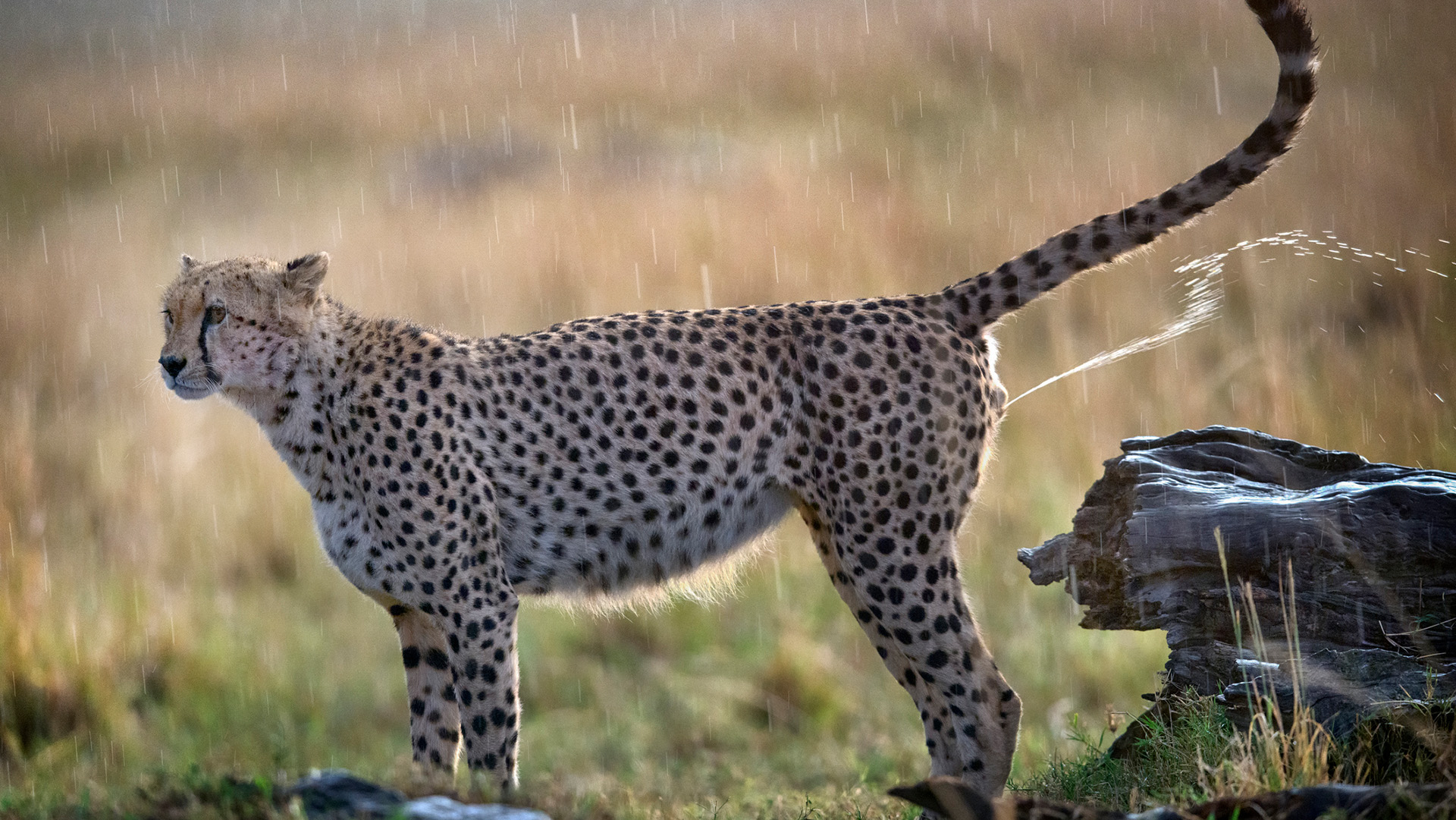
Pee is one of many stages that make up the water cycle.
(Image credit: Vicki Jauron, Babylon and Beyond Photography via Getty Images)
On the water side of the equation, the U.S. Geological Survey estimates that Earth has about 1.4 billion gigatons of water, including that in oceans, ice caps, glaciers, lakes, rivers, groundwater and vapor.
If you divide the weight of the world's water by 0.2 gigatonnes of pee each day, it would take around 7 billion days, or about 19 million years, "to pee out the whole ocean," Donahue said. Given that the asteroid that "smacked the Yucatan" and wiped out the nonavian dinosaurs struck 66 million years ago, "even mammals have probably peed more than an ocean since we took over," he said.
David Kreamer, a professor of hydrology at the University of Nevada, Las Vegas, agreed that when "you go back in history to the dinosaurs and things like that, that's a lot of pee." But he also said calculations that depend on assumptions and generalizations have a large margin of error.
Instead, when it comes to whether every last drop of water on Earth has been peed at one time or another, Kreamer said the answer is no.
For one, water does not move through the water cycle at a constant speed, he noted; water can be trapped as glacial ice for hundreds of thousands of years, and "there is some deep groundwater that's been underground for tens of thousands of years."
What's more, some water hasn't ever been in the water cycle, he said. This water, known as juvenile water, is trapped deep below the planet's surface and "hasn't really emerged from the depths of the Earth ever in Earth's history," Kreamer told Live Science.
Over time, juvenile water can be brought to the surface through volcanic activity in the form of steam or lava. Trapped deep in Earth's crust, "it's released when magma dissolves it, and when a volcano blows up into the atmosphere," Kreamer explained, noting that during eruptions, "there's a certain amount of water or moisture that's released" alongside ash and rock. This water would then enter the water cycle and could eventually find its way into and out of an animal.
Ultimately, at any given time, at sites of volcanic activity around the world, there are streams of new water reaching the surface for the first time. That water "hasn't been peed," Kreamer said — at least, not yet.











 English (US) ·
  French (CA) ·
  French (FR) ·