

 10 hours ago
1
10 hours ago
1
PROTECT YOURSELF with Orgo-Life® QUANTUM TECHNOLOGY
Orgo-Life the new way to the future Advertising by AdpathwaySeventy-one years after the brutal murder of Emmett Till, the way that the US as a country honors his memory is still being contested. Markers commemorating his life have been shot at, stolen and become the site of white supremacist group recruiting events. A new exhibit opening in Chicago asks the country to memorialize his life not only by remembering his death, but by asking America to consider the question: What if Emmett Till Lived?
Open now and running until December, the exhibition If Emmett Till Lived: Freedom on American Ground at the Museum of Contemporary Photography in Chicago is an imagined photo library depicting the life Till never got to live. Through the images on display, co-curators of the show, Sarah Elizabeth Lewis, a Harvard professor and founder of the Vision & Justice initiative, and Reverend Wheeler Parker Jr, Emmett Till’s cousin, best friend and last surviving witness to his kidnapping, ask the nation to consider who gets to be remembered on American soil and how the country chooses to see its history.
“When I see the exhibition on the walls, it brings to mind the question I’ve always asked myself: “What would he have been?” And knowing him, he would have been the center of everything going on,” Parker Jr said. “He wouldn’t let life pass him by without getting involved. So, you think about what it would have been like. Then I look at the other side, at the laws that were passed and the things that were created because of his death. You’re appreciative and you thank God for that, but he’s still not here. So you have a lot of mixed emotions about him and death.”
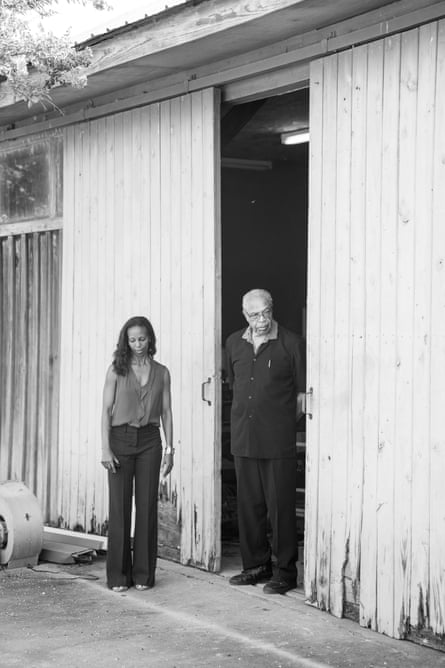
In the months leading up to the exhibit’s opening, the state of Illinois officially designated 25 July, Till’s birthday, as Emmett Till Day. Last month, the barn where Emmett Till was murdered was bought by Patrick Weems’s Emmett Till Interpretive Center, with plans to make the space a site of remembrance. And this week, the church where Emmett Till’s funeral was held unveiled a re-creation of the historic neon sign in honor of Till, signaling the exhibition’s opening.
“Every American needs to do their part to honor Emmett Till,” Lewis says. “I would not have understood the urgency, though, unless I went to Mississippi. When you see the resistance to honoring Emmett Till’s life 70 years later, you start to realize that there’s more to be done. I realized that I not only needed to do my part, but needed to extend the space of the exhibition to constitute a new arena for reimagining society, and that’s what birthed this exhibition.”
In the summer of 1955, Emmett Till, a 14-year-old Black boy from Chicago, was visiting relatives in Mississippi with his cousin, Reverend Parker. While standing outside Bryant’s Grocery & Meat Market, he whistled at a shopkeeper, a white woman. Four days later, the woman’s husband and half-brother kidnapped him and took him to a barn where they tortured, mutilated and killed him. At trial, the woman’s relatives were acquitted but later confessed to the murder in Look magazine.
Lewis argues that it is important to remember Till despite efforts to erase his name from American memory. “My hope is that when you reckon with these roadblocks to equity in American democracy and the resistance to honoring Till, you really begin to grasp why bravery is required, why courage is required and why something more than the work of politics and law is required,” she says. “What’s needed is a transformation of how we see each other.”
Seventy-one years ago, Mamie Till-Mobley, Till’s mother, set out to change how the nation saw her son and, in turn, how Americans saw each other. On 4 September 1955, she held an open casket funeral at Roberts Temple Church of God in Christ on the South Side of Chicago, Illinois, for nearly 100,000 attenders.
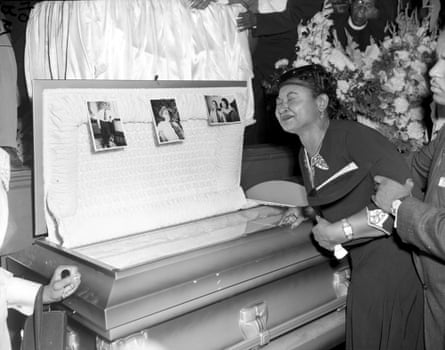
“We have averted our eyes far too long, turning away from the ugly reality facing us as a nation,” Mamie Till-Mobley is quoted as saying in the book If Emmett Till Lived: Freedom on American Ground, which accompanies the exhibition. Till-Mobley hired photographer David Jackson to photograph Till’s brutalized body at his funeral for Jet magazine. “I wanted the world to see what they did to my baby,” she said in September 1955.
“Till-Mobley was prophetic in her understanding that witnessing would be critical for grasping the crucible of American democracy,” Lewis says. With the new show, Lewis and Parker Jr aimed to create “a creative monument” for the nation to see the hopes and possibilities of the life Till did not get to live.
The photographers featured are wide-ranging, from Henri Cartier-Bresson, Carrie Mae Weems, Teju Cole and Gordon Parks to relatives of Till, like his cousin, Lance Omar Thurman. Lewis notes that she wanted to include photographs from an extensive range of image makers.
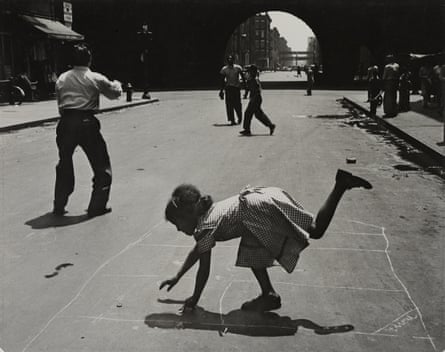
“I approached the show with the democratic ethos,” she says. “I went into the collection, looking for works, regardless of the name of the artist and their stature. I went looking for works that contained a message and an episode in Emmett Till’s life. And it meant that everyone could be part of the story.”
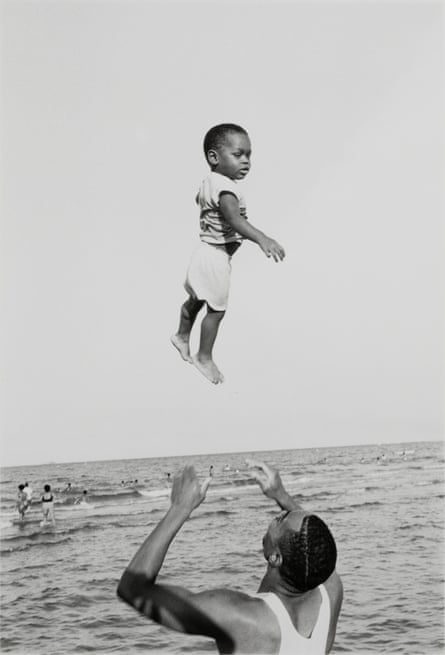
One of the most striking images Lewis chose is the photograph on the book’s cover, taken by Stephen Marc. The photograph is a black-and-white image of a man looking up at a young boy he has thrown into the air, next to a body of water. For Lewis, the image “represents both hope and possibility”.
“I think of Marc’s aunt, Dr Carla Hayden, the former librarian of Congress, as a symbol of the power of the archive,” he says. “These images let us recreate the archive we don’t often see, the possibility for lives cut short. Marc’s photograph, with its paradox of possibility and life cut short, became the metaphor for the exhibition. It became a way to see both Till and the Till in all of us as we live.”
For the exhibition, Lewis and Parker Jr asked many notable people, including Dr Chelsea Clinton, Ava DuVernay, Dr Henry Louis Gates Jr, congresswoman Ayanna Pressley, Hank Willis Thomas and others, to select images and write their own reflections on Till’s life.
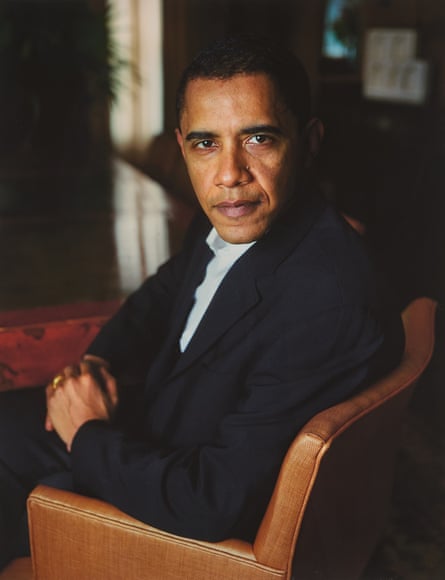
Thomas chose a striking image taken by Dawoud Bey of Barack Obama sitting in a chair, his gaze piercing the camera. In the photograph, the former US president’s facial expression looks present, as if the only thing in the world at that moment is him and the camera. As Thomas notes, the image shows the possibilities that could have come to fruition in Till’s life if he had the opportunity to grow old.
“Emmett Till was denied the chance to grow into a man, to be honored, to age into possibility,” Thomas writes in the book If Emmett Till Lived. “This photograph allows us to sit with one version of what history fought to make possible: a Black man looking directly at a camera and into us, with the full force of his humanity intact.”
The images in the show are memorials to the life taken from Till. As Lewis writes in If Emmett Till Lived, “sometimes a photograph can be a monument. Sometimes, a photograph has to be a monument when all attempts at making a monument, for decades, have been and are still denied.”
The “exhibition is going to help a lot of people”, Parker Jr says. “It helps the cause. As I heard Mamie said, ‘I hope you didn’t die in vain.’”
Though the exhibit focuses on honoring the life of Till, Lewis argues that the show also pays tribute to the lives taken from numerous young Black people. “There are many Emmett Tills today,” he says. “Till is a proxy for understanding a Nolan Wells. A proxy for understanding Breonna Taylor.”
“One of the ways this question of what we do in the face of the visibility of this tragedy is to ask, is witnessing enough? Is witnessing injustice enough to transform the moral imagination? People are seeing the video of George Floyd. Is it enough to let people see? We might have to require people to see, entice them to see and make the invitation to see the truth of American society irresistible.”
-
If Emmett Till Lived: Freedom on American Ground is at the Museum of Contemporary Photography, Chicago, until 19 December















 English (US) ·
  French (CA) ·
  French (FR) ·