

 2 months ago
33
2 months ago
33
PROTECT YOURSELF with Orgo-Life® QUANTUM TECHNOLOGY
Orgo-Life the new way to the future Advertising by AdpathwayIf you’ve ever noticed that some shark cage diving trips feel fast-paced and adrenaline-filled, while others are calm, slow, and deeply immersive, the reason isn’t luck—it’s the ocean itself.
Sharks are not random. Every movement, every approach, and every burst of speed is shaped by environmental conditions—especially water temperature.
At African Shark Eco-Charters, this understanding is at the core of every trip. It’s what transforms a simple shark sighting into a meaningful, educational, and unforgettable marine experience in False Bay.
Why Shark Behaviour Is Not Random
One of the biggest misconceptions about sharks is that they behave unpredictably. In reality, sharks are highly intelligent, responsive animals that constantly adapt to their environment.
Species like the Great White Shark are finely tuned predators. Their behaviour is influenced by:
- Water temperature
- Food availability
- Light conditions
- Ocean currents
- Seasonal shifts
Rather than acting on instinct alone, sharks are making calculated decisions to maximise energy efficiency and hunting success.
In a dynamic ecosystem like False Bay, these changes happen daily—which is exactly why no two trips with African Shark Eco-Charters are ever the same.How Water Temperature Affects Shark Behaviour
Water temperature is one of the most important drivers of shark activity—and one of the most misunderstood.
While many sharks are ectothermic (meaning their body temperature matches the water), Great Whites have a unique advantage called regional endothermy. This allows them to maintain warmer muscles, giving them bursts of speed and power.
Even so, temperature still plays a major role in shaping their behaviour.
1. Energy and Activity Levels
Water temperature directly affects how sharks move and hunt.
In cooler water:
- Sharks tend to be more energetic
- Movements are faster and more decisive
- Predatory behaviour can appear more explosive
In warmer water:
- Sharks conserve energy
- Movements become slower and more controlled
- Behaviour shifts toward curiosity and investigation
For guests diving with African Shark Eco-Charters, this means every trip offers something unique—whether it’s high-energy passes or slow, eye-level encounters that feel incredibly personal.
2. Thermoclines: Hidden Layers of the Ocean
The ocean isn’t one uniform temperature. It’s made up of layers, known as thermoclines.
Sharks move between these layers to:
- Regulate body temperature
- Conserve energy
- Position themselves strategically for hunting
In False Bay, this often creates one of the most unforgettable moments of a dive—a shark emerging suddenly from the deep.
With the extended underwater time offered by the hookah system at African Shark Eco-Charters, guests are far more likely to witness these natural, unscripted movements.
3. Temperature and Hunting Behaviour
Water temperature also affects how sharks hunt.
- Cooler conditions often lead to more dynamic, predatory movement
- Warmer or stable conditions produce slower, investigative approaches
This is why African Shark Eco-Charters doesn’t promise a “show.” Instead, they offer something far more valuable: authentic, condition-driven shark behaviour in a wild ecosystem.
Ocean Conditions That Shape Shark Encounters
Water temperature works alongside other environmental factors to shape each experience.
Visibility (Water Clarity)
Visibility changes how sharks interact with their environment.
- Clear water: Sharks rely on vision → more direct approaches
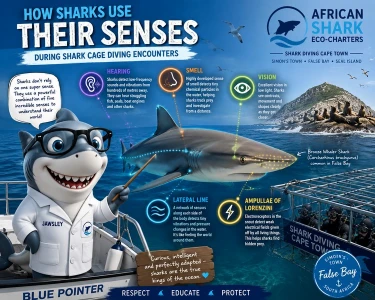
- Low visibility: Sharks rely on other senses → slower, closer passes
Because African Shark Eco-Charters operates with small groups, guests get uninterrupted viewing time—making even subtle behavioural changes easier to appreciate.
Light and Cloud Cover
Sharks are naturally adapted to low-light environments.
- Overcast skies can increase activity
- Dim conditions mimic dawn and dusk—prime hunting times
This means some of the most exciting shark encounters happen on days that might not look “perfect” above the surface. Wind, Swell, and Surface Conditions
While sharks remain active below, surface conditions affect the human experience.
- Calm seas = easier spotting and smoother dives
- Rough seas = more challenging, but still rewarding
The team at African Shark Eco-Charters carefully evaluates conditions daily, ensuring both safety and optimal shark activity.
Seasonal Shark Behaviour in False Bay
False Bay is one of the most dynamic marine environments in the world—and seasonality plays a huge role.
Spring (September – November)
- Rising water temperatures
- Increased marine activity
- More consistent shark sightings
Summer (December – February)
- Warmer, calmer conditions
- Ideal for first-time divers
- Sharks often appear relaxed and curious
Autumn (March – May)
- Excellent visibility
- Balanced conditions
- A favourite for photographers and experienced divers
Winter (June – August)
- Cooler water temperatures
- Potential for more dramatic predatory behaviour
- A raw, powerful ocean experience
No matter the season, African Shark Eco-Charters adapts each trip to the conditions—ensuring guests get the most out of the environment on the day.
Why False Bay Is a World-Class Shark Destination
What sets False Bay apart is its variability.
Unlike other destinations with predictable conditions, False Bay offers:
- A constantly changing ecosystem
- Natural, unscripted shark encounters
- A deeper connection to marine life
With African Shark Eco-Charters, this variability becomes a strength—not a limitation.
Their approach combines:
- Expert ocean reading
- Small, personalised groups
- Longer underwater time with a hookah system
- Strong educational focus
This is not mass tourism—it’s a curated marine experience.
What This Means for Your Shark Cage Diving Experience
When you understand how water temperature affects shark behaviour, your expectations shift.
Instead of hoping for one specific type of encounter, you begin to appreciate:
- The uniqueness of each trip
- The intelligence of sharks
- The influence of the ocean
- The unpredictability of nature
This is where African Shark Eco-Charters stands apart—they guide you through the experience, helping you understand what you’re seeing and why it matters.
Expert Insight: Reading the Ocean
The difference between an average trip and an unforgettable one comes down to expertise.
The team at African Shark Eco-Charters doesn’t rely on luck. They analyse:
- Temperature changes
- Weather patterns
- Wildlife movement
- Ocean conditions
This real-time decision-making ensures that every trip is aligned with the environment—maximising both safety and encounter quality.
A More Meaningful Shark Encounter
Not every shark interaction is fast or dramatic—and that’s exactly the point.
Some of the most powerful moments are:
- A slow glide past the cage
- A shark turning to make eye contact
- The quiet presence of a top predator in its natural habitat
These are the moments that stay with you—and they’re made possible by the longer dive times and immersive approach of African Shark Eco-Charters.
Final Thoughts: The Ocean Is Always Changing
Shark behaviour is a reflection of the ocean—constantly shifting, adapting, and responding.
Water temperature, visibility, light, and seasonal patterns all come together to create a completely unique experience every single day.
And that’s why shark cage diving in False Bay is so extraordinary.
With African Shark Eco-Charters, you’re not just observing sharks—you’re witnessing a living ecosystem in motion.
Experience Shark Behaviour First-Hand
If you want to truly understand how water temperature affects shark behaviour, there’s only one way to do it—experience it yourself.
Join African Shark Eco-Charters in False Bay and discover:
- Longer, more immersive dives
- Small, personalised groups
- Expert-led experiences
- Real, unscripted shark behaviour
This is shark cage diving as it should be—authentic, educational, and unforgettable. Book your shark cage diving trip now.



















 English (US) ·
  French (CA) ·
  French (FR) ·