

 2 hours ago
9
2 hours ago
9
PROTECT YOURSELF with Orgo-Life® QUANTUM TECHNOLOGY
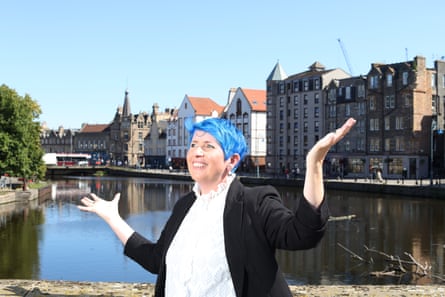
Orgo-Life the new way to the future Advertising by AdpathwayAsking a question can change your mood, and having a questioning mindset can change your life – or, as the philosopher Lani Watson, an honorary fellow at the University of Edinburgh, is more likely to put it, “create change in your life”. When you live in an answer-oriented world, your phrasing tends towards the glib certainty, which is one of the things Watson – speaking to me from her home in Edinburgh – seems quite naturally to avoid.
Questioning fosters exploration and curiosity, she says. It changes your relationship to yourself and to others: it can make you fall in love; it can stop you going to war. Watson’s challenging book, Q: The Hidden Power of Questions in a World that Wants Answers, is written with a deceptive simplicity and an almost kindly encouragement, so you’re knee-deep into her proposition before you have even considered that it might turn out to be quite hard work.
The book is unusually interactive, asking the reader to read a sentence out loud, count the number of questions in a conversation between Watson and her wife, ask basic questions of themselves and stop to think about whether they can be answered. There’s an appendix at the end that promises to get you into a questioning frame of mind, which it turns out you have to write yourself (to be fair, there’s no trickery here; she does say that it’s empty – but in my reflexive quest for answers, I didn’t notice).
Here are some brass tacks, what you might coarsely call proof. From the world of neuroscience and evolutionary biology, we can see that asking questions stimulates dopamine, she explains, and “all that reward circuitry activates regardless of whether you get the answer, because the brain is trying to encourage you to continue exploring your environment”.
Watson divides questioning into four stages. First is proto-questioning, common to all organisms, which is “exploratory information-seeking, tiny little nematodes seeking nutrition”. Then there’s private questioning, which connotes some intentionality, such as asking for information from your environment in a directed and deliberated way – in Watson’s example, you might see it in a penguin leaving its enclosure in Edinburgh zoo just because it’s figured out it can.
Then there’s social questioning, asking a question of another, which creates layers of joint attention and joint intentionality, and which, as far as we know, only humans do. “What’s over that horizon?” would be a classic example of social questioning sparking migration and changing human history. Finally, there is spoken questioning, which builds whole new layers of complexity and abstraction, since now we can jointly approach matters that aren’t right in front of us, that we may only have imagined.
If it sounds intuitive that questioning would be so pleasurable and generative, Watson’s book wonders, how did we end up in such an answer-oriented world? Education is measured in what we know, not what we ask. Our social norms guide us away from direct questioning, in case we look dumb, or intrusive. The overriding drive of our technological experimentation is towards directing all our questions to a machine and none to one another. And so-called “why-chaining” – repeatedly asking “why?” to whatever answer you get – is universally agreed to be the most annoying thing about a three-year-old.
There is a deep-seated desire for “cognitive closure”, Watson says, or, put more simply, knowing. Aporia, the state of bafflement or confusion, is uncomfortable, though some people tolerate it a lot better than others. Watson is an epistemologist by training, “so I’m invested in questions about knowledge. And I do regard myself to be a pretty extreme sceptic with respect to that tradition. I really don’t think we actually do come to know anything, truly, and I’m OK with that. It’s a really interesting conversation to have in a classroom with undergraduates; you have a huge range of levels of comfort with that conclusion, and its implications.”
I’m personally in the cognitive closure camp: I hate an ambiguous ending; I hate agreeing to differ. Someone’s four-year-old on social media the other day had a tantrum when he discovered infinity – he just wanted numbers to end – and I could hard-relate. But you can learn to live with aporia and be richer for it, Watson says. “It’s all about exposure – spending a lot of time confronting big unknowns. A theoretical physicist would be in a similar position.”
She grew up in Southampton, her father a geologist, her mother a researcher in social housing policy, and studied philosophy for her bachelor’s degree at the University of York, before becoming a research fellow at Oxford. “This questioning mindset that I look at is so fundamental to philosophical thinking that when I advocate for it, maybe I’m trying to introduce philosophy through a back door.”

While Watson’s academic discipline came to her so naturally, she’s not blind to its faults. “Philosophy has an identity crisis,” she says, “that’s been formed by 2,500 years of it being done by people who want to make it seem really difficult – abstract, complicated and not for you. When, in fact, it really is something we’re all doing all the time.” It’s sometimes called the “genius only” discipline, but it isn’t only that intimidating intellectual granite face that puts people off, Watson says; it’s also the idea of utility. “We have an aversion to abstraction that is ultimately driven, to some extent, by that problem of: what good is it to me? Why do I need to worry about that?”
Early in Watson’s consideration of what a question was, she stopped using question marks. This made her consider the history of this punctuation mark (it’s more recent than you would think: the court of Charlemagne), and its variations in other languages (there is one that just puts a circle above the salient word, which is cute), but she never went back to using question marks, and it never made any difference. “The only place where I feel an impulse to add a question mark is if I’m indicating that what looks like a statement is, in fact, a rhetorical question, which told me a lot about what the question mark was doing: it’s signalling something, rather than being a part of what a question is.”
But the other thing punctuation is good for, the reason you would have to prise it from my dead hands, is that it speeds up the eye, surely? “Yes, the lack of a question mark helps people to slow down, around this key moment of a question, which is exactly how you develop this questioning mindset.”
You’ll need that patience for the process Watson calls “assumption mining”, questioning yourself more deeply about what you think you already know. She describes this as a habitual intellectual exercise, almost deliberately casting yourself back into aporia. “I always think, when I do it myself, that when I get to space and time as my grounding assumptions, then I’ve reached the bottom. If we go beyond that, we’re back into theoretical physics.” Funny how we keep ending up there.
The spouse-psychologists Arthur and Elaine Aron came up with the 36 questions two people could ask one another that could make them fall in love – anyone, even strangers. Some questions are closed but searching (“Before making a telephone call, do you ever rehearse what you’re going to say? Why?”), while others are open (“What do you most value in a friendship?”). That was back in 1997, and three decades of speed dating have cast some doubt on the inevitability of love as the outcome of the process (which, to be fair, the Arons never claimed), but the idea has endured that questioning itself creates intimacy, symmetrical questioning is more intimate still, and open-ended questions flip you into a more vulnerable, receptive frame.
The philosopher Peter Worley devised the question X manoeuvre, a closed question followed by an open one. “The first is the easier to answer,” Watson explains, “and once you’ve committed yourself to that, you’re happier and more comfortable exploring the area around it.”
It sounds so simple as to be self-evident, but try it for yourself, and try the counterfactual. If someone bowled up with the question: “Do you enjoy what you do?” there’s something simultaneously condescending about it (“Little man, have you found satisfaction in your pursuits?”) and faux naive (“What is this thing called adulthood? Is it enjoyable?”). Try the X technique – “What do you do? Do you enjoy it?” – and not only does the second question follow more naturally from the first, but it gives you the impression that your first answer was interesting enough to have spurred the second.

Question Y is the “divergent” sequence, starting with something easy, closed (“Did you vote in the referendum?”), then following up with something more open, likely to provoke difference but in a precinct you have already established as friendly – “Do you think referendums are a good idea?” Question Z is a line of inquiry that will change direction or the tightness of its focus over its course (think of the shape of a Z). I’m not wild about Watson’s example (“Do you like chocolate?”; “Given that coffee also comes from a bean, doesn’t it follow that you also like coffee?”), but you can see the potential: for unpredictability, as well as a certain inviting quality – part of what puts people off being questioned is the thought that they will be wrong or humiliated. A set of questions that slaloms all over the place is unlikely to have right answers.
Unavoidably, questioning feels as if it drives towards politics of a certain kind. If, as Watson writes, cognitive closure is heightened by stress and drives in-group identification and, with it, suspicion of others, then breaking out of it with a questioning disposition would send you in the other direction, towards (broadly) philosophies of unity and hope. “I really take seriously the project of trying to write for a very broad audience,” Watson says, “so I want to be in a politically neutral space, which is not where I am myself, personally.”
Right, I say. You literally have blue hair. Kemi Badenoch would probably write a speech about you. Unavoidably, she says, “a questioning mindset will bring us a lot closer together, wherever we are, because essentially you’re just opening up space to explore the possibility that you’re wrong about something. That you might not know what you thought you knew.”
It’s a mistake, though, to think curiosity and certainty are utterly at odds, let alone that the first has a monopoly on harmony and the second drives division. “You build curiosity by coming to be an expert and pushing yourself to the edge of your knowledge. So certainty and curiosity can’t be diametrically opposed in that way, because you build curiosity on a foundation of certainties. But there is also a dynamic where you can close down curiosity by being certain.” Nor is she saying that there’s no value in knowledge: “Answers are good; we do need answers. That’s just not my job.”
One of the first examples Watson writes about, almost the definitive question whose purpose doesn’t lie in an answer, is from a therapist: “What is the one thing now that you want to be able to do in the future?” It has elements of a few of those 36 questions to make you fall in love – inviting what might be a painful reckoning with reality, softened by the branching possibilities of the future, and the knowledge of your own agency (the more parlour-game version of this is, “What would you do if you had 12 months to live? Why aren’t you doing it now?”).
“You find a new understanding as an exclusive result of that question,” Watson says, “but not because you’re secretly answering it in your head. That’s a big part of the reason why therapy is such an effective form of healing, because you could ask yourself a bunch of questions and try to solve your own issues, but only someone else can ask a question that you weren’t expecting, push you into a different space and make you feel cared for.”
If interpersonal instances land the most convincingly or recognisably, the credit Watson pays to the question reaches back into decisions we could only guess at, and out into realms we can’t know. “I started to think about what encouraged human migration out of Africa,” she says. “Could it have been that questioning: ‘What’s around the corner? What’s over the horizon?’ The combination of curiosity and exploration, but also the capacity to form those into questions, is integral to moving out and moving forward.” It sounds likely, but we cannot know it for certain. “If you’re just interested in the answers, you are missing out on a form of power,” she says, which is as certain as you’ll find Watson about anything.
Q: The Hidden Power of Questions in a World That Wants Answers by Lani Watson is published on 27 August (Bodley Head, £22). To support the Guardian, order your copy at guardianbookshop.com. Delivery charges may apply.





















 English (US) ·
  French (CA) ·
  French (FR) ·