

.png) 2 months ago
58
2 months ago
58
PROTECT YOURSELF with Orgo-Life® QUANTUM TECHNOLOGY
Orgo-Life the new way to the future Advertising by Adpathway
NEW DELHI: Average rainfall in India during the second half of monsoon season (Aug-Sept) is most likely to be ‘below normal’, IMD said Friday, flagging the continuing risk of El Niño, which is associated with a weak monsoon.Last month, IMD had cited El Niño’s impact to forecast below normal rains in July. The month’s rainfall turned out to be normal due to plentiful showers in central India. The met department attributed this to “intra-seasonal variability”, saying a record 24 days were under the influence of ‘low pressure systems’ (LPS) in July against normal of about 13.5 days.“Four LPS were formed over Bay of Bengal that led to good rainfall from Odisha to Gujarat.
We need to further analyse the reason (for better-than-expected July rains). These LPS couldn’t be captured by our long-range forecast model,” said Mrutyunjay Mohapatra, IMD chief.
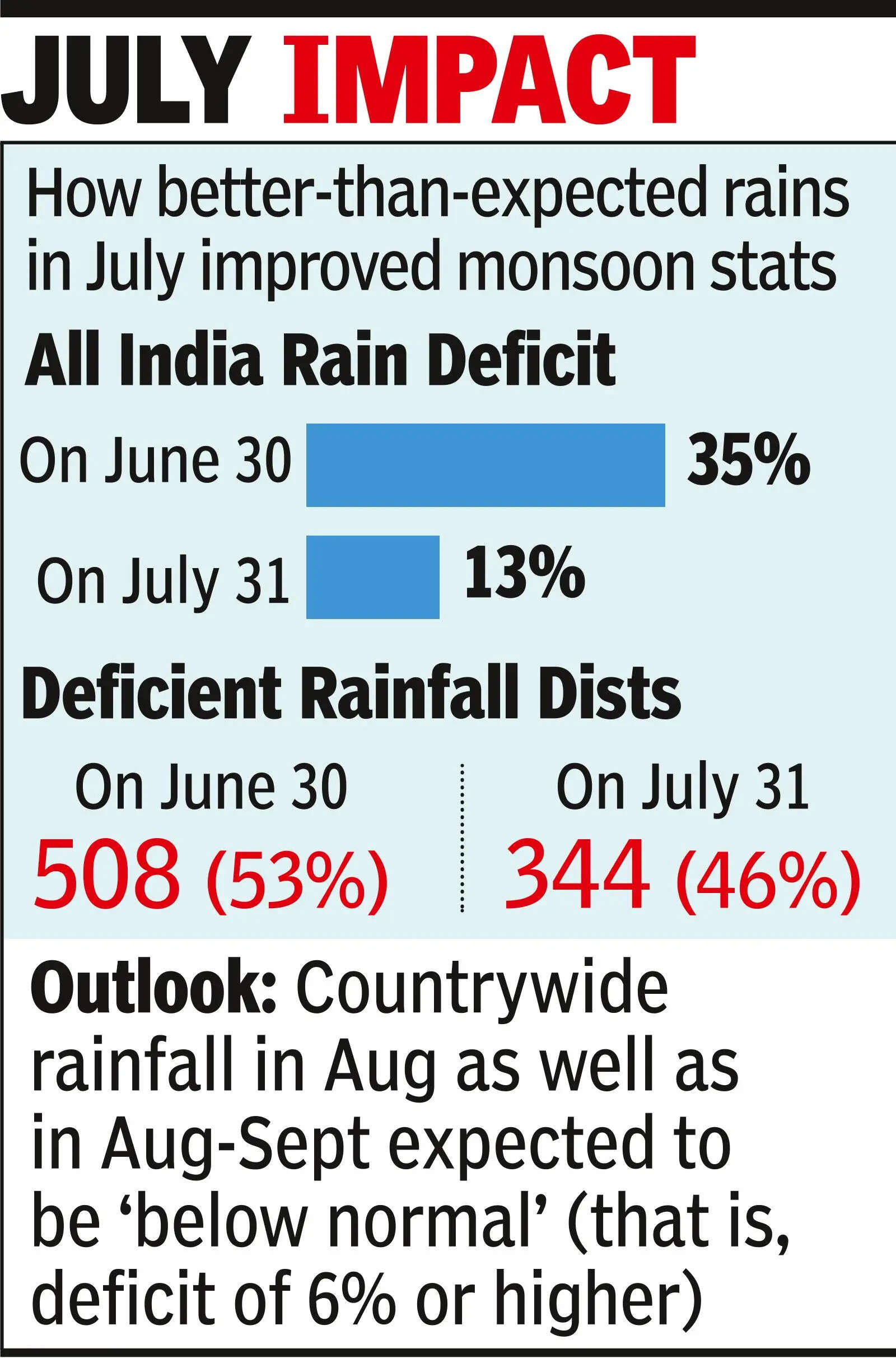
July rain gives hope to farm sectorTwo long wet spells, one during the first week of July and the second from July 22 onwards, helped reduce the overall monsoon rainfall deficit in the country from 35% in June to nearly 13% at the end of July. Since the ‘monsoon core zone’, where farming operations remain mainly rain-fed, largely coincides with central India, good rains in the region could aid recovery of acreage in the month.
Though overall acreage of the summer sown crops continues to be in deficit compared to the corresponding period last year, the deficit reduced from nearly 21% on July 3 to around 3% on July 31, giving hope to the farm sector in an El Nino year.During Aug-Sept, IMD said certain parts of peninsular India, central India, northern parts of northwest India, and east and northeast India may get “normal to above-normal” rains, but it may not change the forecast of overall ‘below normal’ quantitative rainfall in the country.
























 English (US) ·
  French (CA) ·
  French (FR) ·